Showing posts with label sketchnote. Show all posts

Sketchnoting as a #GrowthMindset Journey

A couple of colleagues and I are facilitating a full-day sketchnoting workshop, and as an introduction, we plan to share our sketchnoting journey, so I wanted to take time to reflect and pick out key steps on my path. By the way, I have no art background, and I feel like I'm quite under-qualified to "lead" this session, but I'm working with fantastic colleagues, and we've had a great time planning the workshop.

I discovered sketchnotes in the winter of 2014, and I've been trying them off and on since then. I would like to be more consistent with my practice, so this post will also serve as my attempt to become more accountable. ๐Ÿ˜‰

After I learned about Carol Dweck's work, I always shared the concept of mindset with my students. (Check out all of my posts about mindset.) That particular year, however, my students really struggled with the ideas of failure and risk-taking. I thought if I took up the practice of sketchnoting and shared my work with my students, I could show them my attempts and we could document my improvement over time. I still say, "I'm not an artist," and I continue to have a pretty fixed mindset about it, but I'm determined to practice what I preach!

I found a few sketchnoting resources and started practicing. I believe that's when Sylvia Duckworth started freely sharing her sketches too, so she has inspired me for many years!

At the same time, one of my teammates was finishing her dissertation (basically about notetaking and retention techniques) and she asked if we could try some visual thinking maps with our students. YES, please! One of our units was extra-heavy with vocabulary, so that's where we started. We asked the students to create graphic organizers/sketchnotes to show the relationships between the terms and concepts in the unit. Here's the only sample I saved (and it wasn't even my student) but I loved this student's design and use of colors.

At the end of that school year, I transitioned to my current job, and my interest in sketchnoting grew. Sketchnoting was the subject of my "Genius Hour" project in 2015, and I shared one of my very first sketchnotes with session participants that fall.
Since 2014, I watched countless videos and webinars about sketchnote techniques and tools. I read books, blogposts, and followed Twitter hashtags. I attended sketchnoting sessions at TCEA, ISTE, and at edcamps.

My sketchnote turning point was participating in the 2017 #sketch50 Twitter challenge. I completed all 50 prompts (on time!), learned new techniques, and grew my PLN. The daily prompts were perfect brain breaks, and every day, I looked forward to creating during lunch or as a relaxation activity after work. Here's my entire album of sketches, and it's so fun for me to see the growth and improvement in my sketches.

Another key from 2017 was participating in #ClassyGraphics. That course taught me about colors, fonts, and design, which really helped with my sketchnotes, too.

For the 2018 #sketch50 challenge, the focus was creating quick sketches and #ProcessOverPretty. I'm working to complete more quick sketches, but I still like to take a bit more time with my sketchnotes.

In 2018, I took #ClassyVideos and the subject of one of my earliest videos was a quick overview of my sketchnote journey.


Over the years, I have sketchnoted blog posts, TED talks, podcasts, personal learning, and books. I also try to sketch workshops, but I'm much better at creating sketches as reflections and to synthesize my work, rather than real-time sketching. I've included a few of my sketchnotes in past blog posts, and another goal is to start sketchnoting our podcast episodes. (We'll see.)

For 2019, I have 19 goals ("19 for '19") and one goal is to master 50 sketchnote icons. The experts say you should have 100 icons in your visual vocabulary, and I'm about a quarter of the way there. ๐Ÿ˜ณ

A sketchnoting highlight of 2019 was to host Sylvia Duckworth at Region 10 for a full-day workshop, so I learned from the best!

I continue to have a #growthmindset about my sketchnoting, and I'm always learning!

If you want to see the images that are too tiny to see in my Sketchnote Journey graphic, here's the entire album.
Share:

Inspired at ISTE, 2019 version!

sketchnote of 5 points from my ISTE conference
It is a privilege to be able to attend conferences, and I feel with that opportunity comes the responsibility to reflect and to share what I learned.

With 20,000+ attendees, the ISTE conference definitely qualifies as a mega-event, and now that I have attended four of these conferences, I have a (slightly better) grasp of how I "do" ISTE.

I've been able to share some key takeaways with my colleague Ashley, and I'm still sorting through my notes and other Tweets I curated, but here's a quick summary to explain my sketchnote and to help me document what happens next.
Takeaway #1:
Since reading Make It Stick in 2015, I've been so interested in the learning sciences, and now my interest has turned into a mild obsession. ๐Ÿ˜ƒ (Read more of the story here!) I was surprised that there weren't more sessions about this topic, but I found one presentation and added the presenter's book, Design Ed: Connecting Learning Science Research to Practice to my TBR list. I also learned about ISTE's new initiative called Course of Mind. It includes a podcast, blog, research, and coming-soon a course.

The other presentation related to learning was Dr. Scott McLeod's session and exploration of his 4 Shifts Protocol. (Here's a recent blog post about understanding one of the 4 domains: deeper learning.) He walked us through a couple scenarios, and we worked through a (re)design pivot to "up" the learning experience. I've looked at his 4 Shifts protocol several times, but his explanation and our practice during the session really opened my eyes. I can't wait to explore and implement his work! (And it added his book Harnessing Technology for Deeper Learning to my book pile, too.)

Takeaway #2:
The other big idea on my mind is equity. ISTE definitely made progress this year with more diversity in their keynote speakers and the number of sessions with "Equity" or "Cultural Responsiveness" in their titles, but there is still a long way to go for all of us. (There was some Twitter backlash about some glaringly un-diverse panels.) I think it was also at the forefront of my mind because the week prior to the conference, I worked in districts with vastly disparate device "situations." (In one district, the high school has been 1:1 MacBooks for 5 years. The next day, I was in a district where teachers were hoping for Chromebook carts in the rooms...but they had heard that for the past two years.) I also caught some Twitter discussions about the expense of the conference...how many districts or schools have the funds to send teachers to these kinds of learning events? Travel to Philadelphia and conference fees definitely added up. $$$

I attended the session Constructing the Culturally Responsive Citizen: Moving Beyond #DigCit, and I loved that one of the session norms was to "Be Brave" -- to step outside your comfort zone and to be willing to have harder conversations. We went through scenarios to analyze what bias was present and how to respond. We also had thoughtful discussions about how we equip our students with the language and skills to navigate these sensitive situations. Powerful conversations.

Takeaways #3-4:
Take time for creativity! I've been interested in sketchnoting for at least 4 years now, so it's time I do more with it! Several of the featured speakers emphasized the importance of risk-taking and sharing your failures, so I'm on it! I've sketchnoted conference takeaways from TCEA and now 2 ISTE's and I plan to do more sketchnotes as reflections.

I also enjoyed (more than I expected) our weekly podcast format, and I did almost all of the editing and "producing" of the episodes this year...but I know that can be better. I'm working on that, too! I attended one session about podcasting for students, and it gave me great ideas for our podcast, too. I'm ready to get more creative with our podcast. Stay tuned!

Connections
Like other conferences, the hallway conversations are often the best. Conferences like these often turn into reunions, and I also enjoy opportunities to expand my PLN. I also love supporting other #R10tech friends and strive to stop by their presentations.


Takeaway #5:
More about this news and process later, but I've spent about 6-months working on the ISTE Certified Educator process, and it was fun to be able to celebrate that accomplishment at this conference.


Bonus:
I'm a huge fan of the podcast Note to Self, and it was awesome to be able to hear Manoush share her Bored and Brilliant ideas (and other work).

Reflections for another day: I'm glad to see more conversations on topics such as teacher wellness, mental health issues, device distraction, and the importance of unplugging.

Attending a conference is a perfect example to apply John Dewey's quote:
We do not learn from experience... we learn from reflecting on experience.
Always learning!
Share:

Takeaways from TCEA 2019

After three solid days of "conferencing" in San Antonio, I am happy to be able to spend a bit of time reflecting, processing, and synthesizing a few things learned.

Curate

I think it's important to have a plan or system for how to collect and share conference resources with teammates, colleagues and others. Of course, the use of collaborative Google Docs or Slides is a go-to for many of us. I've recently started implementing outline mode in my digital note-taking, and I hope the headings and subheadings will make the massive document a bit easier to manage.

Of course, I had Tweetdeck going for TCEA, but our group also created a Twitter hashtag, #R10atTCEA. It wasn't used as much as I would have liked, but I loved that others in Region 10 contributed to this hashtag, too.

A new favorite curation tool is Wakelet, and just last month, they announced the feature of collaborative Wakelets, so I thought it would be fun to try out that tool with colleagues at the service center. (Here's a post from Matt Miller that shares more ideas to use collaborative collections.) We had 9 colleagues attend the conference, and several of us posted in our #R10atTCEA wakelet (and I hope others will continue adding to it next week.)

John Bimmerle, a TCEA area director, took curation and Wakelet to the next level, and I loved this idea! He facilitated Solution Circles throughout TCEA, and he created a collaborative Wakelet for every single session AND made them public so we can see all of the session ideas and notes!
I'm always a bit bummed when presenters don't share their slides/resources, but that only happened a couple of times during this conference. Something new that I would like to adapt is a "condensed" version of the slides. I attended a 3-hour workshop from Mandy Froehlich, and instead of sharing her entire slide deck, she gave us a condensed version of organized resources. She used the same template as her original slide deck, but included only slides of the key definitions and resources. Her presentation slides were colorful and more detailed, and this small deck was mostly grey. I thought this was a great idea because it allowed us to focus on her content, but when necessary, we could click links for activities or additional resources.

Connect

The conversations in the hallways are often the most valuable! For an introvert, it is always a push for me to strike up conversations with strangers, but that was a goal that I met this year. (I even had a conversation with two other educators while waiting in line to board the plane home.) Now that I've worked at the service center for 3.5 years, the conference felt like a mini-reunion, and I ran into former colleagues and people from districts all over Region 10.
One glaring takeaway: when facilitating an extended workshop and expect interactions (i.e. "turn-and-talk" activities) take time at the beginning of the presentation for introductions. I think I always remember to do that, but when it's absent during a session, I feel it's sorely needed.

I have now volunteered at several conferences, and I think this will be a must-do for me for all future events. Not only is it a way to connect with other educators, but I feel it's a very small way to give back to all of those who worked to put on this massive event! I had a great time greeting people at check-in, and helping in the Google teaching theater is always a learning experience.


During my sessions, I was also on the lookout for content that might be interesting for others in our group. By using Twitter, it was easy to tag colleagues when I found resources that might connect with their subject area (even if it wasn't applicable to me.)
And as a bonus to show how connections help me, I heard about Tony Vincent's "Random Reflection Generator" during a session and posted that on Twitter. Someone in my PLN shared the blog post from Tony about how to create the prompts, and he then shared the script he used to make his own! (Don save me so much time on my weekend coding project!)

And speaking of reflections...my third huge takeaway from TCEA...

Reflect

After several days of learning-overload, it's so important for me to process and reflect. One new thing I tried this year was to create a separate document for singular ideas and reflections. I kept one document of session content notes (resources, links, summaries, etc.) but when I experienced something that I wanted to use for my own work, I added that idea to a different document of "Random Ideas." When I saw an interesting way to format slides, start a session, survey question, or prompt, I added that to my other document. I hope this will be helpful with future work.

I'm also fortunate to work with a colleague who likes to "convention" like I do. After a full-day at the conference, I'm ready to get a super early dinner and then go back to the quiet of my room...and she wants exactly the same! Our dinners were very work related though, and we spent the majority of the time sharing ideas and information we experienced and discovered throughout the day.

I was also determined this year to find the good in every session or experience. In the past, I sometimes left sessions feeling like I just lost an hour of precious time, so this year, I was on the lookout for even the smallest takeaways. Armed with that mindset, I got something from every session. When I was completely unimpressed, I didn't feel guilty about sneaking out of the back...and my takeaway was to be extremely thoughtful to make certain my session description matches the content of my session.

My final thought and goal was to reflect and blog ASAP, and voila! (I've been home less than 24-hours, and I have this new post!) As a bonus, I attended a session with Lisa Johnson on Notable Note-Taking, and I've been a fan of her digital/analog notes, so I'm trying something I've admired in her work...my sketchnote of take-aways, along with a Thinglink.

 
Conference learning is powerful in so many ways! These days, I don't think I should expect (or want) to walk away from conferences with tools; instead, my head is full of ideas to try.

Always learning...
Share:

Takeaways from Episode Three

As I mentioned at the end of this post, my work team and I host a podcast called Digital Learning Radio. In our podcast, we discuss ideas for implementing technology, interview guests, and share some of our favorite things.

This year, we are working our way through the ISTE Educator Standards, and we're talking to leaders in the field as we take a deep-dive into each one of the standards. For Standard 4, Collaborator, we had the privilege of interviewing Gary Hirsch, who is a Portland artist, botjoy creator, and co-founder of On Your Feet. I shared how I discovered his work in this post about Joy Bots, but participating in this conversation with him was one of the highlights of my year!

As we were getting ready to publish this episode, my colleague Ashley asked if I would create a sketchnote to illustrate a portion of the interview. Gary talked a lot about letting going and the power of risk-taking, so even though I'm still working on my sketchnotes, I thought I could take a risk and share this one (in honor of the interview!)

Used for the thumbnail in the podcast excerpt
Listen to Gary discuss risk-taking:


I originally created this sketchnote for Gary's TEDx talkwhich is all about the power of collaboration...and it's what prompted us to reach out to him to discuss ISTE Educator Standard 4.

After posting these sketches, I decided to really take a risk, so I sketched one of my favorite quotes from this episode. I also created a sketchnote of 5 of my favorite takeaways from our conversation.


Listen to the entire episode here, and enjoy.


Google Hangout with the DL Team and Gary Hirsh

I'm always learning...and thanks to this inspiring interview, I'm learning to take more risks!

Share:

Inspired by ISTE

This week marks my 2-year anniversary at my "new" job, and I continue to learn, grow, and connect, thanks in part to opportunities provided by my work. Attending last week's ISTE conference was one awesome job perk, and what an incredible learning experience! I attended ISTE last year too, but this year, I tried to be better prepared.

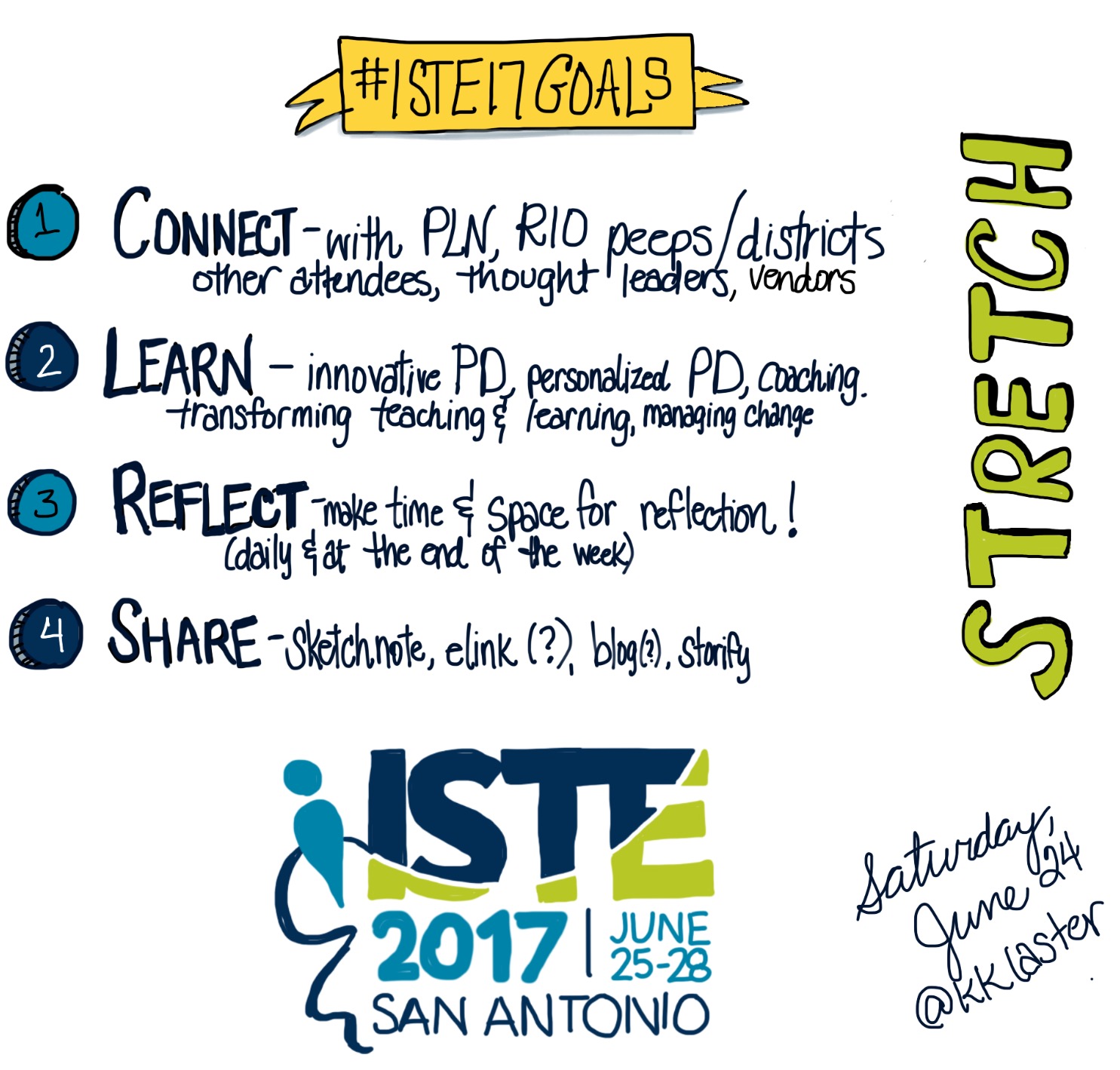
Inspired by advice on Twitter and blogs, I created a few ISTE goals and even sketchnoted my priorities:

I feel I really succeeded at goal #1, and I've decided connections and collaboration will be a priority as I begin year 3 on my job. I know (especially) at tech-focused events, participants are often engrossed in their devices, so at this conference, I was determined to be intentional about striking up conversations, really listening to people, and looking for ways to connect with others. (Such a stretch for me, but it was only for 3 days!) Since ISTE was held in San Antonio, which was a tiny flight or a manageable drive from DFW, I kept running into people from our region, which was so fun! And when I started asking what people were learning and really listening to what they were looking for, I started making connections and started thinking about building bridges, like these...


The past several months, I worked to connect departments and to breach a few silos in the office. It's now time for me to move beyond the workplace and be on the lookout for building those bridges across the region. "You're rural district X and you're just getting into Google? Let me connect you with some leaders in a similar district Y, and they just finished their first year of implementation..." "You're starting a district-wide digital citizenship plan? Let me introduce you to Z who is doing the same thing!" With two years of meeting people and working with more districts and teams, making connections should be a priority!

Bottom line, it always goes back to building relationships, doesn't it?!

Always learning.
Share: