Showing posts with label conference. Show all posts

Inspired at ISTE, 2019 version!

sketchnote of 5 points from my ISTE conference
It is a privilege to be able to attend conferences, and I feel with that opportunity comes the responsibility to reflect and to share what I learned.

With 20,000+ attendees, the ISTE conference definitely qualifies as a mega-event, and now that I have attended four of these conferences, I have a (slightly better) grasp of how I "do" ISTE.

I've been able to share some key takeaways with my colleague Ashley, and I'm still sorting through my notes and other Tweets I curated, but here's a quick summary to explain my sketchnote and to help me document what happens next.
Takeaway #1:
Since reading Make It Stick in 2015, I've been so interested in the learning sciences, and now my interest has turned into a mild obsession. 😃 (Read more of the story here!) I was surprised that there weren't more sessions about this topic, but I found one presentation and added the presenter's book, Design Ed: Connecting Learning Science Research to Practice to my TBR list. I also learned about ISTE's new initiative called Course of Mind. It includes a podcast, blog, research, and coming-soon a course.

The other presentation related to learning was Dr. Scott McLeod's session and exploration of his 4 Shifts Protocol. (Here's a recent blog post about understanding one of the 4 domains: deeper learning.) He walked us through a couple scenarios, and we worked through a (re)design pivot to "up" the learning experience. I've looked at his 4 Shifts protocol several times, but his explanation and our practice during the session really opened my eyes. I can't wait to explore and implement his work! (And it added his book Harnessing Technology for Deeper Learning to my book pile, too.)

Takeaway #2:
The other big idea on my mind is equity. ISTE definitely made progress this year with more diversity in their keynote speakers and the number of sessions with "Equity" or "Cultural Responsiveness" in their titles, but there is still a long way to go for all of us. (There was some Twitter backlash about some glaringly un-diverse panels.) I think it was also at the forefront of my mind because the week prior to the conference, I worked in districts with vastly disparate device "situations." (In one district, the high school has been 1:1 MacBooks for 5 years. The next day, I was in a district where teachers were hoping for Chromebook carts in the rooms...but they had heard that for the past two years.) I also caught some Twitter discussions about the expense of the conference...how many districts or schools have the funds to send teachers to these kinds of learning events? Travel to Philadelphia and conference fees definitely added up. $$$

I attended the session Constructing the Culturally Responsive Citizen: Moving Beyond #DigCit, and I loved that one of the session norms was to "Be Brave" -- to step outside your comfort zone and to be willing to have harder conversations. We went through scenarios to analyze what bias was present and how to respond. We also had thoughtful discussions about how we equip our students with the language and skills to navigate these sensitive situations. Powerful conversations.

Takeaways #3-4:
Take time for creativity! I've been interested in sketchnoting for at least 4 years now, so it's time I do more with it! Several of the featured speakers emphasized the importance of risk-taking and sharing your failures, so I'm on it! I've sketchnoted conference takeaways from TCEA and now 2 ISTE's and I plan to do more sketchnotes as reflections.

I also enjoyed (more than I expected) our weekly podcast format, and I did almost all of the editing and "producing" of the episodes this year...but I know that can be better. I'm working on that, too! I attended one session about podcasting for students, and it gave me great ideas for our podcast, too. I'm ready to get more creative with our podcast. Stay tuned!

Connections
Like other conferences, the hallway conversations are often the best. Conferences like these often turn into reunions, and I also enjoy opportunities to expand my PLN. I also love supporting other #R10tech friends and strive to stop by their presentations.


Takeaway #5:
More about this news and process later, but I've spent about 6-months working on the ISTE Certified Educator process, and it was fun to be able to celebrate that accomplishment at this conference.


Bonus:
I'm a huge fan of the podcast Note to Self, and it was awesome to be able to hear Manoush share her Bored and Brilliant ideas (and other work).

Reflections for another day: I'm glad to see more conversations on topics such as teacher wellness, mental health issues, device distraction, and the importance of unplugging.

Attending a conference is a perfect example to apply John Dewey's quote:
We do not learn from experience... we learn from reflecting on experience.
Always learning!
Share:

Takeaways from TCEA 2019

After three solid days of "conferencing" in San Antonio, I am happy to be able to spend a bit of time reflecting, processing, and synthesizing a few things learned.

Curate

I think it's important to have a plan or system for how to collect and share conference resources with teammates, colleagues and others. Of course, the use of collaborative Google Docs or Slides is a go-to for many of us. I've recently started implementing outline mode in my digital note-taking, and I hope the headings and subheadings will make the massive document a bit easier to manage.

Of course, I had Tweetdeck going for TCEA, but our group also created a Twitter hashtag, #R10atTCEA. It wasn't used as much as I would have liked, but I loved that others in Region 10 contributed to this hashtag, too.

A new favorite curation tool is Wakelet, and just last month, they announced the feature of collaborative Wakelets, so I thought it would be fun to try out that tool with colleagues at the service center. (Here's a post from Matt Miller that shares more ideas to use collaborative collections.) We had 9 colleagues attend the conference, and several of us posted in our #R10atTCEA wakelet (and I hope others will continue adding to it next week.)

John Bimmerle, a TCEA area director, took curation and Wakelet to the next level, and I loved this idea! He facilitated Solution Circles throughout TCEA, and he created a collaborative Wakelet for every single session AND made them public so we can see all of the session ideas and notes!
I'm always a bit bummed when presenters don't share their slides/resources, but that only happened a couple of times during this conference. Something new that I would like to adapt is a "condensed" version of the slides. I attended a 3-hour workshop from Mandy Froehlich, and instead of sharing her entire slide deck, she gave us a condensed version of organized resources. She used the same template as her original slide deck, but included only slides of the key definitions and resources. Her presentation slides were colorful and more detailed, and this small deck was mostly grey. I thought this was a great idea because it allowed us to focus on her content, but when necessary, we could click links for activities or additional resources.

Connect

The conversations in the hallways are often the most valuable! For an introvert, it is always a push for me to strike up conversations with strangers, but that was a goal that I met this year. (I even had a conversation with two other educators while waiting in line to board the plane home.) Now that I've worked at the service center for 3.5 years, the conference felt like a mini-reunion, and I ran into former colleagues and people from districts all over Region 10.
One glaring takeaway: when facilitating an extended workshop and expect interactions (i.e. "turn-and-talk" activities) take time at the beginning of the presentation for introductions. I think I always remember to do that, but when it's absent during a session, I feel it's sorely needed.

I have now volunteered at several conferences, and I think this will be a must-do for me for all future events. Not only is it a way to connect with other educators, but I feel it's a very small way to give back to all of those who worked to put on this massive event! I had a great time greeting people at check-in, and helping in the Google teaching theater is always a learning experience.


During my sessions, I was also on the lookout for content that might be interesting for others in our group. By using Twitter, it was easy to tag colleagues when I found resources that might connect with their subject area (even if it wasn't applicable to me.)
And as a bonus to show how connections help me, I heard about Tony Vincent's "Random Reflection Generator" during a session and posted that on Twitter. Someone in my PLN shared the blog post from Tony about how to create the prompts, and he then shared the script he used to make his own! (Don save me so much time on my weekend coding project!)

And speaking of reflections...my third huge takeaway from TCEA...

Reflect

After several days of learning-overload, it's so important for me to process and reflect. One new thing I tried this year was to create a separate document for singular ideas and reflections. I kept one document of session content notes (resources, links, summaries, etc.) but when I experienced something that I wanted to use for my own work, I added that idea to a different document of "Random Ideas." When I saw an interesting way to format slides, start a session, survey question, or prompt, I added that to my other document. I hope this will be helpful with future work.

I'm also fortunate to work with a colleague who likes to "convention" like I do. After a full-day at the conference, I'm ready to get a super early dinner and then go back to the quiet of my room...and she wants exactly the same! Our dinners were very work related though, and we spent the majority of the time sharing ideas and information we experienced and discovered throughout the day.

I was also determined this year to find the good in every session or experience. In the past, I sometimes left sessions feeling like I just lost an hour of precious time, so this year, I was on the lookout for even the smallest takeaways. Armed with that mindset, I got something from every session. When I was completely unimpressed, I didn't feel guilty about sneaking out of the back...and my takeaway was to be extremely thoughtful to make certain my session description matches the content of my session.

My final thought and goal was to reflect and blog ASAP, and voila! (I've been home less than 24-hours, and I have this new post!) As a bonus, I attended a session with Lisa Johnson on Notable Note-Taking, and I've been a fan of her digital/analog notes, so I'm trying something I've admired in her work...my sketchnote of take-aways, along with a Thinglink.

 
Conference learning is powerful in so many ways! These days, I don't think I should expect (or want) to walk away from conferences with tools; instead, my head is full of ideas to try.

Always learning...
Share:

YouTube for Learning?

Anyone who is around me for more than 5 minutes hears about my favorite educational book The New Pillars of Modern Teaching. The ideas in Gayle Allen's book truly transformed how I think about teaching and learning. (See this post for an overview.) So this reflection started as ponderings about YouTube, but as with most everything in my educational world, it's going to circle back to the New Pillars.

Last year, I read great advice for conference-going, which was to attend a session that was outside your comfort zone or area of interest. Find something that might push your thinking. For that reason, on the last day and the final session of ISTE 18, I found the session Teacher Reflection and Professional Growth Through Vlogging. The session description sounded interesting (except for the video part) but I didn't recognize the presenters' names. I ran into a former colleague in this session, and based on his enthusiasm (and the response in the room!) I learned that the presenters were "celebrities" in the TeacherTuber world! I had no idea that just like blogs, Twitter, and Instagram, there is an entire community of educators that share and support each other on YouTube. Check out CJ Reynolds' and Darin Nakakihara's channels to see their vlogs. Their presentation was dynamic and inspiring, and they spoke with enthusiasm about their community of learners and how they used video to learn, grow, reflect, and share.


As wonderful as their presentation was, I have not spent any additional time exploring YouTube and TeacherTubers. I am not interested (right now) in joining that community of learners. BUT because of my understanding of the New Pillars, I realize that's OK...that type of medium is not my learning preference. I also realize that vlogging might be a favorite platform for some of my session participants, so how can I provide more video as an option? Just like students in our classrooms, our preferences are not going to be the same as our students, so how can we accommodate for those differences? How can we design learning experiences that meet the needs of more of our learners?


In The New Pillars of Modern Teaching, Dr. Allen provides a brief self-assessment for us to determine our own learning preferences. She asks us to reflect on a favorite learning experience and break down the experience in terms of the four elements of powerful learning design: time, place, medium, and socialness.

  • Time: How much time did the experience take? Was it a short burst of time or a semester?
  • Place: Where did the learning occur? Face-to-face? In a university? Online? Synchronous?
  • Medium: What platforms were used? Audio, video, online, face-to-face?
  • Socialness: How much interaction occurred? Was it face-to-face or virtual?
I've reflected on my favorite learning experiences multiple times, and for our online book study, we ask participants to create a graphic to explain their preferences, so here's one of mine.


Now that I deeply understand my learning preferences, I know to look for learning opportunities that meet my needs as a learner. And because I realize my preferences differ from most others, I strive to include multiple elements in my sessions. I'm always looking for more ways to provide more choice, though! And for classroom teachers, what does this look like for classrooms where the curriculum is so tight and we have so many other spinning plates?

A couple of years ago, we interviewed Dr. Allen for our podcast, and here's a short clip of a suggestion from her.

In the book, Dr. Allen recognizes that teachers lack time to be able to do it all, and she frequently reminds us to start small. With learning design, she suggests to choose one of the four elements (like medium) and make a few tweaks. Her example above was part of a discussion about curation, but the idea applies to both of the pillars.

Understanding these elements of powerful learning design also align with the ISTE Educator standard of Designer. At first glance, The New Pillars doesn't look like a technology book, but if we are going to succeed in implementing the three pillars, technology must be part of the picture. This standard and indicator ask us to use technology to design experiences that take all of those learner preferences into consideration.


If interested, here's our entire episode with Dr. Allen.


So if a vlog and a YouTube community is not your cup of tea, I'm certain it is for someone you know. (Have any of your students declared they wanted to become a YouTuber? That's a thing!) Maybe you're extremely social and believe collaborative groups are the way to go, but is that true for all of your students or session participants? (oops!)

Have you reflected on your learning preferences? Do you use those preferences to design your own learning experiences? Would the learning preference self-assessment help your students or those you coach?

Reflecting on learning preferences and learning design...and always learning.
Share:

X-tra Special Summer X-periences

Many (many) months ago, I thought it might be a fun challenge to create blog post titles using the first letters of the alphabet, not knowing it would take so long to complete 26 posts. Now that I'm so close to finishing the pattern, 🤓I'm taking creative liberties with my spelling. But I did want to share what I learned from a few special summer experiences.

Don't forget about conference Poster Sessions and Playgrounds!

At this summer's ISTE conference, my colleague and I "presented" during the ISTE Administrator Playground, and it was so fun! I loved the opportunities to visit with people, share our work, and have face-to-face conversations. It wasn't nearly the pressure/prep of a full-scale presentation, and it was a fantastic way to network. We used our online book study example (I've mentioned The New Pillars in several posts) as a way to design professional learning to empower others. (Here's the document we shared.)
Ashley and I are ready to share at the ISTE Admin Playground!
Because we were presenting during one of the Playgrounds, I made a special point of attending as many of these types of "sessions" as possible. What I learned: Posters and Playgrounds may be one of my new favorite ways to conference! In the past, I did not participate too much with these types of sessions, but this summer, I was much more strategic about how I visited, and I loved this format.

With Poster sessions, you can wander around and do a bit of window shopping and eavesdropping, or you can find the 4-5 tables that truly interest you and have wonderful conversations with the table hosts. If you're strategic about your timing, you may also have the opportunity to engage in discussions with others and learn a lot in a short amount of time. OR if you're feeling introverted, or if it's too crowded, you may just smile, grab the information link, and move on. I will definitely check out future Playgrounds/Poster sessions at upcoming conferences, and I feel these types of sessions allow much more personal interactions...and because of the ability to have these up-close conversations, it brings me to the next extra-special experience...

Let others know you appreciate them.

At mega-events like ISTE, there are more opportunities for "fan-girl" moments when you see those you admire. So this year, I decided to actually share my appreciation and thanks to those I don't know IRL. And for the most part, people seemed genuinely happy and appreciative that I spoke to them. And because I found these educators during Poster/Playground sessions, we had time for more than a few seconds of conversation. 

I stopped a couple other people and just said, "Thanks for your work and what you share with educators," and that always resulted in hugs. Most people want to know that you appreciate their work, so my lesson is to tell them!

Step outside your comfort zone.

Several colleagues from my former district created EdChange Global, which is a 24-hour online learning experience. When they asked if I wanted to be on the organizing team, I agreed and helped plan the event. But the giant step outside of my comfort zone was to go to ECG "Headquarters" to help facilitate everything the day of the event. I flew to Scottsdale, AZ, for a quick weekend of work, and wow, what a learning experience. (Everyone said to visit Arizona in January, not July!) I had not spent much time with the people from my former district, I had never been to Arizona, and I only knew the location host from Zoom meetings and emails. 
The event was exhilarating (and exhausting.) Participating allowed me to connect with people from all over the globe and to expand my PLN. I discovered some best webinar practices. I helped connect others. I better understand the ins-and-outs of leadership and teams.

At about 20-hours into the event! 😴😴
The downside of this experience was that it occurred during the busiest part of my summer. It took about two weeks for me to be able to catch up on sleep and work. If the event is at the same time next year, I doubt if I will participate in the same manner, but I'm very glad I stepped outside of my comfort zone and tried something new with a different group of educators.

Prepping for the closing session of EdChange Global
As a consultant, I spend my summer facilitating learning experiences for educators. Now that school is in session, I have a bit more time to think, reflect, and unwind. It was fun to remember these extra special summer moments and to consider how these experiences helped me learn and grow.

Always learning, even during hectic work times!
Share:

Wondering in the Windy City

Even though the conference was a couple months ago, I wanted to share a bit about this summer's ISTE Chicago experience.

I'm still processing and working through ideas, but here are a few key takeaways from my day 1:

Ken Shelton's Designing Culturally Relevant Learning Experiences session:
  • A something-to-think about quote was “If you don’t have the technology to hear from every student every day, that’s not an equitable classroom.” I'm wondering: how many of our districts practice this kind of "techquity?" (his word) Our districts are all over the place with access and use of devices. What can our team do to help facilitate more techquity in our region?
  • We tried several culturally relevant icebreaker activities during this presentation. One I adapted and played in several of my subsequent sessions this summer was Game of Phones. Click through the slides to see additional resources and ideas. The idea from this activity: most of our students use Snapchat or Instagram, so how can I take advantage of those platforms in the context of learning environments? Students use visuals and imagery, so why don’t we? (If our students don't have phones, use a computer to look up a relevant image.)
Tony Vincent's An Emoji Education:
  • I waited outside the room for an hour to ensure I had a seat in this session. I participated in two of Tony's online courses and learned so much from him, so I really wanted to meet him face-to-face. I appreciated my colleague Ashley for waiting with me, and we both wanted to see him present. And side-note: I know the long lines cause some grumbling, but that's part of the conference experience, and that's where great conversations happen, too.
    • Tony's session was fantastic and fun. He was engaging, the ideas were easy to implement and relevant, and he shared many tools and resources. 
    • One of my favorite moments of the session was that Tony recognized me in the audience...even though we had never met face-to-face! After I recovered from the excitement of his simple, "Oh hey, Kathryn," I reflected on the importance of names, acknowledging others, and making connections. How often do I call others by their names during my sessions or even in the hallways at work? (Not enough!) After this huge reminder, I worked during the rest of my summer sessions to learn as many names as possible, even if I was with the educators for only 1 hour. If I knew anyone in the audience, I wanted to make certain I said something to them personally. How many opportunities have I missed when working with teachers? I think I did a much better job when working with students, but this personal experience made me realize that "I see you" is just as important for adults.
    • As Ashley and I reflected that evening, we brought up the possibility/need of offering more online courses in our work. We both mentioned that a problem with online courses was the lack of community and collaboration...but then Ashley said WAIT, Tony created an amazing community of learners in his courses, so it can be done. I experienced it myself, as did apparently most people in the room and in line in the hallway. As soon as Tony started walking toward his presentation room, the energy seriously changed in the waiting area. When he mentioned #ClassyGraphics or #ClassyVideos during his session, the room erupted with applause! Tony created this terrific community of learners, all within the confines of an online platform, so it was a reminder of the power of virtual collaboration. So the big question for us is how can we replicate a similar sense of community for online courses we develop?
Revisiting my notes and reflections from ISTE day 1 has given me plenty of things to wonder about. My theme from this day (and probably the conference) was connections. It's so important to find ways to make connections with our students and the adults we serve. What can I do connect with others in more meaningful ways?

Wondering and learning...

Share:

Inspired by ISTE

This week marks my 2-year anniversary at my "new" job, and I continue to learn, grow, and connect, thanks in part to opportunities provided by my work. Attending last week's ISTE conference was one awesome job perk, and what an incredible learning experience! I attended ISTE last year too, but this year, I tried to be better prepared.

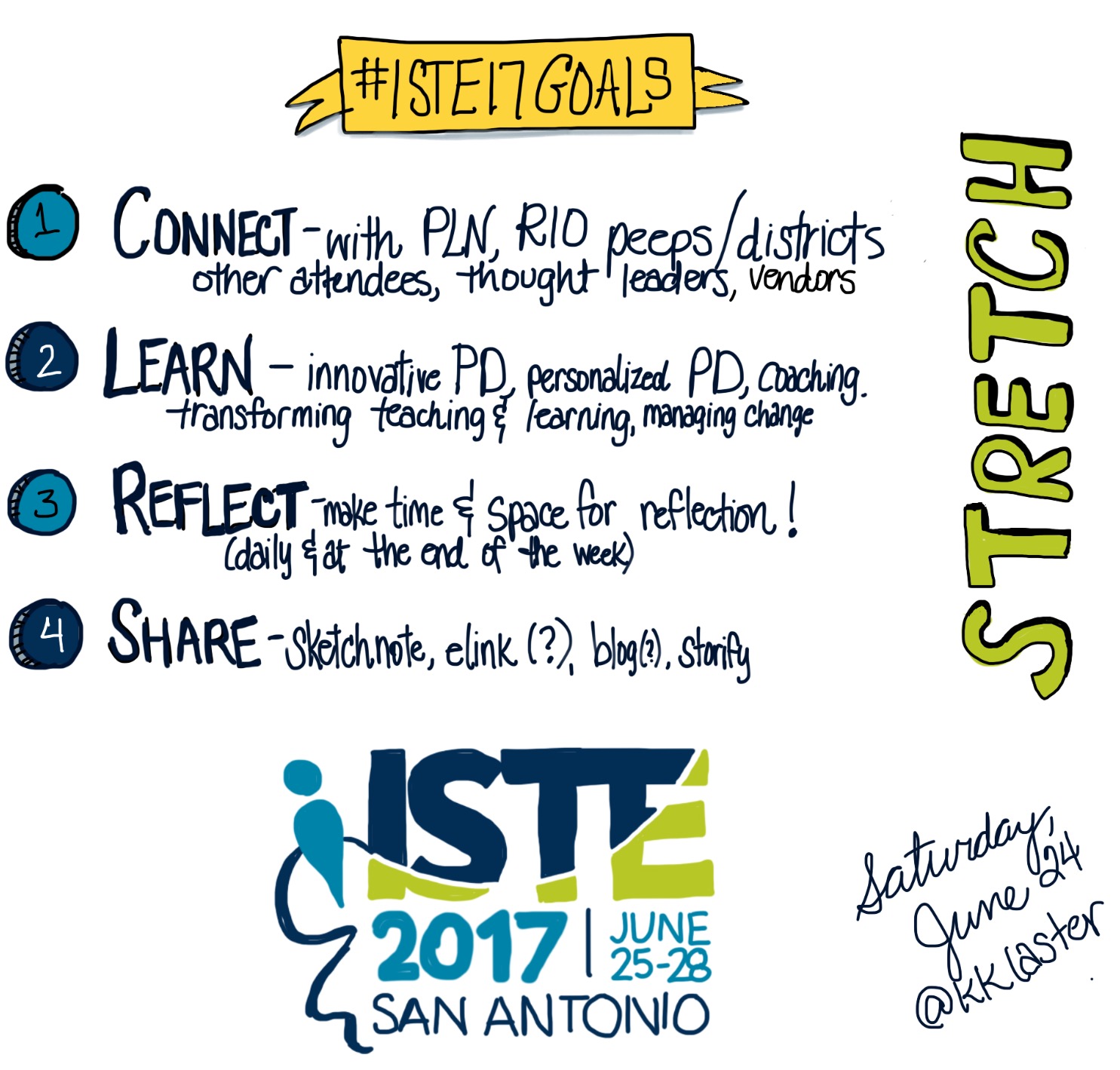
Inspired by advice on Twitter and blogs, I created a few ISTE goals and even sketchnoted my priorities:

I feel I really succeeded at goal #1, and I've decided connections and collaboration will be a priority as I begin year 3 on my job. I know (especially) at tech-focused events, participants are often engrossed in their devices, so at this conference, I was determined to be intentional about striking up conversations, really listening to people, and looking for ways to connect with others. (Such a stretch for me, but it was only for 3 days!) Since ISTE was held in San Antonio, which was a tiny flight or a manageable drive from DFW, I kept running into people from our region, which was so fun! And when I started asking what people were learning and really listening to what they were looking for, I started making connections and started thinking about building bridges, like these...


The past several months, I worked to connect departments and to breach a few silos in the office. It's now time for me to move beyond the workplace and be on the lookout for building those bridges across the region. "You're rural district X and you're just getting into Google? Let me connect you with some leaders in a similar district Y, and they just finished their first year of implementation..." "You're starting a district-wide digital citizenship plan? Let me introduce you to Z who is doing the same thing!" With two years of meeting people and working with more districts and teams, making connections should be a priority!

Bottom line, it always goes back to building relationships, doesn't it?!

Always learning.
Share:

Going to a Conference!


Letter G in my #ReflectiveTeacher journey...

Last week, I found this blog post from Imagine Easy Solutions that encouraged educators to blog during their conference sessions...but I forgot about it until now, so I will start tomorrow. I didn't arrive in Austin until almost noon today, and I only attended a couple sessions, so perhaps an end-of-day reflection is OK for today!


Take-Aways:

  • #TCEA16 will probably trend all week. I was almost overwhelmed yesterday (before I even arrived at the conference) trying to keep up with the flood of ideas, posts, and resources. Following giant conference hashtags is now at the top of my to-do list. I can't believe how much I'm learning through Twitter.
  • TCEA organizers have their conference down to a fine science, and I appreciate all of the time and work it must take to pull off an event of this magnitude! Check-in was a breeze, the conference app is constantly updated, and there are signs, marquees, and volunteers everywhere, so my questions are already answered!
  • Presenters: thank you for providing access to your handouts! If we cannot get into your session, your notes, sites, or presentations are giant birthday gifts, waiting to be unwrapped and explored. (I just need more time to look at the 500+ links!)
  • It is hard to attend a ginormous conference by yourself. This year is so much better, though, because I have made so many connections during my time at my new job, so I keep running into people I know (or who know me!) Whether it's in the hallway or in the fast-moving Twitter stream, it's awesome to be a bit more connected this year. 
  • ...but attending a ginormous conference can also be overwhelming, so quiet time at the end of the day is a must for me!
  • I didn't put in a proposal to present this year, and I kind of miss presenting, but I must admit, it is more relaxing to "just" be a learner and participant.
  • At a technology conference, so many people are glued to their devices, so I always appreciate when the presenter prompts us to "turn to your neighbor and share..." In my opinion, one of the best parts of a conference is making connections, and that's a bit difficult when you're constantly looking at a screen.
  • I am such a math-person (linear, concrete-sequential, etc.) and I have planned PD sessions for many years, so I prefer presentations that are super-organized, purposeful, and thoughtful. Your slides don't have to be designed by a graphic artist, but please follow some kind of outline, provide an essential question, or explain the session goals.
  • I caught a Google Hangout (on Air) reflection session from one of our district partners, and I thought that was an awesome way to end the day! The tech leader had several of his teachers tell one or two of their favorite take-aways from the day, and it looks like he plans to follow this model all week. How awesome is that, to model the tool, get the teachers reflecting, and document their learning!?
In other news, I helped moderate the very first Twitter chat for our service center, so that was an accomplishment for the evening. I worked with a science consultant, and we have the next several months of topics planned. (#R10chat) It was a small group, but we know we had lurkers and a few who were new to Twitter, so to get more people excited about connecting is exciting!

Looking forward to another day at #TCEA16.
Always learning.
Share:

Classroom Management and #ASCDCTE14

Post #3 about the ASCD Conference, and I'm ready to reflect on goodies from one awesome session...

A large part of my job as Instructional Specialist is to support our new teachers, and a top concern for new teachers is classroom management.  In addition, I support all of our teachers on implementing school and district initiatives, and when we're talking about flexible grouping with differentiation, PBLs, and managing technology and devices, we must also have conversations about classroom management and procedures.  It seems like we assume veteran teachers have the management part down, but that's not necessarily the case; therefore, it was a no-brainer that I attended a session on classroom management.

(Side note: I didn't realize that many of the presenters would be pushing their own websites, materials, and books at this conference, but because this message and the presenter were so amazing, I'll include those links!)

If you ever have an opportunity to see Grace Dearborn present, run to her session!  She had our room of at least 300 people completely engaged, laughing, sharing, and accepting her every word as golden.  It's kind of sad that she is no longer in the classroom because I imagine she worked magic with her students...but at least she is sharing her wisdom with others.

Her session was Conscious Classroom Management, and the goal of her session was to provide "Stuff you can use."  Mission accomplished! She shared a few oldies but goodies, but it's always good to hear reminders about these strategies:

  • 2 x 10 -- for your most challenging student(s), if you spend 2 minutes a day for 10 days in a row having a personal, non-academic conversation with that student, behavior will improve.  If a student is absent (ill, suspended, etc.) for several days, you must start over with the 10 days.  Be consistent as possible.
  • "Procedures Precede Content" -- teach and reteach your procedures, and again, be consistent. (She used the example of the safety procedures on airplanes.  Have you ever not heard the flight attendants go over the airplane rules with visuals, demos, and talk-throughs??)  She even provides sample procedure quizzes on her website.  Another suggestion: if you have trouble with the consistency part, i.e. you don't always make your students raise their hands, give yourself a visual, such as a picture of a raised hand, posted in the back of the room where you'll see it.  Also, really spend the time in class to practice the procedures.  For example, require your students to move their desks into groups of 4 within 20 seconds.  Get out the stop watch, make them practice, explain how it must be done, and make them practice again. (One of her engaging strategies: she told us we had "32 seconds" or "17 seconds" or "2.18 minutes" to share--it was never a round number, which really amused me for some reason.)
The new stuff...she was all about visual cues for procedures and management, and that idea was such an a-ha! She took pictures of what she wanted and had those images projected or posted around the room.
  • On test days, as students entered the room, she projected a picture of a desk that was cleared except for a pencil and calculator.
  • For science lab days, she had a picture projected with all equipment needed for the lab (goggles, lab book, pen, calculator, 2 beakers).
  • On her bookshelves, she had two pictures.  The "YES" picture showed her books in order, spines vertical, supplies in the correct containers, everything neat.  The "NO" picture showed the same bookcase with the textbooks mixed together, supplies thrown around, loose papers on the shelves, etc. (She also used this strategy for her youngsters' toy chest at home.)
  • A funny: for the elementary teachers, Grace shared the struggle of dealing with kids who tattle. To remedy that, a teacher posted a picture of a giant ear on the wall, so when kids started to tattle, she said, "Tell it to the ear!"  The teacher said after recess, there might be a line of kids waiting to "tell the ear" what had happened.  Grace also said a high school government teacher posted a big picture of President Obama, and when his seniors started to complain, he said, "Tell it to the President!" and he said kids would actually talk to the poster! :)
Grace was also all about creating rubrics with her visuals, and then she could tell students they needed to get from a "3" to a "5."  She had students demo each number on her rubric, she took pictures of each scenario, labeled each picture with the appropriate number, and then posted or showed pictures when necessary.

  • For high school students, she had an issue of kids packing up before the end of the period, so she created a 1 - 5 rubric for her end of the period procedures.  A "1" was where kids were lined up at the door, ready to leave.  For a "3," some kids were seated, some were standing, some had backpacks on, some students were still working.  A "5" was the ideal situation, and kids were still seated with work on their desks.  She posted the pictures around her door frame, and some days had to say, "I see most of you are at a 3, but I need you to be a 5 before you are dismissed!"  Kids could simply look at the photographs to see what they needed to change.  
  • For her elementary example, she created a similar rubric for kids lining up in the hallways.  This document shows her photos and rubric, plus it gives a couple other examples of using visuals for classroom management.
Added bonus: the images of the expectations would be so useful for our English Language Learners!  We have a large ESL population, so I think this strategy would really help those kiddos understand.  

Another side note: I do not have my own classroom and float into two different classrooms, but it would be easy to keep the photos on my iPad and display them when necessary.

Any other favorite classroom management tips?  Have you ever used visuals or a rubric to help your students learn your class procedures?
Share:

A Lot of Learning at #ASCDCTE14!

I love reading blog reflections after conferences, seminars, and summer institutes (@druinok & @KimAxtell!) and it's a wonderful way to document the great things learned.  Last weekend, I attended the ASCD Conference on Teaching Excellence, and I now have enough new information to keep me thinking and reflecting for at least a month! But before I get to the content, a few side observations...

  • Attending a conference is expensive! I had the ASCD + Texas resident discount, plus my mom lives minutes from the conference location, so I stayed with her.  In addition, she dropped me off each day so I didn't have to pay for parking.  But whoa, how do all of those people and/or districts afford to vacation it up at the conference at the Gaylord? (Next to do: investigate grants for PD!)  It was only mildly embarrassing that I had to tell someone that I was waiting for a ride from my mom. :)
  • I was surrounded by great educators.  One of my presenters was one of Benjamin Bloom's students, yes that Bloom.  I've been fortunate to see Carol Ann Tomlinson before, and I am in awe of her wisdom and thoughtfulness about differentiation, and I am captivated when she speaks.  Her keynote brought tears to my eyes.  One of my presenters was her student, and she was also just as incredible!  I also saw a mind-blowing presentation by Jane Pollock, one of the co-authors of Classroom Instruction That Works, so I guess she's one of Marzano's BFFs.
    • ...however, I learned that just because a person holds multiple advanced degrees and is an educational consultant and author, it doesn't necessarily mean that s/he is an earth-shattering presenter.  Most of my sessions were fantastic, but I heard other comments that were not so great.
  • I was surrounded by great educators part 2.  All of the participants seemed to be amazing educators too, and that was just as energizing!  I met professors, administrators, instructional coaches, curriculum directors, and teachers...all who were excited to learn and find ways to help students succeed.  I don't think I've ever attended a conference that had so many out of state and international visitors.  The people from New York were not happy with our heat and humidity, and the principal from New Zealand said it was snowing back home.  Gotta love summer in Texas.
  • This conference was definitely not tech-y, which was rather interesting and refreshing.  In February, I attended the TCEA (Texas Computer Education Association) conference, and it was almost impossible to meet people because everyone was glued to his device.  During past conferences, I always loved visiting with people at my table, in the hallways, waiting for the next session...but when you're at a tech conference, we're sometimes too engaged with our social media, etc. to have conversations.  At this conference, however, we saw "regular" power-points, and we were never asked to use back channels, poll everywhere, or any other tech response system.  We engaged with our neighbors, and I loved the face-to-face conversations!  There were only a few sessions devoted to technology, but I chose to attend presentations about formative assessment, grit, differentiation, coaching, etc.
  • You chose either 90-minute or 3-hour sessions, which meant in 2.5 days, you didn't have time for a lot of presentations.  At first, I wanted to attend more sessions, but with that amount of time, you really had more opportunities to learn deeply, process, and engage with those around you.  Thumbs up!
I've already blogged about my first session, which was on Fostering Grit; it also coincided nicely with tonight's #eduread

So one quick take-away of something new and tech-y: a teacher shared info about the site http://dropevent.com/, and it's a place where you can quickly upload pictures to a shared site.  (The site is really for parties, weddings, events, etc.)  You can create an "event," and anyone can share photos by emailing to a specified address or posting them on the site.  The event expires after 6 months, but you can download all of the pictures before they expire.  If you want to practice and see how it works, feel free to upload a picture to my "Testing" event: http://dropevent.com/gallery/pho56503 .

My first idea for how to use this is for our site-based staff development.  I could have our new teachers take selfies in the morning, and we will all have pictures of each other and of the day (and important building locations.)   I might also have our teachers take pictures of their classrooms or favorite parts of their classrooms, and then we would have a collection of all kinds of cool classrooms.

For a class, I thought we might take pictures of work, projects, or even daily notes and submit them to the site.  In math, we could ask students to find a picture of a __________ (scalene triangle, parent function, graph in a newspaper, polygon...) and upload the photo before the next class period.  You do have the option to moderate the pictures before they are posted, and I would definitely take advantage of that restriction with my classes.

This Drop Event site was shared at a "networking" breakfast, and the day only got better from there!  I have so much to share and so much to remember...so even if I don't fulfill the July challenge, I might be able to get several posts out of this conference! :)

Super nerd-alert: while I was in the book store, my DI hero, Dr. Tomlinson herself, was just sitting there, waiting to sign books and talk to people!  So I had her sign a book, and I asked if I could take a picture.  An ASCD staff member asked if I wanted to be in the picture too, so the rest is recorded for all of history.  There are actually a few people at school who will be so envious that I got a picture with the differentiation rock star. :)

Yep, that's CAT herself!


Share: