Showing posts with label differentiation. Show all posts

Voice and Choice

My teammates and I facilitate a session called Designing Instruction in the Digital Age, and as I updated my work this summer, I found it interesting how all of my "favorite instructional worlds" kept colliding.

Three summers ago, one version of this session was called Flipped Learning. The next summer, the session became Blended Instruction. We now take the foundations of the new pillars and add bits of thinking from differentiated instruction to create the current iteration of this session. Bottom line: it's all about voice and choice. (I know, that's almost a buzzword, but it's certainly my focus now!)

Here's what we say about voice:
Student voice includes creating content to demonstrate their learning and sharing their voice with others through discussions, backchannels and possibly social media.
Our definition of choice:
Student choice means students choose how they learn something, how they demonstrate their learning and, possibly, what they learn.
Here's one slide from the presentation, and I use exactly the same wording whenever I discuss differentiated instruction.
What choice to students have in choice of content, process, product, environment?
from Courageous Edventures, Jennie Magiera

In The New Pillars of Modern Teaching, the first pillar is design. Dr. Allen describes the four elements of powerful learning design as time, place, medium, and socialness. We want to provide voice and choice as we're designing instruction (or helping our students design their own learning experiences.)

In the professional learning sessions I facilitate, I feel like I'm doing a decent job with the choice part of the workshop or training. I provide a variety of mediums for participants to access the content. I typically allow time for educators time to pick-and-choose articles, tools, or resources to explore. For the voice part, I'm looking for additional ideas. We usually have a backchannel for the session, and we encourage participants to share their reflections using a common hashtag...but what else? What kind of voice and choice do educators need for their own professional learning?

I plan to ask these questions in upcoming sessions, and I hope I'll receive some audio clips to create a small podcast about this content. If you would like to try out the Anchor and record a message (that might be included here!) the instructions are below:
  • Download the Anchor app.
  • Search for Kathryn Laster.
  • Click on the episode and “send a message.”
  • Respond to any of the questions: What does voice or choice mean to you? What kind of voice and choice do educators need for their own professional learning? How do you provide voice and choice in your own classrooms? Include your name and role, and then share your ideas. (You have 1 minute.)
  • Type your name as the title and send.

Thinking a lot about voice and choice, and my journey of differentiated instruction, the new pillars, and now designing instruction in the digital age.
Always learning...
Share:

Love for Let's Geddit!

Last spring, I discovered a new web resource called geddit, and after playing with it just a little bit, I'm determined to figure out how to make this resource an integral part of my class this year.  (When a website mentions "formative assessment" and "differentiation," I know I have to investigate!)


Teachers prepare a lesson, topics, and questions (mostly in advance) and students "check in" and provide answers and self-assessments as the lessons progresses.  During the lesson, students can change their assessment about the topic and material, and teachers can monitor the class' progress.

Teacher perspective, lesson & question planning


One great thing about the advance preparation is that it really makes me think of the questions I want to ask in class.  (And now, I know I want a variety of Mastery, Understanding, Self-Expressive, and Interpersonal questions.)


Teacher perspective, topic addressed and student feedback


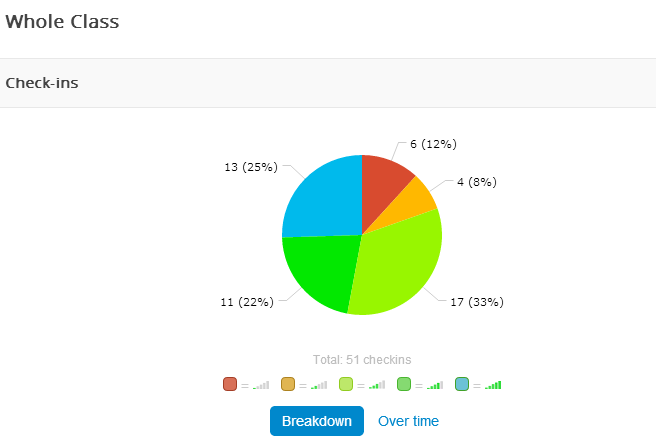
Once you start the lesson, you ask a question and give students an opportunity to check-in.  I created this lesson in May, but I didn't get a chance to use it with my classes, so I used myself as a student to get these screen shots.


I used my iPad and the geddit app for students to demonstrate the student responses.

Student perspective, answered question and check-ins


Student perspective, topics addressed and check-ins

Student perspective, changing self assessment from low to high
Student perspective, hand raised


During class, you can quickly assess how your students are doing, based on their self-assessments.


After the lesson ends, you get all kinds of reports and data of all of the students' responses, including how many times students checked-in, who specifically might be struggling, and their questions, responses, and any comments to you.


It was also easy to upload pictures to use as part of the lesson or a "quiz."  For this image, I used my iPad and a note-taking app, took a screen shot, and opened geddit on my iPad to upload the image.


Teacher considerations: as I mentioned earlier, this resource requires quite a bit of pre-planning and work on your end, but I want to prepare my questions in advance, so that's good!  (You also have the option of a "quick question," so it doesn't all have to be advanced work.)  You now have the option of stopping and resuming a lesson, so you can prepare work that spans several days to get ongoing assessments from your students, so that's a plus.

One other issue: I like to write notes using my iPad, but I needed to see the student feedback, so I needed two devices to make this work for me.  Since I am a floater teacher, it was a bit of a pain to lug around an extra device, and I had to figure out in each room how to set up my space to be able to see the students' responses as we moved through the lesson.

Another good thing: taking time to stop and assess was a great reminder to "chunk" information and to slow down to allow students time to process.  I think I'll have a student volunteer be my geddit assistant--someone who stops me and reminds the class to check-in. 

Classroom management considerations: our school is BYOD, and I have a few iPads to use during class, but this resource is definitely an individual student response system.  With some of the other apps, I allow students to work in pairs or with tables, but for geddit, I wanted individual assessments, so I wanted everyone to have a device.  

Students must log in and join your class, so there are always the "I can't remember my password" issues, plus the "I can't get on the network" kind of days.  Because I expected students to have logins to several websites and apps, I plan to have them create some kind of reminder (a Google doc, perhaps?) with all of their passwords listed.

I started using geddit prior to spring break, and students were always itching to be on their device.  I think for next year, I will have the stipulation that if I see your device out, I must see multiple check-ins throughout the class.  If you're not checking in (and using your device for educational purposes, such as formative assessments) I'll pick up your device!

I think if I start using geddit at the beginning of the year, and if we work out all of the classroom management issues, this resource will be a terrific addition for my class and for my quest for ongoing formative assessments.  The developers continue to update the program, and they are quick to respond to any questions.  The students found the app easy to use, and once they got over their silliness of comments and of virtually raising their hands, they appreciated the feedback.

Has anyone else used geddit?  Any other suggestions for class management and questioning issues?  Features that you love?
Share:

Flexible Grouping, Flexible Teaching!

On my journey to differentiated instruction, I know one non-negotiable of DI is strategic flexible grouping. During the past few years, I have worked diligently on grouping my students, but I know I need to improve the strategic part of my grouping process. 

(By the way, I use the "Touch Blur" app to blur students' faces.)
I also learned that differentiation doesn't always mean group work, nor does it mean that groups are based solely on ability levels.  Some lessons require "whole group" instruction, and then we can move into individual, partner, or small group work as necessary.

Types of Groups:
And groups may be based on...
Whole Class
Readiness
Small Groups
Interest
Pairs
Similar Learning Profiles
Individual Work
Random Selection

Choice

In addition, I learned you must establish a community in your classroom to make the different groups most effective. Students must be willing to talk with each other, take risks together, and know how to truly collaborate on their work.  To help with the community building in class, as soon as I change my groups, I ask students to introduce themselves and answer a question that requires collaboration.  (Rate yourself from 1-10 on how you're feeling today, and average all of your ratings.  Come to a consensus about the best thing to eat in the cafeteria.)  I love Sarah's idea for establishing group norms, and you can download her posters from her blog.  And finally, let's not forgot about the classroom management aspect of the group process. When working on building community and flexible grouping, it's so important to have those procedures in place about moving desks, turning in work, getting materials, ...


To help students understand that grouping is a norm in our class, at the beginning of last year (and I will repeat) we did a quick "line up" activity.  I had huge classes, so the students actually remained seated, but I participated, too. I projected the list shown here, and we went through the items one by one. It is more effective when you can demonstrate a line up and have your kids move from one end of the spectrum to the other, but they got the point by their self-assessments. After we went through the entire list, I asked questions such as who had a chance to rate themselves as a 4 or 5?  And who rated themselves a 1 or 2 at least once?   The final reflection: in our class this year, there will be times when you will be an expert and times when you will be a novice. You may sometimes be grouped with like team members, but sometimes, I will want you to "stretch," and you may be grouped outside of your comfort zone.  (Here's an opportunity to share a bit about making mistakes, grit, and growth mindset!)


The line-up activity is great for establishing the understanding of groups based on readiness, but since I'm on a quest this year to group by learning profile, I think (hope!) it will work for the idea of any changing groups.

Unfortunately, I only strategically grouped a few times last year, but it was a great victory for me when a student walked in and asked, "Do you want us to sit in our CAP groups or our random groups?"  So at least I'm getting the grouping thing down a bit better.  Another bit of great feedback--an end of year note included the comment, "I learned to collaborate with my peers, some of whom I had never talked to before."

Unsolicited advice: if you want to start changing up your class, try random groups, but make certain you include the aspects of community, group norms, and class procedures.  If  you're looking for ways to try random grouping, there are so many available resources.  Our science teachers recommended this site to create random groups, and I found a collection of sites to create groups here. On this post, Beth at Algebra's Friend also suggested Super Teacher Tools to generate groups, and this site provides no-tech options for grouping students.

So now I have the grouping component ready to try again, and I really want to focus on differentiating by learning profile...next steps: put the two together and work on specific lesson components!


Any suggestions for creating a community of learners in your classroom?  How do you create groups?
Share:

Planning Ahead with Learning Profiles

Based on this #eduread and after exploring my new book Math Toolshere's a very tiny bit of what I have so far for week one of school.  (Eeek, it's only early July!)

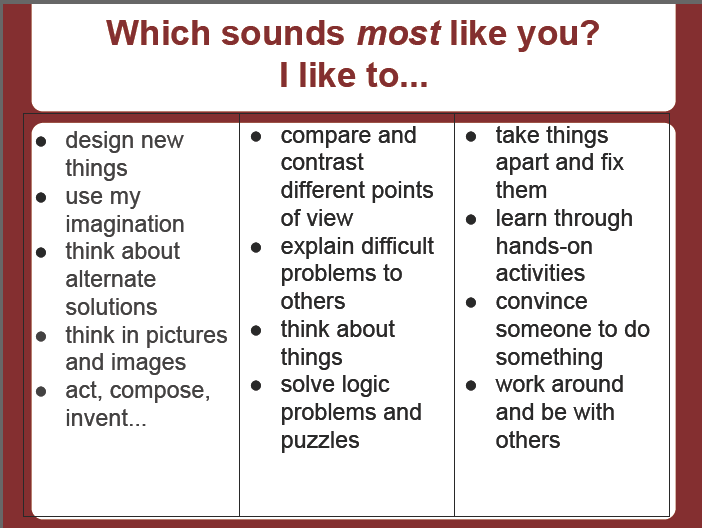
Since in the first week we will be in the getting to know you stage, I'm opting for a very quick assessment to determine students' learning profiles as Mastery, Understanding, Self-Expressive, and Interpersonal.  At my recent ASCD conference, the presenter used these images to analyze our style as instructional coaches, and the simple images created such rich discussions, so I hope that will happen in our class, too...but since it's week one, I may be overly optimistic!  


I'll show them this slide, have them share out a few ideas, discuss a few more specifics from this document, and have students record their responses on this Google form so that I will have a record of their preferences.  I plan to seat students according to this learning preference during the first couple weeks of school.


I teach pre-calculus, and we start our year using a unit circle approach to trigonometry.  I looked over my unit objectives, and I knew in the past, my students really struggled with understanding coterminal angles, determining which quadrant an angle lies, finding reference angles, and (when it's first introduced) finding exact trig values using the unit circle...so that's where I wanted to start my differentiation. (I know differentiation is a proactive approach to teaching. I already know where kids will struggle, so I need to plan ahead to anticipate their difficulties.)


For today's post, I am just sharing one small formative assessment idea, but it's a start, and I bet it will get easier as I keep practicing.  (#growthmindset!)  After receiving my Math Tools book, I skimmed through the ideas and jotted down the ones that I already used or the ones that appealed to me.  The book provides tools for each category of Mastery, Understanding, Interpersonal, and Self-Expressive, and the final chapter uses a combination of all four of the learning profiles.

Because I know the kids usually struggle with coterminal angles, I want a more thorough check for understanding after that lesson.  For the last 5-7 minutes of class, I plan to use these questions as an exit ticket.  Students will choose the one question that appeals to their learning profile and turn in their responses for me to check and plan for the next lesson.  If students finish early, they may try another question, or they may share their responses with their group members.  For this assessment, I want to see their level of understanding of coterminal angles and learn where they are still struggling.
Since this will be our first "experiment" with these learning profiles, I will make certain we have time to reflect about the students' choices of question and how I will use their work to inform my teaching decisions.  I want the students to be comfortable with their first groups, we'll be practicing procedures, and the first week is so hectic, so I think this will be a safe formal assessment.

It took me less time to create this small assessment than to write this blog post, so I am hopeful that I will be able to eventually have a collection of questions, assessments, and tasks...but for now, I'm starting with asking where do the kids struggle, and what I can I do to check their level of understanding and deepen their level of understanding.  If I can start by creating two-three "things" per unit, I'll be a happy camper.


Update:  I knew I rarely included Self-Expressive type tasks, so I wanted to focus on creating those types of questions.  Going back to Math Tools, I wrote these questions to use at some point during the unit.


Have you found ways to incorporate these learning profiles into your lessons?  What do you think?
Share:

What I WANT to Know About Learners

As I mentioned on an earlier post, I am now obsessed with the idea of differentiating by learning profile.  I know I have a good understanding of what learning profile really means, but now I'm to the more difficult implementation stage.  I'm happy that I found a colleague who will help me fine tune some of these ideas, and I have found an overwhelming amount of information online to help with this part of the journey.

What I WANT to know (and do)... 
From a teacher's perspective, I want to know how to vary my questions, tasks, and assignments in order to address the variety of learning profiles in my classes.  I'm still at the point where I'm thinking about a giant juggling routine, but I want to make this more manageable: how to group my students, how to ask questions, how to get students to ask questions, and how to create thoughtful assignments and assessments.
  • I found this awesome reflection after our #eduread.  @mwbigger classified different types of assignments and assessments according to their Silver-Strong profile.  He also referred to Sarah's post about 26 good homework ideas.  For some homework assignments, I would love to keep a generic list of possibilities from each of the learning profiles and allow the students to choose their favorite (or maybe one from their style, one from another style?).
From the free preview chapter of the Math Tools book, I found this chart, and I know that will help when I'm designing the work.


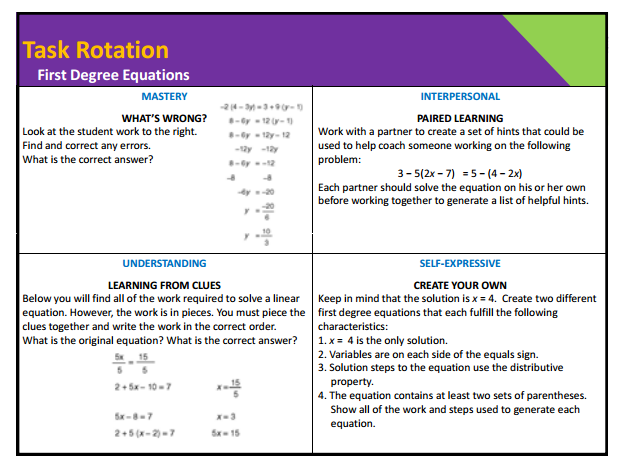
I keep reading about Task Rotations, and I think I could start by creating something like this to use on our "bring it all together" or review days.  The difference between the task rotations and menus is that for the task rotations, you must complete all 4 tasks, and each task intentionally addresses one of the four Silver-Strong learning styles (mastery, understanding, self-expressive, interpersonal).  I found this example on a page of Thoughtful Classrooms' free resources:


A "low prep" idea: I plan to use the vocabulary for each of the profiles, so I could ask my students to identify the types of questions I ask during class.  If they're seated with their like profile groups, I could ask them to change my question to one that "fits" their profile (or make up an additional question, if my question matches their profile).  To stretch themselves, they could exchange questions with another group and answer at least one question from each category.

I hope each week that I'll say things like, "The next part of class will appeal to those of you who are interpersonal learners; otherwise, you'll have an opportunity to stretch outside your comfort zone a bit," or "If you have a self-expressive learner in your group, then s/he will be able to help you think outside of the box for this activity."

Next steps...I'm ready to look at my own calendar, assessments, and lessons!

Any examples of task rotations for math?  Have you grouped your students based on different learning profiles?

Share:

What I KNOW About Learners

OK, thanks to an earlier #eduread, I am now officially obsessed with teaching and differentiating by understanding learning profiles.  I feel like I'm a bit late to this party, and I found so many resources that I finally had to force myself to stop reading, bookmarking, clipping, and flipping articles and posts.  I also had to restrain myself with additional purchases, but I finally settled on one more book, Math Tools, Grades 3 - 12... by Silver et al.

I was thinking about a KWL chart for differentiation by learning profile, and for now, I have a lot of Ks and Ws!

I KNOW that differentiating by learning profile increases efficiency.
I know I have a better understanding of what it looks like to differentiate by readiness or interest (but just because I know what it means doesn't mean that I'm an expert!)
When I first started teaching (ahem...years ago) I thought learning style simply meant auditory, visual, kinesthetic, but now I know that a complete learning profile involves so much more.

During the past two years, my students and I have dabbled with understanding Gardner's Multiple Intelligences and Sternberg's Intelligences (creative, analytical, and practical).  Our  #eduread article introduced me to the Silver-Strong profiles (mastery, understanding, self-expressive, and interpersonal). And hooray, hooray, I just found an older ASCD article and then an image on this slide-share that put everything together for me!


I know I need to educate my students about the different profiles, that the styles fluctuate depending on the context, and that no one profile is better than another!
  • Idea for the first week(s) of school: give students a variety of inventories, have them create a learning profile a la the "Me at a Glance" pages on Sarah's blog.  For the Silver-Strong inventory, I found this post on Math Hombre's page, and he adapted the inventory to math. Teach the vocabulary.  Help students understand the philosophy of strategic flexible grouping.  (Some days we'll be grouped according to your strengths, and some days we'll make you work outside your comfort zone so that you'll be stretched!)  Work on the management aspect of how to let kids know the seating arrangement o' the day.  Create a Google form for students to record their preferred learning profiles.  
  • Oh, I also know that mindset will be part of this conversation, too.  If we're grouping kiddos or if the questioning/task is outside of their preferred learning profile, what can I do to help students persevere? What are their options when they struggle? 
  • I know that building a classroom community is an integral component of the big picture of differentiation, so with our discussion of learning profiles, I will also help students learn the importance of respecting the differences in all of us.
Unfortunately, I have absolutely no tangibles...YET...but at least I have a nebulous idea for the "2nd curriculum" objectives for the first week(s) of school.

A future post will focus on the WHAT.  What I want to know, my goals for the teaching, questioning, and assessing aspect of this idea.

Thanks for reading!  Any other insight on learning profiles?  Do you have favorite inventories that you have used?  
Share:

Learning about our Learners

It's been so long since I've written anything (and I never blogged much overall) but the Read...Chat...Reflect #eduread article chats have so inspired me (and challenged me!) that I had to write. :)

This week's article was "Creating a Differentiated Mathematics Classroom," and since our district has been on a journey to differentiated instruction during the past three years, I am always on the lookout for DI ideas specific to math.

I've had a lot of professional development on DI, and I'm in the Dr. Carol Ann Tomlinson fan club, so if you're not familiar with the tenets of differentiated instruction, here's a quick summary of what I know...

The principles of DI include high quality curriculum, ongoing assessment, *instruction that responds to student variance, all working within a classroom community.  (Dr. Tomlinson's latest edition of The Differentiated Classroom has changed a bit of the wording. When we first learned about DI, we separated *this tenet into flexible grouping and respectful tasks.)  Teachers can differentiate through content, process, and product, all according to the student's readiness, interests, and learning profile.

In addition, differentiation by interest increases student motivation, differentiation by readiness produces growth, and differentiation by learning profile improves efficiency.

As as a math teacher, the "easiest" way for me to understand differentiation was by student readiness.   I thought, "Sure, I can do a quick assessment to see where my students are struggling," and respond to their needs.  (That only took two years, and I'm definitely not an expert, but I have a growth mindset about learning about assessment!)  I'm still working on writing awesome pre-assessments for my students, though...that is a real challenge for me!

I struggled with understanding learning profile, but the first thing I tried was to have my students assess themselves on their intelligence type.  (They learned a tiny bit about Gardner's Multiple Intelligences, they completed a survey and responded on a Google form, so then I had a record of their personal assessments.)  I created seating charts and groups based on their preferred intelligence, and they enjoyed sitting with like-minded students, but I didn't do much else with that grouping.  (sad face)

This year, I tried an additional activity to use learning profile, and it was moderately successful.  In recent trainings, I enjoyed "CAP" activities, so that's what I tried to duplicate for math...but I only did this one time.  (another sad face!)   I talked my students through the creative-analytical-practical descriptions of Sternberg's Theory of Intelligence, and they quickly self-assessed their intelligence on this Google form.

Column 1: Creative; Column 2: Analytical; Column 3: Practical

My students divided into their C-A-P groups, and they had the remainder of the period to work on this assignment.  We were creating and solving sinusoidal models, and I originally thought this type of assignment was general enough that it could be used with a variety of future lessons.  (Sigh.  Perhaps if I had been faithful about blogging, I would have returned to this idea!)


I'm now trying to picture how this week's #eduread article will add to the entire schema of learning profiles in my classroom.  Several teachers in our school refer to the True Colors test, which is loosely based on Myers-Briggs, and I like how the profiles in this article align with the colors.  (Mastery = Gold, Understanding = Green, Interpersonal = Blue, and Self-Expressive = Orange)  Someone in our district found this learner profile worksheet, and I like the structure of this handout.  I also saw the "Me at a Glance" post for interactive notebooks at Everybody is a Genius, and I loved all of her ideas about putting all of the strategies on a page.

I guess the bottom line is to know your students, craft lessons based on their needs, and be purposeful about students' work and assessments.  (Whew, is that all???)  I'm looking forward to the #eduread chat to help solidify my thinking about differentiation and learning profiles in mathematics!


A few of my summer educational reads...

  • The Differentiated Classroom: Responding to the Needs of All Learners (2nd edition), Carol Ann Tomlinson
  • Trust Matters: Leadership for Successful Schools (2nd edition), Megan Tschannen-Moran
  • Instructional Rounds in Education: A Networked Approach to Improving Teaching and Learning, City, Elmore, Fiarman and Teitel
  • Leaders Eat Last, Simon Sinek
  • Quiet: The Power of Introverts in a World That Can't Stop Talking, Susan Cain
  • (re-read) Teach Like a Pirate, Dave Burgess


Share:

Watch and Win!

As usual, a recent Twitter chat motivated me to write this post.  It definitely fits into my differentiation theme, and I wanted to explain this school initiative, but our recent #efachat prompted me to pick up the tempo on sharing the idea.

Several years ago, we received staff development "credit" for observing two teachers' classrooms. Earlier this year, I heard, "Hey, do you remember when we were required to watch other classrooms? That was great! I wish we could do that again.  I would love to see Mr. W's class or Mrs. N's class."  The department chair replied,  "Why don't you just ask if you can watch their classes? It doesn't need to be a requirement for you to watch and learn."

A few weeks later, the department chair and I (with admin approval) decided to create an opportunity for teachers to feel more comfortable about visiting other classrooms.  We called the initiative "Watch and Win!" and we created this brief reflection form for teachers.  We knew brief was important, and we definitely didn't want the visit to feel like an evaluation, thus happy face clip art and cute font.  (The fun font is KG Seven Sixteen.) 


Our principal first promoted the initiative, and we sent follow-up emails that encouraged teachers to simply watch any other classroom and win teaching strategies, lesson plans, and classroom set-up ideas.  We emphasized the observations did not need to take the whole class period--visit any portion of any classroom. We also reminded teachers to ask permission before visiting.  We did not require teachers to return the reflection form, but our principal was kind enough to provide a prize as an incentive for visiting and reflecting. 

For the upcoming school year, the district is now encouraging (requiring) teachers to visit other classrooms, but schools will have the option to choose to what extent.  We are so happy that we can expand our Watch and Win initiative and slowly work on changing the culture of our school.  (One option from the district was to participate in Japanese Lesson studies, but we are not ready for that kind of intense observation/reflection!)

We will begin the school year with version 2.0 of Watch and Win.  We will first encourage teachers to open their classroom doors as often as possible.  Using scrap wood, our construction class made door stops for all rooms, and our Girls Service League's summer project was to paint all of the door stops.  We are also printing and laminating these signs for teachers' doors, so when a teacher is up for visitors, he/she hangs the sign on the door.  We hope that as teachers walk down the hall and see green signs, they'll be motivated to drop by and visit the classrooms.  (I created my very first iMovie as a somewhat staged "commercial" for this school plan, so if you're dying to see my amateur video of some of our teachers and classes, I can send you the link.)

KG Only Hope font
We are also going to encourage teachers to share (via departmental or mass email) invitations to observe particular parts of a lesson.  "Hey, I'm using the Socrative exit ticket app today, so if you would like to see a demo, please feel free to stop by B112 during the last 10 minutes of 1st, 2nd, or 5th periods."

We hope teachers win a lot of ideas from these observations, but we also believe visiting classrooms will help build our school community of teacher-learners.  We hope teachers will more frequently say things like, "I just saw this cool idea in Mr. G's room, and I thought it would be great if our class tried it, too!"  (a la "I just read about this great idea on another blog," or "My twitter friends were talking about this lesson.")


Once teachers realize the observations are not evaluations, our next step will be to facilitate how observations can be used for learning.  We realize that not all teachers are there yet, but we hope Watch and Win is a step in the right direction.

  • I'm trying to improve my questioning techniques.  Will you please visit my classroom and record my types of questions?
  • I would love some help with keeping my 6th period students engaged.  Would you please watch that class and provide feedback about your observations?


Another Twitter reminder--Krissy Venosdale shares her lovely, free posters on this amazing site!
If you are not (yet) in the position to create a school-wide initiative, what about convincing others in your subject-team or department to observe each other?  Or ask your lunch friends to commit to observing other classrooms?  Observing other teachers is one of the favorite parts of my job, and I learn something new every time I visit another classroom.

Is visiting other classrooms encouraged in your school?  How can we convince others that classroom observations are positive learning experiences and not a waste of time?

To be continued...

Growing List of Summer Educational Reads:
5 Practices for Orchestrating Productive Mathematics Discussions, Margaret S. Smith & Mary Kay Stein
Embedded Formative Assessment, Dylan Wiliam
Engaging Teachers in Classroom Walkthroughs, Donald S. Kachur et al
Essential Questions, Jay McTighe & Grant Wiggins
How to Assess Higher-Order Thinking Skills In Your Classroom, Susan M. Brookhart
Leadership for Differentiating Schools and Classrooms, Carol Ann Tomlinson & Susan D. Allan
More Good Questions, Marian Small & Amy Lin
Teach Like a Pirate, Dave Burgess


Share:

My DI Journey

Differentiated Instruction (DI) is nothing new in education-speak, but for me, it is a recent classroom changer, so I want to share my (limited) wisdom about DI.

In a previous post, I mentioned our district is doing our DI initiative right, which means slow implementation, training for teachers and administration, extra staff/support, and continuous professional development.  As a campus instructional specialist (IS) I was part of the initial training, and I helped roll-out the plans to our departments, common planning teams, and campus.  Our year-3 framework and goals are now in place, and this summer, I am working on a new-and-improved classroom.

My First Ah-Ha Moments…
#1: One of the first things we learned was the DI is NOT a set of strategies, but it is a way of thinking about teaching and learning.  It starts with Mindset.  It is about being proactive.  We plan to share this video with our new teachers to get them motivated about DI:


#2:  One teacher used the analogy that she previously thought of teaching as triage: kids who need the most help get a blood transfusion and transplant, but those who already “got it” would be fine with a band-aid.  But DI means to move kids, where ever they are, from one level to the next.  So that means if after the first week of school I already know a student would make a 5 on an AP exam, I must find a way to move her beyond that.  And when a non-English speaking refugee enrolls in my class, I cannot let him keep falling behind, but I must find a way to move him forward, even if by mere millimeters.  DI is teaching up.

#3: DI does NOT always mean “activities” and group work.  Parts of the lesson will be whole group instruction.  When you do utilize group work, the groups should be flexible.  (I intend to explain that part of my journey in another post!)

Next…
The non-negotiables of DI are high-quality curriculum, supportive classroom community, continuous assessment, flexible grouping, and respectful tasks, but all components are intertwined.  Texas is not a CCSS state (we have TEKS) and our district provides curriculum for tested subjects, so our district/campus focus is the remaining 4 non-negotiables. 

Side-note: I teach pre-AP pre-calculus, which is not tested, so one summer project was to transform my old curriculum to one of “higher quality.”  I researched Essential Questions and Understanding By Design to write my KUDs (know-understand-do).  (The “do” part is what I will differentiate!)

DI and Assessments…
I completely believe in the power of continuous assessment, so what happens next?  What does it look like in my classroom?

My students complete a pre-assessment/exit ticket/quick classroom check for understanding (which is why I’m lovin’ #EFAmath) and I realize that most kids are ready to move on, but a few are still stuck on one concept.  While the majority of the class is working on something else, I call those few kids to the board at the back of the room, and we hold a “10-minute tutorial” on the missing concept.  (One example of flexible grouping is to group by readiness.)  And because we have established a sense of community and respect in our classroom, no one has a problem with being a tutoree.  We have this sign hanging in our classroom, and students realize we will do whatever it takes to make each person successful!


Real-life example: one master teacher at our school was ready to “DI-it” from day one, and her level 3 students completed a pre-assessment during the first week of school.  She realized 1-2 students lacked a bit of knowledge, so she created an opportunity in class to pull those kids aside for a review.  The problem: one student was so upset and proclaimed, “I know why you’re pulling us aside! You took our quiz from yesterday and put us in groups! I’m not dumb!”  Teacher and student continued the conversation in the hall, and the teacher quickly soothed the student.  When the teacher reflected on the situation, she said she had not yet had time to build the community in her class and establish trust with her students.  Bingo!

DI Goals…
This process all makes sense in my head, and I can’t wait to try it out in this year’s classrooms.  I will have high quality, engaging lessons (thanks to EQs and TLAP).  Because I am familiar with the curriculum, I am aware of the typical tough spots, and will be proactive in my planning.  Formative assessments will be a regular part of the curriculum (thanks EFA) and I will immediately use the results to plan for and respond to students’ needs. I will create a supportive classroom community.  Students will understand that when grouped, their teams will change regularly, depending on their needs, the lesson, or activity. 

It sounds so reasonable, but there are so many other components that are part of this whole process. 

Whew, what a journey! To be continued…


Summer Educational Reads:
Embedded Formative Assessment, Dylan Wiliam
Essential Questions, Jay McTighe & Grant Wiggins
How to Assess Higher-Order Thinking Skills In Your Classroom, Susan M. Brookhart
Leadership for Differentiating Schools and Classrooms, Carol Ann Tomlinson & Susan D. Allan
Teach Like a Pirate, Dave Burgess

Share:

Learning Profiles vs. Learning Styles

I know I've neglected this blog, but after a recent #efamath chat (and a little hint from @druinok) I'm ready to dive back in and am ready to share, reflect and learn!


Over the past two years, our district has wholeheartedly embraced differentiated instruction (aka DI) and they are doing everything right to make certain that we know, understand, and do everything to embrace it, too.  In my role as an instructional specialist (an instructional "coach" for our school) I have participated in all kinds of wonderful additional professional development, have planned training for our departments and school, and have tried a lot of new things in my classroom.  These struggles and successes have provided enough material for at least 10 new blog posts, and I hope to use this forum as a place to help reflect and sort through what I've learned.

On to Learning Profiles...
In Embedded Formative Assessment, the author discusses the "myth" of Learning Styles and the lack of research to substantiate the use of learning styles to improve learning.  Several teachers mentioned this misconception in the recent #efachat, and I will raise my hand to admit that I've given kids quizzes at the beginning of the year to assess learning styles!

Thanks to some amazing training (first at a DI Institute with Carol Ann Tomlinson and then with a lot of follow up from my district) I now have a better understanding of a learner's profile, rather than a learning style, and have used learners' profiles a bit in my classroom.

It has taken me almost 2 years to comprehend and begin to implement the DI philosophy into my classroom (DI is not a set of strategies, by the way!) so a blog post will not do it justice.  However, for the sake of getting to the point, one of the non-negotiables of DI is flexible grouping.  According to Tomlinson, you may group students based on readiness, interest, or learner profile (or random) and each grouping achieves different goals.  Readiness leads to growth, grouping by interest increases motivation, and grouping by learner's profile improves efficiency.

The DI gurus use either Robert Sternberg's Theory of Multiple Intelligences (analytical, creative, practical) or Howard Gardner's Multiple Intelligences Theory (which I believe more people know) to address learning profiles.

To introduce the idea to our faculty, we used this brief activity during a staff development (which we modeled from something we saw at our DI Institute.)   After teachers completed the task individually, we asked them to group together with one person from each group to share their responses.  (Hold up a finger 1, 2, or 3, and find the other two numbers to form a group.)


We then shared the slide to show the green group was analytical, yellow was the  practical group, and purple was the creative group.  If we had grouped by like intelligences, the discussion would have been very quick, thus the efficiency.  (One person read the definition, yeah, we all got that, too.)  


Now to stretch yourself, what if you complete the same activity using the prompt from another group?  Or what if we asked teachers to write the definition in 3 different ways?  (That idea reminds me of a Frayer model.)

In a math classroom, a quick example (or exit ticket) could be something like "Explain what a function is," choosing one of these prompts: a) write a definition that you might find in your textbook glossary; b) write a list or examples of the attributes of a function; or c) draw a visual representation or metaphor of a function (not necessarily a graph).  I only did this a few times, but a goal for next year is to make this type of quick assessment more of a norm.  "For concept _________, either write a definition, write how you could explain it to someone, or draw a representation."  Students could turn in their work, share with their table, or share with "unlike" intelligences.  (Wouldn't this be an easy assessment for any level, any content area?)

For my classroom this year, instead of the good ol' learning styles quiz (auditory, visual, kinesthetic) that I had used in the past, I tried assessing my students on Gardner's multiple intelligences.  With my class blog post, I found several surveys (online and paper copies), included videos and definitions, and had the kids complete a Google form with their results.

I then created a seating chart based on their intelligence preference (as best as I could) and let the kids try those groups for a few weeks.  I did notice the discussions, questioning, and explanations were quite different from each of the groups, so that was interesting, but I didn't design enough tasks that catered specifically to their strengths.  (Another post for another day...)

In Embedded Formative Assessment, the conclusion to the "Learning Styles" section was simply to be aware of different styles and encourage all students to use as many styles as possible.  So I don't think the old learning style idea is completely wrong, but perhaps it's just incomplete and can be strengthened by adding a bit more information.  This document is something from our district, but I do not know where it came from, so I cannot give the appropriate credit (and it's a PDF, unfortunately) but it is an example of a very thorough learner's profile.  In addition to the intelligence theory, DI also requires building the community in your classroom and with your students, which means the importance of learning students' interests.  (Another post for another day...)

I'm really looking forward to reading the rest of the book, and the book is about using assessments, not the small tangent of learning styles/profiles.  But in learning about differentiation, I really see the connection and importance of both.  Isn't the bottom line that we must know our students?? 

Once again, thanks to @druinok and #made4math to motivate me to start blogging in the first place.  I've been an avid blog reader for several years, but writing about practices really helps me solidify my thinking.

I loved this post by @pamjwilson who challenged us to "Model What We Wish To See" and who now posts her great reading list on her blog.  So to follow her lead...

Summer Educational Reads:
Embedded Formative Assessment, Dylan Wiliam
Essential Questions, Jay McTighe & Grant Wiggins
How to Assess Higher-Order Thinking Skills In Your Classroom, Susan M. Brookhart
Leadership for Differentiating Schools and Classrooms, Carol Ann Tomlinson & Susan D. Allan
Teach Like a Pirate, Dave Burgess

Interesting Posts:


Thanks for reading!  Anything to add?  What else do you know about learning profiles?
Share:

The Power of YET!


How about a favorite word for one of my favorite things?  Does that count?  My new favorite word is...

YET.

Why?  And how does it apply to my classroom, teaching, and learning?

Last fall, in conjunction with our district's initiative of differentiation, several of us started studying and reflecting on Carol Dweck's mindset.  (I think we're a bit late on the mindset bandwagon, but at least we have started the conversation!)  During professional development, we introduced our faculty to the ideas of growth vs. fixed mindsets, several of us read her book Mindset: the New Psychology of Success, we created failure walls in our classrooms, we talked to our students about ways to overcome a fixed mindset (especially in math!) and our principal took our entire Instructional Leadership Team to see Dr. Dweck when she had a speaking engagement in town.

At Dr. Dweck's talk, she mentioned the "Power of Yet," and that was a light-bulb moment for me, and I immediately shared this concept with my students and our faculty. 

  • Student: I don't understand that example.  Me:  YET.  But let's try the the next one together to find your missing step.
  • Student: I don't know why I missed that question on the quiz.  Me:  YET.  Please ask your partner to help you work through it again since he answered it correctly.
  • Student: I don't get how to ____________  (fill in the blank with any appropriate topic).  Me: YET.  What can we do to help you understand?
  • Student: I don't have my problems finished...YET.  But I promise I'll get them to you first thing tomorrow.
  • Teacher: I don't think that instructional strategy will work for me.  Me: YET.  But let's change this one little piece to help it become a better fit for your teaching style and students.  Are you willing to try it now?
  • Me: I haven't started on the calendar or syllabus for either class.  My brain:  YET.  But you still have a little time and you know you'll have it ready for the first day of school.
  • Me: Once school gets into full swing, I don't know how I'll be able to keep up with the whole blog/twitter universe.  My brain:  YET.  You've already learned so much in the past few weeks, and people seem so willing to share.  You'll figure out how to make it work.
In my classroom, YET became a common phrase, and a few of my students even responded to a blog post about the power of yet in academics and sports.

I don't know if Carol Dweck coined the phrase "the power of YET," but after a quick Google search, it looks like the business world is all about YET, and I found these blogs in a long string of posts and videos:


Richard Bravo's blog: Positive Expectancy: the power of "yet"
Create What Matters Most: The Power of "Yet!" - Shift Focus, Create Results
Creative Life Changes: The Power of Yet

I am now all about this tiny word YET and its power.  I know it's not as fun to say as multiplicative, but it has become my favorite word.  Do you see its power, too?

Happy Friday!


Share:

Made4Math - Graffiti Boards

I have had so much fun finding new blogs, looking at classroom and project pictures, and reflecting on all of the contributions for #made4math!  I am so fortunate that I stumbled into this amazing community of math teachers and bloggers.


Today's idea is an easy strategy that can be implemented on day #1: using a "Graffiti Board" in your classroom.  (I am a floater teacher and share board space in my classrooms, so my personal examples are not Pinterest-worthy; however, I have included one example of a semi-permanent board, and I'm certain there is a lot of creative potential.)  

This strategy came from a differentiation institute, and the session presenter suggested graffiti boards for two purposes: assessment and building class culture.  I have tried this tool for a few months, and I have used boards for both purposes, and it is a strategy that I will implement next year.  (And my HS students seemed to respond well, or at least they enjoyed writing on the board!)

Making your own graffiti board is as easy as 1, 2, 3.
  1. Write any question (or word, thought, quote, etc.) on your board before class begins.
  2. Get students to respond (as they enter or leave the room, or at another designated time).
  3. Comment or somehow use the results.
Graffiti Boards as a Quick Assessment
My first graffiti board was a pre-assessment, and I asked my students what they remembered about logarithms.  I wrote the question on the board before class, and hoped students would respond.  Obviously, only a few did, so I needed to work on step #2.   (Resolved: I left more markers out, and as students entered, I simply asked them to answer the question on the board.  After a few mornings of "graffiti time," most kids entered the class hoping to be able to write on the board.)


The second board is an example from the middle of a unit.  Several of my boards asked, "How are you feeling about ______?" which also led to conversations about problem solving, confidence, study skills, and growth mindset.  (From the board results, I allowed AM to move on to the next lesson, I talked to the "1's" individually about tutoring, and I changed the pacing of the lesson a bit.)  


After using a number-line graffiti board every week or so, we even created another type of language in our class. "Work with your partner until you both feel closer to a 4," or "Ms. L, I'm feeling about a 2 on solving log equations, so when are you available for tutoring?"


One of our chemistry teachers created a much prettier example of a graffiti board to use with a week-long project.  Each of her students made a "marker" using a popsicle stick with a magnet glued to the back and his name written on the front of the stick.  As the project evolved and as students uncovered research, they moved their names along the scale to answer the posted question.  ("In order to combat dependence on fossil fuels, the US should build more nuclear fission reactors."  Do you agree, disagree, or are neutral?)  I loved that she was able to create a single, permanent board for 4 of her class periods, and it was great to see her board change after each day of research.


Graffiti Boards to Encourage Participation
The other use of graffiti boards is to encourage participation, create a positive classroom culture, and build rapport.  At the differentiation institute, I learned if students write or speak at the very beginning of class, they are more likely to participate throughout the class. 

I started my class blog in February, and I offered the first post as a tiny extra credit--just to see how the commenting worked, who would participate, how did we like the idea of blogging, etc.  I used a graffiti board to remind the kids about this bonus opportunity and to see if they were willing to comment on our class blog.  (Results: yes, I would write another blog entry, and I would expect many student comments for the first post.)


On occasion, I asked a non-math question on the graffiti board, just to get everyone to write something as they entered the room.  The questions were usually silly so I don't have pictures, but I would write the question and students wrote their answers all over the board.  Example questions are as follows:
  • Who's your favorite character on Glee?  
  • Before the release of Hunger Games: would you rather live in District 12 or live in the Capitol? 
  • What are you looking forward to this summer?
  • To ask the first week of school: what is the best part about starting a new school year?
I would always share my answer, we would discuss the question for 1-2 minutes, and students found similarities in the responses, which helped build class relationships.  The kids loved the "Would you rather...?" questions and wanted that type of board more than any other. :)

Other Ideas
Graffiti Boards in a Flipped Class
An idea for a teacher who flips his class is to write a problem on the board that relates to the previous night's video, and ask students to rank their understanding of the problem AND sit at a table corresponding to that number.  For example, students who are completely lost (or who didn't watch the assigned video) would be "1's" and sit at table #1.  As the teacher works the groups, he knows whether to provide a lesson intervention or an enrichment, simply based on their table number.

Graffiti Boards in Staff Development
In a small group meeting, we used the board below to assess our knowledge about mindset.  "Growth Mindset" was written in the middle of the board, and we all went to the board and wrote our definition or ideas about the main topic.


Student Responses and Technology Thoughts
Last year, we allowed students to use their cell phones for instructional purposes, so I tried Poll Everywhere and GoSoapBox (when it was free).  Our district is now moving to BYOD, so this summer, I have been playing with Socrative and Wiffiti (especially now that I am working on tweeting) and we have several sets of "clickers" floating around the school.  I definitely love the idea of using technology to help assess my students, but for the quickest, easiest, last-minute set-up, nothing beats a graffiti board--writing a question on the board and asking students to respond.

Would a graffiti board work your classroom?  I would love any suggestions or examples of how you have used the boards in your room!
Share: