Showing posts with label assessment. Show all posts

Screencasting for Teaching and Learning

With devices in the hands of so many students and teachers, I don't think screencasting and webcam recordings receive the credit these strategies deserve. In this post, I share a few favorite tools and how they can be used for both teaching and learning.

How can we use screencasts for teaching?

When I started creating videos for my classes, I only had an iPad. I found Show Me, which was an easy way to create tutorials, plus the videos could be viewed on various devices.

I didn't have the time to "flip" my entire class, so I started by creating tutorial videos for concepts where I knew the kids struggled. (After teaching the same subject for many years, you know the difficult topics!)


It took a while for me to get the hang of speaking and writing (and listening to the sound of my voice). I had to let go of the idea of perfect, beautiful videos...because they were not! But I soon achieved my goal of a 3-minute video taking no more than 5-minutes to record. The students appreciated the tutorials, and they seemed to prefer my videos over ones they found elsewhere online. 

(By the way, you can now record screencasts on your iPad using iOS 11, so an app may not even be necessary.)

For my work today, I could probably utilize screencasts in every single professional learning session. Content delivery can all be done with a video. (Same is true for classrooms, right?)

I'm slowly (eek!) adding a bit of webcam to my screencasts, and there are several easy tools for these videos.

I discovered the Soapbox Chrome Extension during an edcamp, and it allows you to switch between your webcam, screen, or both.

I shared Loom (and WebCam Record) in this post about Quick Wins. All of these tools require very little set-up, and the free plans are sufficient for my needs.

When beginning your screencast journey, start small and go for the product, rather than perfection. Get a video or screencast out there to help students, rather than spending too much time editing, doing re-takes, creating graphics and transitions.

How can we use screen-recordings for students and learning? 

Instead of standing up giving full presentations, students could record screencasts of their work, and partners could provide feedback on each other's work before it is submitted to the teacher. (Save class time!)

Students could explain (justify, question) anything on a webpage...vocabulary, steps for solving a problem, what a particular reading passage means...

Teachers could provide slides (information) and students could create a screencast to develop predictions, make inferences, or draw conclusions about the content.
  • In a math session, I provided about 15 slides with different graphs, charts, and data points, and I asked the teachers to choose 2-3 slides to discuss. See my samples below. I used Screencastify and Nimbus for the recording tools.


I know a lot of people love using Screencastify because it saves to Google Drive; however, it requires quite a bit of set-up.

You really don't need any fancy tools or programs, and if students have a device with a camera, they can take a video of them talking about their work or project. Keep it simple!

If you have Chromebooks, check out this post from Richard Byrne and Free Tech For Teachers where he shares 7 screencasting tools that work on Chromebooks. (Soapbox, Loom, Screencastify, and Nimbus are all included.)

Do you have any favorite tools or suggestions for screencasts? How can you use screencasts for teaching and learning?

Share:

Retrieval Practice


When I first joined Twitter, I dipped my toes into Twitter chats by participating in #eduread. This small group of math teachers shared and discussed educational books and articles, and although some resources were content specific, most books focused on great educational practices.

Right before I changed jobs, our summer book was Make It Stick: The Science of Successful Learning. Because I was in a career transition, I did not participate in the chat, but I did read and study the book. (This new phase in my life coincided with my beginning of listening to podcasts. I discovered The Cult of Pedagogy blog/podcast with this episode, where Jennifer Gonzales interviewed Peter C. Brown, the author of Make It Stick.) Because I was teaching adults, rather than children, I wasn't able to try any of the strategies from the book with my own students, so I only occassionally grabbed the book to review and share a learning strategy.

Fast forward a couple years, and another Cult of Pedagogy podcast episode grabbed my attention, and this time, I am determined to make it stick. In this episode, Gonzales interviewed Dr. Pooja Agarwal about the power of retrieval practice, and the research and the implications on learning blew me away. Even better, Dr. Agarwal shares many ideas you can try tomorrow in your classroom, and they require very little prep or materials.

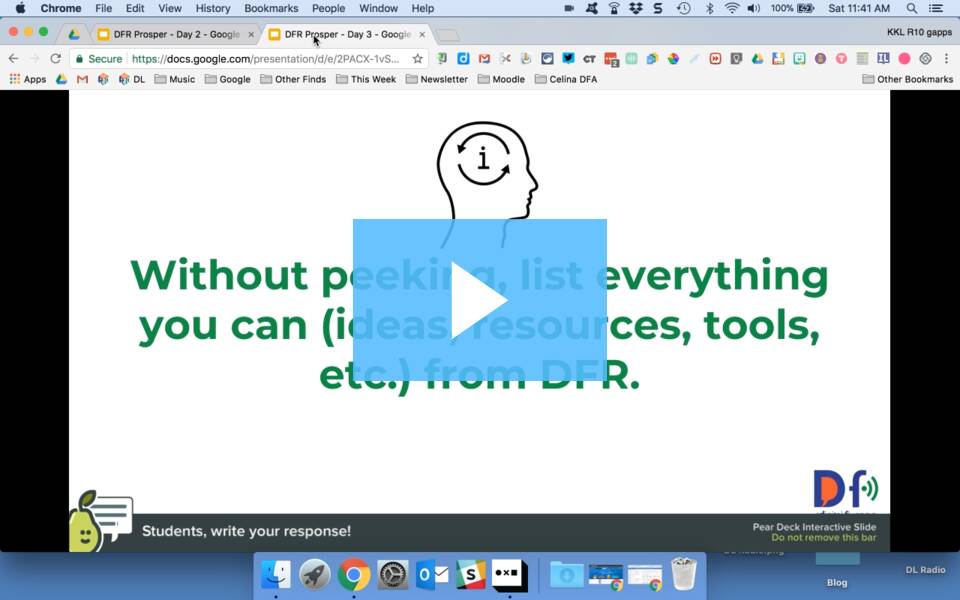
I started practicing retrieval in my PD sessions by changing one slide. For extended trainings (all day or mult-day) I typically provide a bullet-pointed list of "Remember, here's what we covered earlier." This information puts information into participants' heads.
From this slide...

Here's how I changed my slide to pull information out of participants' heads to provide the exercise of retrieval.


...to this one!
Notice the "Without peeking" part of the instructions!

This very minor tweak allows me to demonstrate retrieval, and then start our conversation about how it could look in classrooms.

Dr. Agarwal founded retrievalpractice.org, and her site contains resources, research, and ideas...but at the very least, sign up for her newsletter. You can also glance at the newsletter archives to see all the learning goodness she shares. Her work is definitely relevant and classroom friendly. (You may have seen Dr. Agarwal's interview during the Ditch Summit, but unfortunately, that video is no longer available.)

This information and research is so important, so I'm trying to share her work with as many people as possible. I even brought up the idea at my dinner group (all teachers, so school talk is the norm) which led to a fun follow-up. One of my friends reached out to a former student who is now a cognitive scientist, and this was her viewpoint:


One last related resource: The Learning Scientists are contributors to the Retrieval Practice site, but they also have their own podcast and resources. They're working their way through the Six Strategies of Effective Learning, and they have two podcast episodes per strategy.

Have you read and applied the work from Made to Stick? What are you doing to improve learning in your work?

I'm always learning (and working to make it stick!)

Share:

Quick Wins

One of our vendors (Clarity BrightBytes) calls strategies "Quick Wins" and "Game Changers,"  and my teammates and I enjoy using those same phrases in our work. Colleagues request my go-to tools, so I started a list of my own quick wins. These ideas require only one-click, little set-up, or very low prep.

You can use four out of five of these quick wins for feedback or formative assessment. Three of these tools allow you to include video responses in your work.

Fist-to-Five 

I shared this strategy in an earlier post, and now I discovered that using this non-verbal assessment is as effective with adults. As shared in this video, educators can use fist-to-five for both social and academic check-ins, pre-assessments, quick exit polls, etc. My usual questions are:

  • How are you feeling today? (0 - 5 = worst day ever --> lovin' life!)
  • How do you feel about technology in general? (what's a smartphone --> I love all gadgets)
  • For Google training: How do you feel about Google apps?
  • What do you know about differentiated instruction?
When using fist-to-five with my students, 5 = I can teach someone else. After a few uses of this strategy, the kids start using the same language to assess themselves. Win!

As with all formative assessments, the key is to use the "data" to make instructional decisions. When my training session consists of participants who rate themselves as 4-5 with technology, I can move a little more quickly with the tech. The session attendees are more likely to click and experiment with the tools with very little prompting.

First-to-five is a quick win because it requires no prep, it can be used at any time, it's low risk, and it provides me with good information.

Google Docs Quick Create

This Chrome Extension allows you to create a new Google Doc, Sheet, Presentation, Drawing, or Form with a single click. I don't need to go to my Drive or type anything in the Omnibox...simply click and start a new document. One click is definitely a quick win!

WebCam Record

Alice Keeler shares a lot of information about the importance of immediate, specific feedback. She created this Chrome Extension for video feedback, and her tools are so efficient! Click the extension, click start, and the video immediately begins recording. You may record up to 90-seconds. Once you stop recording, the video saves in a folder in your Google Drive, and the video's shortened URL is automatically copied to your clipboard. Here's my sample video, and here are Alice's posts and suggestions about using her Webcam Record Chrome Extension. One-click + an efficient feedback tool = quick win! 

Loom

If you need longer videos, check out Loom. There are a lot of screencasting tools available, but this (new-to-me) Chrome Extension takes one click to start and stop, requires very little set-up, and includes these extra features:
  • You can add timestamps.
  • There is a text box underneath your video.
  • You can add comments that are time stamped.
  • You can set permissions for viewing the video (with a password or with a link).
  • You can choose where to position your webcam "circle," the size of the video-cam, or to have no video at all!
I used Loom for this quick screencast about another tool, but if you watch on Loom (click the icon in the upper right corner) you can see the video, comments, and text box.


Flipgrid

Last year's tool with the most buzz was Flipgrid. With their amount of social media interactions and responses to this product, the company built an enthusiastic community of educators. There are now more features and options for set-up, but Flipgrid is definitely a quick win because it is so easy for the user; click the green button and start recording! Flipgrid has a large number of possibilities for classroom and school use, such as introductions, reflections, and formative assessments. A colleague has used Flipgrid with the littles (PK-K students) and I ask even the most tech-timid to try Flipgrid...and all groups experience success with this tool.

Time is a precious resource for educators, so I'm always eager to share ways we can save even a few seconds. When a simple strategy or tool provides a lot of bang for your buck, it definitely needs to be shared! What are your favorite quick-wins?

Always learning...
Share:

Learning About Learning


During the past few months, I have been reflecting a lot about documenting learning and how technology can help with that process. For several years, I have been interested in using formative assessments to make instructional decisions, and I know there are connections between the two, so now, I'm reflecting on this year's experiences and trying to put all of these learning-pieces together.

My Knowledge Base

John Hattie's work and his three feedback questions helped me solidify understandings about effective feedback and how/where to infuse feedback into the learning process. In The Google Infused Classroom, Holly Clark and Tanya Avrith share related ideas when they discuss assessment for/as/of learning. In their book, they also provide ways to make thinking visible and discuss how technology can amplify the learning process, and they reference the Project Zero Thinking Routines. The work from Silvia Tolisano and these posts have also inspired a lot of reflections on documenting for/as/of learning. (Silvia also creates fabulous graphics and sketch notes, and I'm looking forward to her upcoming book.) All of these thoughts about learning, feedback, and thinking routines are swirling in my head!

Blending Ideas

Holly and Tanya include a lot of ways to use technology to make thinking visible, so I'm going to try to do the same. I work with adult learners, but I'll begin with some of the strategies I used in my classroom. By the way, one big eye-opener in their book was the importance of learning from others to shift thinking. It's OK to have "public" posts for all to see, and that is definitely a shift in my thinking. Yes, some kids may copy answers, but others may think, "Oh, that's what she meant!" and formulate their own responses.

See-Think-Wonder

One of the first thinking strategies I tried was "What do you notice, and what do you wonder?" We even tried this idea with trigonometry vocabulary words on day 1 to illustrate that a lot of pre-calculus would be based on concepts you already know! (Trying to activate prior knowledge.)

Here's a description of the See-Think-Wonder routine, and here's an example of the routine being used in a health class. I always used the "Notice and Wonder" questions, but I like the structure of See-Think-Wonder, so I'm going to add the third question when I use this routine now.

When I tried this activity in class, I only had students share responses with each other and then "popcorn" out a few answers. In the video linked above, the teacher created a graphic organizer for his students, used think-pair-share for students to compare their responses, and then had a final debrief with a show of hands.

Options with technology...

Instead of simply observing an image, listing a few see/think/wonder statements, and sharing with a neighbor, how could technology be used to amplify this process?
  • You could use comments in Google Docs, and I have used this notice-wonder activity in my sessions. Students could choose their preferred image, and they could reply to each other's comments. 
  • You could use a Padlet board to collect comments from each student, and with the new "shelf" option in Padlet, you can create the see-think-wonder prompts as columns.
  • If you didn't want the kids to see each others' responses, you could use Google Drawings to create a graphic organizer and share as a template in Google Classroom (or "force" a copy for each individual.)
  • Another option if you wanted individual responses: you could use a Google Form to collect all responses.

I can see benefits to both the individual and shared responses...it all depends on the activity. BUT by using technology, you have amplified the process because you are able to hear from every student ("Even the quietest student has a voice!"), responses are documented, and if students can see all of the work, they can learn from and provide feedback to each other.

And with adult learners?

My friend Katie recently used Mentimeter for a faculty poll, and the responses are below.

I think the See-Think-Wonder strategy would be an excellent debrief after this type of activity, and I think it would help educators understand how technology could amplify the learning/feedback process. A few things I hope the participants would see, think, and wonder:

  • There were 184 entries, so the entire faculty had a chance to respond.
  • How long would it take for you to go around the tables and ask 184 people to answer the question?
  • The most common responses/trends are evident. (The largest words received more responses.)
  • How long would it take to see trends if responses were on post-its or slips of paper?
  • If you couldn't immediately think of a response, you could see what others said to give you ideas.
  • How could this tool/strategy be used with your class or team? What are the benefits? What are the drawbacks?
After working on this post today, the ideas are still swirling in my head, but I really like the idea of taking visible thinking routines and looking at tech-options. I firmly believe that you don't use technology for the sake of the bells-and-whistles, but I feel, at least in this case, the use of technology really could amplify the learning/feedback process.

What are your favorite thinking routines? I would love to see if technology could facilitate the process!
Share:

Formative Assessment Goodness

Several years ago, I started to up my formative assessment "game," so I wanted to share a few things I learned. I slowed a bit on my alphabet journey for #ReflectiveTeacher, but I'm back on track with formative assessments.

One of the key components of differentiated instruction is continual assessment "that informs teaching and learning," and I have written several posts about DI and assessment. During our DI trainings, one of my favorite analogies about assessment is the medical one:
Summative assessments are like autoposies, and formative assessments are wellness check-ups.
If I start assessing my students' learning on the day of the major test, then I am too late. I need to conduct frequent formative assessments throughout the class/day/unit, and adjust my teaching as a result of these check-ups.

The other big point (that only took a year or so to get) is the last part of the previous sentence: adjust my teaching. Oh yes, I jumped in on the exit ticket bandwagon, but sadly, I didn't always look at the students' responses until days after the assessment. [sad face!] That was too late! I needed to immediately take actions on the students' questions, comments, and (mis)understandings.

I love that technology helps with the efficiency of these quick formative assessments. Whether it's a Google form, a game-based tool (like Kahoot) or a more low-tech tool like Plickers, these resources make it so quick for teachers to get real-time results and feedback on their students' learning. I found this great blog post by @mpilakow, who created a very informative chart to compare several student-response systems.


One of my new favorite tools on the scene is Formative. As a math teacher with a few iPads and smart phones, this tool was an awesome addition to the growing list of student-response systems. I LOVE that students can respond by writing their responses to show all of their work on the screen! I LOVE that I can import an image of a coordinate plane and have students graph their answers on the grid! When I've demonstrated this tool to teachers, they have all oohed and ahhed about its functionality.

Because of the positive responses from so many teachers, I created a short how-to video about using Formative, and it illustrates writing a question and responding. (Their playlist of videos is excellent, by the way!)


My favorite non-tech tool is the good ol' hand gesture fist-to-five strategy. "If you have no idea what I'm talking about, show me a fist. If you could teach this concept to another person, show me a five." I can't remember where I heard the tweak of 5 = teach to another person, but that really helps make the distinction about giving yourself a five.


I could tell this strategy became the norm in our class when students started using phrases such as, "I'm only feeling about a three on this concept, so can I come see you for tutoring in the morning?" During class when I started having "workshops" (small tutoring groups) on a particular concept, I let the students know, "If you feel like you're still a two or three on this objective, I'll be at the table in the back of the room in 10 minutes to answer your questions."

This strategy works with adults too, and I ask the same type of question on a pre-assessment or as an intro to the session. In Google Forms, I can use the linear scale question type, or I revert to the hand gestures, just like with the students.

At the end of class (or a presentation for teachers) I ask students to reflect: "If you felt like you were a fist or one at the beginning of class, did you move to at least a three? If you were a three when we started, are you now a four?"

If you're really into assessments and use Flipboard, I've curated an entire magazine on Assessments, and I share my favorite blog posts, tools, and other resources.

View my Flipboard Magazine.

So now on the more reflective side: I hesitated to write this post (guess that's why there was such a delay) because there are so many great things already written about formative assessments and feedback, whether you want to know the brain research, the strategies that impact learning, or the newest tech tools to help...so what does this post add to the plethora of information already out there?

I know, I know...blogging should be about reflecting, learning, and growing as an educator, and writing this post certainly helped with that idea. Now when I'm training teachers, I will go into a tad more depth about the purpose of the pre-assessment, the first-to-five, and any other assessment we try during the session. Make the strategies more transparent. Good lesson for me.

The other good thought: I work with teachers who have such a wide range of levels of "tech expertise," so these resources for formative assessments are great entry points for teachers who are trying to introduce technology into their classrooms...and used thoughtfully, these tools can impact teaching and leraning. The tools are easy to set-up, they are mostly device agnostic, and they definitely help with the efficiency part of collecting information to inform the teaching decisions.

So OK, the time spent writing this post was worth it. :)
Always learning.
Share:

Love for Let's Geddit!

Last spring, I discovered a new web resource called geddit, and after playing with it just a little bit, I'm determined to figure out how to make this resource an integral part of my class this year.  (When a website mentions "formative assessment" and "differentiation," I know I have to investigate!)


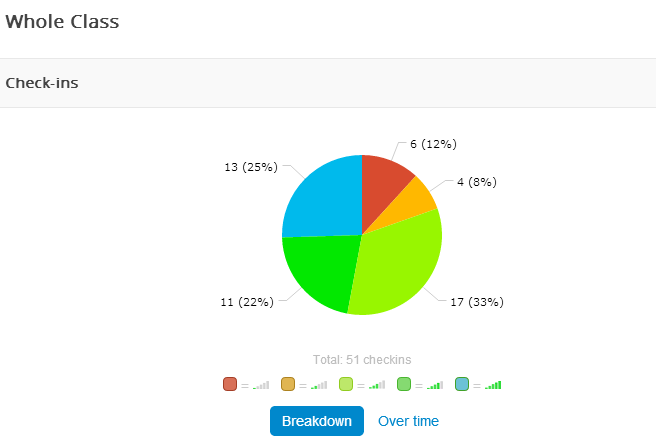
Teachers prepare a lesson, topics, and questions (mostly in advance) and students "check in" and provide answers and self-assessments as the lessons progresses.  During the lesson, students can change their assessment about the topic and material, and teachers can monitor the class' progress.

Teacher perspective, lesson & question planning


One great thing about the advance preparation is that it really makes me think of the questions I want to ask in class.  (And now, I know I want a variety of Mastery, Understanding, Self-Expressive, and Interpersonal questions.)


Teacher perspective, topic addressed and student feedback


Once you start the lesson, you ask a question and give students an opportunity to check-in.  I created this lesson in May, but I didn't get a chance to use it with my classes, so I used myself as a student to get these screen shots.


I used my iPad and the geddit app for students to demonstrate the student responses.

Student perspective, answered question and check-ins


Student perspective, topics addressed and check-ins

Student perspective, changing self assessment from low to high
Student perspective, hand raised


During class, you can quickly assess how your students are doing, based on their self-assessments.


After the lesson ends, you get all kinds of reports and data of all of the students' responses, including how many times students checked-in, who specifically might be struggling, and their questions, responses, and any comments to you.


It was also easy to upload pictures to use as part of the lesson or a "quiz."  For this image, I used my iPad and a note-taking app, took a screen shot, and opened geddit on my iPad to upload the image.


Teacher considerations: as I mentioned earlier, this resource requires quite a bit of pre-planning and work on your end, but I want to prepare my questions in advance, so that's good!  (You also have the option of a "quick question," so it doesn't all have to be advanced work.)  You now have the option of stopping and resuming a lesson, so you can prepare work that spans several days to get ongoing assessments from your students, so that's a plus.

One other issue: I like to write notes using my iPad, but I needed to see the student feedback, so I needed two devices to make this work for me.  Since I am a floater teacher, it was a bit of a pain to lug around an extra device, and I had to figure out in each room how to set up my space to be able to see the students' responses as we moved through the lesson.

Another good thing: taking time to stop and assess was a great reminder to "chunk" information and to slow down to allow students time to process.  I think I'll have a student volunteer be my geddit assistant--someone who stops me and reminds the class to check-in. 

Classroom management considerations: our school is BYOD, and I have a few iPads to use during class, but this resource is definitely an individual student response system.  With some of the other apps, I allow students to work in pairs or with tables, but for geddit, I wanted individual assessments, so I wanted everyone to have a device.  

Students must log in and join your class, so there are always the "I can't remember my password" issues, plus the "I can't get on the network" kind of days.  Because I expected students to have logins to several websites and apps, I plan to have them create some kind of reminder (a Google doc, perhaps?) with all of their passwords listed.

I started using geddit prior to spring break, and students were always itching to be on their device.  I think for next year, I will have the stipulation that if I see your device out, I must see multiple check-ins throughout the class.  If you're not checking in (and using your device for educational purposes, such as formative assessments) I'll pick up your device!

I think if I start using geddit at the beginning of the year, and if we work out all of the classroom management issues, this resource will be a terrific addition for my class and for my quest for ongoing formative assessments.  The developers continue to update the program, and they are quick to respond to any questions.  The students found the app easy to use, and once they got over their silliness of comments and of virtually raising their hands, they appreciated the feedback.

Has anyone else used geddit?  Any other suggestions for class management and questioning issues?  Features that you love?
Share:

My DI Journey

Differentiated Instruction (DI) is nothing new in education-speak, but for me, it is a recent classroom changer, so I want to share my (limited) wisdom about DI.

In a previous post, I mentioned our district is doing our DI initiative right, which means slow implementation, training for teachers and administration, extra staff/support, and continuous professional development.  As a campus instructional specialist (IS) I was part of the initial training, and I helped roll-out the plans to our departments, common planning teams, and campus.  Our year-3 framework and goals are now in place, and this summer, I am working on a new-and-improved classroom.

My First Ah-Ha Moments…
#1: One of the first things we learned was the DI is NOT a set of strategies, but it is a way of thinking about teaching and learning.  It starts with Mindset.  It is about being proactive.  We plan to share this video with our new teachers to get them motivated about DI:


#2:  One teacher used the analogy that she previously thought of teaching as triage: kids who need the most help get a blood transfusion and transplant, but those who already “got it” would be fine with a band-aid.  But DI means to move kids, where ever they are, from one level to the next.  So that means if after the first week of school I already know a student would make a 5 on an AP exam, I must find a way to move her beyond that.  And when a non-English speaking refugee enrolls in my class, I cannot let him keep falling behind, but I must find a way to move him forward, even if by mere millimeters.  DI is teaching up.

#3: DI does NOT always mean “activities” and group work.  Parts of the lesson will be whole group instruction.  When you do utilize group work, the groups should be flexible.  (I intend to explain that part of my journey in another post!)

Next…
The non-negotiables of DI are high-quality curriculum, supportive classroom community, continuous assessment, flexible grouping, and respectful tasks, but all components are intertwined.  Texas is not a CCSS state (we have TEKS) and our district provides curriculum for tested subjects, so our district/campus focus is the remaining 4 non-negotiables. 

Side-note: I teach pre-AP pre-calculus, which is not tested, so one summer project was to transform my old curriculum to one of “higher quality.”  I researched Essential Questions and Understanding By Design to write my KUDs (know-understand-do).  (The “do” part is what I will differentiate!)

DI and Assessments…
I completely believe in the power of continuous assessment, so what happens next?  What does it look like in my classroom?

My students complete a pre-assessment/exit ticket/quick classroom check for understanding (which is why I’m lovin’ #EFAmath) and I realize that most kids are ready to move on, but a few are still stuck on one concept.  While the majority of the class is working on something else, I call those few kids to the board at the back of the room, and we hold a “10-minute tutorial” on the missing concept.  (One example of flexible grouping is to group by readiness.)  And because we have established a sense of community and respect in our classroom, no one has a problem with being a tutoree.  We have this sign hanging in our classroom, and students realize we will do whatever it takes to make each person successful!


Real-life example: one master teacher at our school was ready to “DI-it” from day one, and her level 3 students completed a pre-assessment during the first week of school.  She realized 1-2 students lacked a bit of knowledge, so she created an opportunity in class to pull those kids aside for a review.  The problem: one student was so upset and proclaimed, “I know why you’re pulling us aside! You took our quiz from yesterday and put us in groups! I’m not dumb!”  Teacher and student continued the conversation in the hall, and the teacher quickly soothed the student.  When the teacher reflected on the situation, she said she had not yet had time to build the community in her class and establish trust with her students.  Bingo!

DI Goals…
This process all makes sense in my head, and I can’t wait to try it out in this year’s classrooms.  I will have high quality, engaging lessons (thanks to EQs and TLAP).  Because I am familiar with the curriculum, I am aware of the typical tough spots, and will be proactive in my planning.  Formative assessments will be a regular part of the curriculum (thanks EFA) and I will immediately use the results to plan for and respond to students’ needs. I will create a supportive classroom community.  Students will understand that when grouped, their teams will change regularly, depending on their needs, the lesson, or activity. 

It sounds so reasonable, but there are so many other components that are part of this whole process. 

Whew, what a journey! To be continued…


Summer Educational Reads:
Embedded Formative Assessment, Dylan Wiliam
Essential Questions, Jay McTighe & Grant Wiggins
How to Assess Higher-Order Thinking Skills In Your Classroom, Susan M. Brookhart
Leadership for Differentiating Schools and Classrooms, Carol Ann Tomlinson & Susan D. Allan
Teach Like a Pirate, Dave Burgess

Share:

Homework Contemplations

I am so grateful that the #HSSunFun topic of the week is homework!  It's time for me to re-evaluate my system, so this post has motivated me to get thinking.  Thank you @Carol_Leonard for compiling our blogs.

Over my many years of teacher, I think I have tried every HW policy ever shared with me, and these are my take-aways from all of the attempts:

  • Whether I have 60 or 150 students, I am terrible about checking and returning papers on a daily basis.  
  • My purpose of assigning homework is to practice a new skill.  As we all probably do, I tell the students that just as they must practice music, sports, or playing video games, they must somehow practice the new skills learned in math, which could involve working (and re-working) problems.
  • I realized that I'm very OK if students do not have an assignment completed the next day after it is assigned.  Students are involved in extra-curricular activities, or they work, or they have an AP English 3 project due, and they often face busy, late nights.  So for me, HW deadlines are negligible, but I want their homework finished before the unit test, just so they have had opportunities to practice and ask questions.
  • Students want to be acknowledged for their work, and they don't seem to care if it's a stamp, check mark, or a grade.
I have tried...collecting and checking homework daily and collecting stacks of papers at the end of the unit.  I have given HW quizzes, where students re-copy 5-6 problems straight from a week of assignments, a la David R. Johnson's 1990 book, Making Every Minute Count.  I have collected notebooks and graded a few random problems.  I have rolled a die and collected a row of HW assignments.  I have collected HW assignments and have graded only 1 problem on each paper.  I have had a "surprise" HW policy, where I could collect, check, or ignore HW on any given day of the week.  I've checked homework on completion using a rubric and a score of 10, 7, 5, 3, or 0.  I've checked homework on completion with a YES or NO--complete or not, 5 or 0.

For most years of teaching, I have checked HW on completion.  Students begin with a 100 HW average, and each assignment is worth 5 points.  For every assignment they skip, I deduct 5 points.  For extra goodness (super explanation, working extra problems, showing how they've re-learned something, peer tutoring) I add points to their HW average.  I have an Excel chart for each class period, and I always have my clipboard close by for checking, adding, and subtracting points.  At the end of the grading period, they only receive one grade for a HW average, but with the chart, I have documentation about what they have done.  (I can't believe I found an old check sheet around my house this morning!)

This procedure has worked fairly well over the years, and it has worked extremely well when the students are self-motivated.  In my classes with younger or ESL students, the stamp sheet idea (blogged here) seemed to help the students with an extra step of organization.

As I'm writing this, or until I see something new to try when I read other blogs, I think I'm going to continue with the completion-check-system with each assignment 5 points, but I think I will add a twist I learned at an AP summer institute.  The instructor checked daily homework on completion; however, if a student made 85 or greater on a "big test," he was excused from the homework checks until the next test.  Who were the students who made >85 on tests?  The students who somehow practiced their work in whatever way worked for them.  Differentiation is a district initiative this year, so I believe this homework policy will be one small way to differentiate a class process.

This post was a great exercise for rethinking my homework purposes and policies, and it's great to have this forum for reflections. But I am really looking forward to reading about other homework policies.  I still have a whole week before the students return...so I have plenty of time to read other great ideas and change my mind!
Share:

Made4Math - Partner Quizzes + Extras!

Today's #Made4Math post has once again been inspired by a few tweets and blogs!  Thanks to @druinok for organizing the posts, and I look forward to reading and learning from so many others.


I am what is politely referred to as a veteran teacher, so when I first started teaching (ahem, 1990) everything was teacher directed, i.e. stand-and-deliver, students in rows and quietly taking notes.  When teachers realized that we had to change our ways, our district helped us get our feet wet by using Kagan cooperative structures.  I probably use variations of "Think-Pair-Share" more than any other technique, but my second favorite strategy is the 2-person Rally Coach, or as my students call it, a partner quiz, and I have included one example is below:
Rt Triangle Trig Rally

The Rally Coach was a great way to ease my way into successful group work. Directions may be found here, but I've included a few additional hints and benefits:
  • When writing the quiz, I try to divide the questions' difficulty level as even as possible, so person A doesn't have all of the "easy questions."
  • Use only one piece of paper and one pencil (and calculator) per pair, so the students truly have to share and work together.
  • The first times I give this type of assessment, I also talk about the benefits of teaching others.  I tell students if you can explain something to someone else, or if you can analyze work and find an error, you've got it.  My favorite part of the activity is listening to the students' great math conversations.
  • I also talk about the importance of coaching, being positive and how to politely disagree.  As person A explains her problem, person B listens and coaches.  Once person B agrees with person A's answer, he initials the paper to confirm the work.  (In my class, I ask students to initial and write a positive comment.  Best comment written on this quiz: "That's Shrek-tastic!")
  • I usually make at least one of these questions very interesting, and students really need to use each other to complete the activity.  (The quiz above isn't difficult, but I provide too much information, so the kids have little debates about how to answer the last question.  It's great!)
  • This type of activity always takes longer than expected, so plan your time accordingly.
  • Floating teacher bonus: since I do not have my own classroom, this activity gives us an easy opportunity to practice moving desks and returning them to the original position in another teacher's classroom.
Building relationships bonus:  At the bottom of my quizzes and tests, I usually write a little non-math question, such as "What great books have you recently read?" or "Any good news to share?" and I always respond to their notes.  If I forget to write a question, they ask about it and/or write a note to me!

Making students self sufficient (and classroom management) bonus:  I try to give this type of activity very early in the year to allow students to learn to rely on each other for help.  Several years ago, I heard a teacher say, "Ask 3 before me!" which has become a motto in my classroom.  Students must ask at least three of their classmates before asking me a question.  For today, I made a new flyer, so it's easy to simply point to the sign before students run to me with their questions.  (I'm not the most creative person--you can make it prettier!)
3 before me

After reading a tweet about desk signs and red/yellow/green paint chips (and later the dry-erase bins found by @jreulbach) I recreated a desk tri-fold used by my favorite French teacher.  If a student is stuck on a problem, he may be tempted to sit and hold his hand up (and possibly distract others) until the teacher can respond.  As a gentle reminder, the side opposite of PLEASE HELP says PLEASE KEEP WORKING.  The sign alerts the teacher, but it also reminds the student that he can move on to another problem, keep working, and try something else.  Students can decorate their desk sign and keep it in their notebook to use throughout the year.

Desk Trifold

(By the way, I used "Ray of Sunshine" and "Seven Sixteen" fonts, and I have downloaded more of her fun fonts here.)


And finally, my priority is to make respect central to the cultural of my classroom, and one way I do this is by using common courtesies for everything.  For example, as used above, please and thank you are on all flyers, instructions, and interactions.

I enjoy the partner quizzes because they give students the opportunity to communicate mathematically, but I also love all of the other "lessons" that this activity provides. 

Have a great week!  Good luck with all of the back-to-school happiness!
Share:

Made4Math - Stamp Sheets


Hooray for this week's #Made4Math Monday!  Thanks, as always, to @druinok for organizing our blogs and tweets!

While glancing at Twitter on Sunday morning, I saw the very end of a "How can I use my new stamper?" conversation, and that confirmed what I wanted to post for today.  It takes a village...or in this case, several teachers in my school plus a mathtwitterblogosphere to improve upon an idea, so thanks to many people for shaping my new-and-improved stamp sheet.

Several teachers in our department use weekly stamp sheets (rather than a table of contents in a folder) to help students organize their work.  Students fill in the assignments, teachers check homework/practice daily and give students a stamp, and students turn in the completed paper at the end of the week.  While students work on their warm-up, the teacher walks around the room and looks at their assignment.  The Algebra 2 teacher who used this sheet had two stamps, and different colors represented different point values based on completion of the work.


I decided to try this idea with my ESL students, who really needed help keeping things organized, but I also wanted more space for kids to write and possibly complete warm-ups. Another one of our math teachers created something similar where the front side of her sheet was a table with Monday-Friday warm-ups, and the back side of the page was a table with Monday-Friday exit questions, and she stamped papers after completion of those problems.

Our French teacher shared her great stamp sheet, which I really liked because it also included a place for participation AND a warm-up, so I modeled my last year's sheet after the one below:
Stamp Sheet (Fr)

My stamp sheet from last year would have been just fine...until I saw what other people had created, and I knew I could do something better.  I loved the Bell Work form @mathequalslove created because it gave more space for each day's warm-up.  (And I loved the fonts!)  @mathtastrophe's Smash stamper was a must, plus the forms and templates she and @druinok created looked so great with all of those cute fonts and formatting.


So for my new and improved form, I created this document:
Stamp Sheet


Bonus idea: for the last summary question on the document, the kids respond to the questions:  what are you square with, what are 3 points you want to remember from the week, and what is still circling in your mind?


I downloaded at least 15 new fonts and used "Throw My Hands Up in the Air" for this document.  I found the Smash stamper at Target, plus I found a couple other self-inking stampers and sticky-tabs for fun.  


I created a practice sheet, stamps and all, and my samples are below:


After completing my first stamp sheet, I noticed a couple things.  My font may be too "scripty" for my ESL students, so I may need to go back to something more straight.  In case you're wondering about my vocabulary choices, I teach a newcomer ESL class, comprised mostly of refugees.  (I recently saw another math blog where the author is in the same situation, and now I can't find it!  Any ideas?)  We have a huge population of Burmese refugees, and last year we also started enrolling quite a few students from Nepal and Somalia. Some of the students cannot respond to "What is your name?" and none of them have ever held a TI-84.  The first six weeks is always very interesting, and I can now say hello in at least 12 languages. :)  But English does not look like Karen, Chin, Nepali, or Arabic, so straight fonts and big, printed letters are best!


I also read a sentence on @pamjwilson's post that got me thinking:
Sure you could put a check mark, stamp it, etc. but the sound / click of the hole – punch (or stapler) does something crazy and the students - especially for those who are struggling are motivated to keep on working.  Weird, huh?
She is so right!  Last year, I used the stamper below, and it had a very satisfying sound.  As soon as a student finished the classwork and practice, I stamped his/her paper.  Once I started stamping papers, the kids kept working so hard so they could get their practice stamp before the end of the period.  (I also stamped the participation column at the end of the period.)  If they didn't finish their work, I simply stamped their paper at the beginning of the next period.
Students turn in their completed sheets on Friday, and I check their warm-up and reflections for the week and count stamps for a participation grade.  I can definitely use the Smash stamp, stickers, and flags on their papers that I check outside of class, but during class, I may stick with my old red/blue stampers from Office Depot...just so we can hear those happy sounds!

(ESL side note: when I started using this stamper, it led to a quick conversation about the differences between a noun stamp on an envelope or a rubber stamp, the verb stamp your paper with a stamp, and how to stomp your feet.)

For my students, we mostly fill in the stamp sheet one day at a time.  (We also write in quizzes and tests on appropriate days at the beginning of each week.)  On Monday, their "assignment" will be to turn in their information paper, and they will receive a stamp when I receive their paper.  Their participation stamp will be a freebie, but I hope they will at least verbalize their name.  On Tuesday, their assignment stamp will be checking that their foldable is finished and taped into their notebook.  Their participation stamp will probably be to complete a sentence starter, such as my name is ______, or this is _______ class, or your name is Ms. _______.   Last year, I also used the stamp sheet to get the kids to predict our lesson for the day, i.e. "Monday and Tuesday, we practiced solving equations by add and subtracting.  What do you think we will do today?"   Furthermore, at the beginning of the week, if we filled in a TEST on Friday, I asked them what we would do in class on Thursday.  (Review, of course!)

I am excited about my new stamp sheet, and I am happy to have this routine ready for the beginning of the year.  When I started using this strategy last February, it took a few extra minutes of class, but I thought it was a valuable use of time, helped the kids stay organized with their work, and made me more consistent about including writing and speaking in my ESL class.

What do you stamp in your classroom?  Do you give your students a participation grade?
Thanks for reading!
Share:

Made4Math - Graffiti Boards

I have had so much fun finding new blogs, looking at classroom and project pictures, and reflecting on all of the contributions for #made4math!  I am so fortunate that I stumbled into this amazing community of math teachers and bloggers.


Today's idea is an easy strategy that can be implemented on day #1: using a "Graffiti Board" in your classroom.  (I am a floater teacher and share board space in my classrooms, so my personal examples are not Pinterest-worthy; however, I have included one example of a semi-permanent board, and I'm certain there is a lot of creative potential.)  

This strategy came from a differentiation institute, and the session presenter suggested graffiti boards for two purposes: assessment and building class culture.  I have tried this tool for a few months, and I have used boards for both purposes, and it is a strategy that I will implement next year.  (And my HS students seemed to respond well, or at least they enjoyed writing on the board!)

Making your own graffiti board is as easy as 1, 2, 3.
  1. Write any question (or word, thought, quote, etc.) on your board before class begins.
  2. Get students to respond (as they enter or leave the room, or at another designated time).
  3. Comment or somehow use the results.
Graffiti Boards as a Quick Assessment
My first graffiti board was a pre-assessment, and I asked my students what they remembered about logarithms.  I wrote the question on the board before class, and hoped students would respond.  Obviously, only a few did, so I needed to work on step #2.   (Resolved: I left more markers out, and as students entered, I simply asked them to answer the question on the board.  After a few mornings of "graffiti time," most kids entered the class hoping to be able to write on the board.)


The second board is an example from the middle of a unit.  Several of my boards asked, "How are you feeling about ______?" which also led to conversations about problem solving, confidence, study skills, and growth mindset.  (From the board results, I allowed AM to move on to the next lesson, I talked to the "1's" individually about tutoring, and I changed the pacing of the lesson a bit.)  


After using a number-line graffiti board every week or so, we even created another type of language in our class. "Work with your partner until you both feel closer to a 4," or "Ms. L, I'm feeling about a 2 on solving log equations, so when are you available for tutoring?"


One of our chemistry teachers created a much prettier example of a graffiti board to use with a week-long project.  Each of her students made a "marker" using a popsicle stick with a magnet glued to the back and his name written on the front of the stick.  As the project evolved and as students uncovered research, they moved their names along the scale to answer the posted question.  ("In order to combat dependence on fossil fuels, the US should build more nuclear fission reactors."  Do you agree, disagree, or are neutral?)  I loved that she was able to create a single, permanent board for 4 of her class periods, and it was great to see her board change after each day of research.


Graffiti Boards to Encourage Participation
The other use of graffiti boards is to encourage participation, create a positive classroom culture, and build rapport.  At the differentiation institute, I learned if students write or speak at the very beginning of class, they are more likely to participate throughout the class. 

I started my class blog in February, and I offered the first post as a tiny extra credit--just to see how the commenting worked, who would participate, how did we like the idea of blogging, etc.  I used a graffiti board to remind the kids about this bonus opportunity and to see if they were willing to comment on our class blog.  (Results: yes, I would write another blog entry, and I would expect many student comments for the first post.)


On occasion, I asked a non-math question on the graffiti board, just to get everyone to write something as they entered the room.  The questions were usually silly so I don't have pictures, but I would write the question and students wrote their answers all over the board.  Example questions are as follows:
  • Who's your favorite character on Glee?  
  • Before the release of Hunger Games: would you rather live in District 12 or live in the Capitol? 
  • What are you looking forward to this summer?
  • To ask the first week of school: what is the best part about starting a new school year?
I would always share my answer, we would discuss the question for 1-2 minutes, and students found similarities in the responses, which helped build class relationships.  The kids loved the "Would you rather...?" questions and wanted that type of board more than any other. :)

Other Ideas
Graffiti Boards in a Flipped Class
An idea for a teacher who flips his class is to write a problem on the board that relates to the previous night's video, and ask students to rank their understanding of the problem AND sit at a table corresponding to that number.  For example, students who are completely lost (or who didn't watch the assigned video) would be "1's" and sit at table #1.  As the teacher works the groups, he knows whether to provide a lesson intervention or an enrichment, simply based on their table number.

Graffiti Boards in Staff Development
In a small group meeting, we used the board below to assess our knowledge about mindset.  "Growth Mindset" was written in the middle of the board, and we all went to the board and wrote our definition or ideas about the main topic.


Student Responses and Technology Thoughts
Last year, we allowed students to use their cell phones for instructional purposes, so I tried Poll Everywhere and GoSoapBox (when it was free).  Our district is now moving to BYOD, so this summer, I have been playing with Socrative and Wiffiti (especially now that I am working on tweeting) and we have several sets of "clickers" floating around the school.  I definitely love the idea of using technology to help assess my students, but for the quickest, easiest, last-minute set-up, nothing beats a graffiti board--writing a question on the board and asking students to respond.

Would a graffiti board work your classroom?  I would love any suggestions or examples of how you have used the boards in your room!
Share: