Living in a Digital World

D = Digital!
As I continue the ABCs for my #ReflectiveTeacher journey, I had so many "D" words that it was hard to decide on the topic for today's post. The final toss-up was between differentiation and digital "something," but because my new job is all about technology, and I'm working to reflect on that, I went with digital. (I already posted quite a bit about differentiation, and I know there will be a way to include that again, too.)

In my new job, one of my favorite (so far) sessions we provide is called a Digital Fluency Academy. I cannot take credit for this wonderful concept, but I was able to help update the session, so I feel my fingerprints are on today's version. The Academy is a 4-day offering where we introduce participants to the ISTE student standards, we help them understand the idea of what seamless tech integration really looks like, and we help them realize how they can accomplish tech integration in their own classroom or school.

I feel we're about to reach a key threshold in education, which is why I loved the image I found for today's post. As more teachers and students gain access to devices, I often see the deer-in-the-headlights look of "Now what?" There are demands from admin/district/community to jump in to use the devices, but some teachers receive little or no training on the why, how, and what of the device. (I feel that's precisely the purpose of my new job!)

In our Digital Fluency Academy, we first ask the participants to create a definition of digital fluency by describing differences between being digitally literate and digitally fluent. One participant used the analogy of learning a new language and being literate vs. being fluent in Spanish, which I thought was a great comparison.

Next, we direct the educators to this fabulous sketchnote and article by Tim Clark and the BYOT Network.  At this point, we hear a lot of "oops!" and "a-ha!" as some people realize they are working on the digitized side of the chart. It reminds me of when I received technology "credit" on my teacher evaluation for using the overhead and calculators. :)

In our Academy, one of our first slides is "Pedagogy first, then technology," which often brings a sigh of relief. As we go through the ISTE standards, we get to model creativity and collaboration, and we find ways to help others develop information literacy. We challenge the participants to embed digital citizenship in all aspects of their classrooms. Actually, my work partner insists we now use the phrase "Citizenship in the digital age," which I feel is more appropriate. (We also use "Learning in the digital age," rather than "21st-century learning.")

We sometimes overwhelm the participants with information, resources, and tools, but we also provide the most valuable resource--time--for educators to think, process, and share what they've learned.

I am thrilled that more teachers and students have access to devices, and that we now see more examples of how the technology can help us learn and grow...but I also need to remember to take it slow, to realize that we're all in different places on the journey, and we all have different needs, entry points, and experiences as learners. (Oh, there we go: I did get to include my why for differentiation in this post! "We all have different entry points into the learning.")

Always learning.
Share:

C is for Caring

Many years ago, a grad school assignment was to compose a teaching philosophy. Over the next few years, I fine-tuned some of my reflections, and I ended up modeling my thoughts after H. Jackson Brown's book Live and Learn and Pass It On, starting each key point with "I have learned..."

When I changed jobs this summer, I revisited my philosophy, and as I'm working to reflect on the new path of my career, I'm happy to see that most of my original thoughts are still relevant today. The point that is especially poignant this week (with the end of the semester chaos) is my belief that educators must take of each other. In 2004 as part of my philosophy assignment, I wrote the following:

I have learned teachers need to take care of each other. Teaching is a difficult job, so it is crucial to help others whenever you can, whether it is helping someone with his/her computer, teaming with other teachers to create lesson plans, or just listening when someone needs an ear.


As I adjust to new people, places, and responsibilities, I constantly see reminders that educators are some of the most dedicated, hard-working people (on the planet?). With pressures of school and district mandates, testing, and societal expectations, I think it's time for extra doses of caring and kindness. These posts share ideas about creating a culture of kindness and caring, and I found something wonderful in each of the articles.


Most of these ideas are simple: compliment a colleague's class, send a note of appreciation, tell an adminstrator thank you, take a break from work and have lunch with your colleagues... but all were fabulous reminders for me. I'm working to use these ideas to model a community of caring with the people I work with and with the educators I serve.

Always learning.
Share:

Reflect, Blog, Learn, Share, Repeat

I'm incredibly impressed with educators who make blogging a habit. (What are their secrets to a regular posting schedule?!?) I understand the importance of reflection, and I learn so much from others through their blogs and social media, so I feel obligated to reciprocate and share...but in the past, the time commitment overwhelmed me.

With my new job, my time structure is different, so blogging is on my priority list, first as a tool for self-reflection. I know all pro-bloggers say write for yourself, and I need to figure out my new place and roles. But because my job is about serving educators, I also want my blog to include my best finds.

To continue my #ReflectiveTeacher ABC journey, I'm sharing what I recently discovered about blogging, reflection, and habits.

When I first started exploring blogs, I used Google Reader to keep up with posts. I now use Feedly and the Mr. Reader app to access my subscriptions. In the past, I followed blogs via RSS feeds and rarely looked at actual blog pages, so when I started this blog, I wasn't too concerned about the theme, background, widgets, etc. I personalized this blog a bit, but it wasn't a huge concern.

Fast forward just 3 years, and now I discover many resources on Twitter and other places. When I click a link, I now get to see the actual blog...along with all kinds of creativity and more information! As Larry Ferlazzo points out in this post, if you plan to share your work, you must consider a myriad of social media outlets--not just RSS feeds.

Blogging Logistics
In an effort to update my blog, make it more personal, and add functionality, I explored the resources listed below. FYI, some of these updates required a bit of coding, so I'm glad I felt comfortable playing with a bit of HTML!

  • I first updated my template (after downloading and trying about 5 others, plus changing all kinds of options in Blogger.) Personalizing the social media icons, updating the widgets, and changing the header took more work than I expected, but I'm pretty happy with it now.
  • How to Make a Professional Website on Blogger inspired me to buy my own domain name, and I utilized the new Google Domain, which made connecting to Blogger a breeze! I also updated my favicon.
  • Emily LaGrange shares how to create a custom signature, and I've seen many cute ones on other blogs, but this is still on my "maybe" list. This post from Code It Pretty is a bit older, but I followed these steps, and I have a signature that I can also use elsewhere.
  • I never even considered updating an error page until I read this post from Hello Brio Studio.
Blogging Reflections - WHY and HOW


A few resources about the importance of reflection for growth and improvement:

Blogging Habits
Finally, I am working to change my habits for reflecting (thus blogging). I am currently reading Gretchen Rubin's book Better Than Before: Mastering the Habits of Our Everyday Lives to learn more about habits and tendencies. I learned that I am an upholder, so by adding external accountability, I am more likely to keep a habit. I've started by adding "Update Blog" to my weekly calendar, but I may need even more external "pressure." We'll see. :)

Shout out to #MTBoS and "Made4Math" Mondays, which inspired me to start enter the world of educational blogging. I'm now open to any ideas to keep me in the habit of blogging, reflecting, and sharing!
Share:

Always Learning

Update Blog has been on my to-do list for over a year, which is not a good feeling for a person who likes to check off everything on a list.

In August, I caught a Tweet from #ReflectiveTeacher that suggested blog posts with themes that corresponded to letters of the alphabet, and I immediately started working on topics, so I am happy to finally get some thoughts on paper! It is has been quite a year, so I definitely need some time and space to reflect. Today's post is sponsored by the letter A: always learning

After spending 25 years in a school district, I have a new job...and it is my dream job, but it is definitely hard to start over and leave the comforts of everything you know! I went from being the person who has all of the answers to being one with all of the questions. I knew every single adult on our campus, and I had many connections throughout the district, and now I know about 10 people in our building. This experience reminds me of some of the struggles of new teachers, but I have loved every minute of the new job, and I know I've made the right decision to change.

I am now a "Digital Learning Consultant" at an Education Service Center, which means I provide professional development about technology integration for educators in multiple schools and districts. For the past 7 years, I planned our campus staff development, which I truly enjoyed. I also worked diligently to incorporate meaningful technology into my own math classes (and model tech integration into all professional development) so this new job combines two of my favorite things!

The more you learn, the more you realize how little you know.

The quote exemplifies my "theme" from the last few months, and I'm really trying to wrap my head around my purpose, my speciality, and my (new?) WHY. I continue to learn about what meaningful tech integration really looks like, but I know that will evolve. I also now know more about working with administrators, vendors, and adult learners, and I know I'm at the tip of the iceberg with that knowledge. I plan to use this blog to continue my reflections and to share the things I've learned. Maybe by the time I get to Z, I'll have everything straight in my head! In the mean time, I plan to reflect about technology and topics such as...

  • differentiated instruction,
  • formative assessments,
  • best teaching practices,
  • presentation reflections,
  • digital learning and digital fluency,
  • citizenship in the digital age,
  • and (I can't leave out) math!
The last few months have been an incredible journey, but I have a long way to go.

Always learning...
Share:

I Heart AP Summer Institute! (day 1)

I'm attending a calculus AP Summer Institute this week (thank you RISD for sending us to APSI every 4 years!) and even though I'm not teaching calculus next year, I enjoy working math problems, and I have a few great take-aways from day one:

To remind students that it's not just about the answer, our instructor said she has a poster of "WHY?" on her front board.  I would love to display a giant WHY poster to remind my students and to remind me to always look beyond the answer.  During our sessions, I bet we'll be asked "WHY?" many, many times over the course of the week.  (And since WHY has been part of our instructional journey, the question has even more meaning for me...start with why!)

One of our first activities was to explore limits numerically, using problems like the one below. Instead of simply having us fill in the table together, each person in class received a different card with a problem and the instructions "one hundredth to the left" or "one thousandth to the right."  She told the entire class the magic number was -3, and then we evaluated our function at those particular points, i.e. one hundredth to the left of -3 = -3.01. She then collected all of our answers and we filled in the tables to find the limits.   


Creating the table with the class was fine, but the cool part was our debrief. We shared out how we found our answers, and we had so many different methods of evaluating the functions--tables, graphs + trace key, "plug and chug." We were using the TI-89 calculators, which were new to a lot of us, so the activity was primarily an exploration of the calculator.  Our instructor said she uses this activity with complex functions, and students first have an opportunity to practice their calculator typing skills, and then she challenges the students to find the answer in as many ways as possible.  Since we're always trying to explore functions using multiple representations, I loved the flexibility we had in finding our answers, plus it was so interesting to hear how others solved the problem.  Check plus, this strategy can be used in any math class!

One other thing to ponder: our instructor said she does not give her students formal notes; instead, she jots things down on a side board, points out key terms, and creates lists of items.  It is the student's responsibility to learn how to process the information in a way that is meaningful to him/her, and then take the notes using their best method.  She said students often take pictures of her side board of information, and they return to class the next day with their notes organized.

On the ride home, this novel idea of note-taking was a big discussion in my carpool.  No "structure" for note-taking? Gasp! Would that work? I know the left side of INB is for reflection and can be more unstructured and creative, but seriously, no structure?  We plan to ask more questions tomorrow to see if our instructor presents skills-based lessons in this manner.  We did think this idea would work well for concept-based lessons, and that was our model lesson today--the idea of a limit--but we thought skills needed some steps, procedures, and algorithms.  Our entire vertical team is pretty standard ("old school") in the note-taking world, and a math class with no set note-routine might be a bit scandalous! ;)

One last note: I'm in the middle of planning our before school site-based staff development, and 7 hours is a long time to sit and learn.  The first morning of APSI is typically procedural (going over the AP audit, introductions, structure of the week, etc.) but the material was important and had to be covered. Hmmm...Reminder to self: just like the stuff we have to cover at the beginning of the year, whether in staff development or in our classrooms, chunk information, break up the tasks, provide time for interaction, provide variety, take stretch breaks, talk to your neighbor, pair-share, etc...

A lot of good learning today...
Share:

Love for Let's Geddit!

Last spring, I discovered a new web resource called geddit, and after playing with it just a little bit, I'm determined to figure out how to make this resource an integral part of my class this year.  (When a website mentions "formative assessment" and "differentiation," I know I have to investigate!)


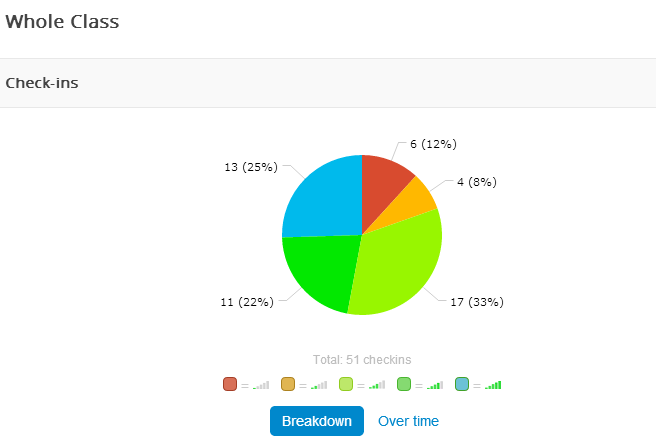
Teachers prepare a lesson, topics, and questions (mostly in advance) and students "check in" and provide answers and self-assessments as the lessons progresses.  During the lesson, students can change their assessment about the topic and material, and teachers can monitor the class' progress.

Teacher perspective, lesson & question planning


One great thing about the advance preparation is that it really makes me think of the questions I want to ask in class.  (And now, I know I want a variety of Mastery, Understanding, Self-Expressive, and Interpersonal questions.)


Teacher perspective, topic addressed and student feedback


Once you start the lesson, you ask a question and give students an opportunity to check-in.  I created this lesson in May, but I didn't get a chance to use it with my classes, so I used myself as a student to get these screen shots.


I used my iPad and the geddit app for students to demonstrate the student responses.

Student perspective, answered question and check-ins


Student perspective, topics addressed and check-ins

Student perspective, changing self assessment from low to high
Student perspective, hand raised


During class, you can quickly assess how your students are doing, based on their self-assessments.


After the lesson ends, you get all kinds of reports and data of all of the students' responses, including how many times students checked-in, who specifically might be struggling, and their questions, responses, and any comments to you.


It was also easy to upload pictures to use as part of the lesson or a "quiz."  For this image, I used my iPad and a note-taking app, took a screen shot, and opened geddit on my iPad to upload the image.


Teacher considerations: as I mentioned earlier, this resource requires quite a bit of pre-planning and work on your end, but I want to prepare my questions in advance, so that's good!  (You also have the option of a "quick question," so it doesn't all have to be advanced work.)  You now have the option of stopping and resuming a lesson, so you can prepare work that spans several days to get ongoing assessments from your students, so that's a plus.

One other issue: I like to write notes using my iPad, but I needed to see the student feedback, so I needed two devices to make this work for me.  Since I am a floater teacher, it was a bit of a pain to lug around an extra device, and I had to figure out in each room how to set up my space to be able to see the students' responses as we moved through the lesson.

Another good thing: taking time to stop and assess was a great reminder to "chunk" information and to slow down to allow students time to process.  I think I'll have a student volunteer be my geddit assistant--someone who stops me and reminds the class to check-in. 

Classroom management considerations: our school is BYOD, and I have a few iPads to use during class, but this resource is definitely an individual student response system.  With some of the other apps, I allow students to work in pairs or with tables, but for geddit, I wanted individual assessments, so I wanted everyone to have a device.  

Students must log in and join your class, so there are always the "I can't remember my password" issues, plus the "I can't get on the network" kind of days.  Because I expected students to have logins to several websites and apps, I plan to have them create some kind of reminder (a Google doc, perhaps?) with all of their passwords listed.

I started using geddit prior to spring break, and students were always itching to be on their device.  I think for next year, I will have the stipulation that if I see your device out, I must see multiple check-ins throughout the class.  If you're not checking in (and using your device for educational purposes, such as formative assessments) I'll pick up your device!

I think if I start using geddit at the beginning of the year, and if we work out all of the classroom management issues, this resource will be a terrific addition for my class and for my quest for ongoing formative assessments.  The developers continue to update the program, and they are quick to respond to any questions.  The students found the app easy to use, and once they got over their silliness of comments and of virtually raising their hands, they appreciated the feedback.

Has anyone else used geddit?  Any other suggestions for class management and questioning issues?  Features that you love?
Share:

Flexible Grouping, Flexible Teaching!

On my journey to differentiated instruction, I know one non-negotiable of DI is strategic flexible grouping. During the past few years, I have worked diligently on grouping my students, but I know I need to improve the strategic part of my grouping process. 

(By the way, I use the "Touch Blur" app to blur students' faces.)
I also learned that differentiation doesn't always mean group work, nor does it mean that groups are based solely on ability levels.  Some lessons require "whole group" instruction, and then we can move into individual, partner, or small group work as necessary.

Types of Groups:
And groups may be based on...
Whole Class
Readiness
Small Groups
Interest
Pairs
Similar Learning Profiles
Individual Work
Random Selection

Choice

In addition, I learned you must establish a community in your classroom to make the different groups most effective. Students must be willing to talk with each other, take risks together, and know how to truly collaborate on their work.  To help with the community building in class, as soon as I change my groups, I ask students to introduce themselves and answer a question that requires collaboration.  (Rate yourself from 1-10 on how you're feeling today, and average all of your ratings.  Come to a consensus about the best thing to eat in the cafeteria.)  I love Sarah's idea for establishing group norms, and you can download her posters from her blog.  And finally, let's not forgot about the classroom management aspect of the group process. When working on building community and flexible grouping, it's so important to have those procedures in place about moving desks, turning in work, getting materials, ...


To help students understand that grouping is a norm in our class, at the beginning of last year (and I will repeat) we did a quick "line up" activity.  I had huge classes, so the students actually remained seated, but I participated, too. I projected the list shown here, and we went through the items one by one. It is more effective when you can demonstrate a line up and have your kids move from one end of the spectrum to the other, but they got the point by their self-assessments. After we went through the entire list, I asked questions such as who had a chance to rate themselves as a 4 or 5?  And who rated themselves a 1 or 2 at least once?   The final reflection: in our class this year, there will be times when you will be an expert and times when you will be a novice. You may sometimes be grouped with like team members, but sometimes, I will want you to "stretch," and you may be grouped outside of your comfort zone.  (Here's an opportunity to share a bit about making mistakes, grit, and growth mindset!)


The line-up activity is great for establishing the understanding of groups based on readiness, but since I'm on a quest this year to group by learning profile, I think (hope!) it will work for the idea of any changing groups.

Unfortunately, I only strategically grouped a few times last year, but it was a great victory for me when a student walked in and asked, "Do you want us to sit in our CAP groups or our random groups?"  So at least I'm getting the grouping thing down a bit better.  Another bit of great feedback--an end of year note included the comment, "I learned to collaborate with my peers, some of whom I had never talked to before."

Unsolicited advice: if you want to start changing up your class, try random groups, but make certain you include the aspects of community, group norms, and class procedures.  If  you're looking for ways to try random grouping, there are so many available resources.  Our science teachers recommended this site to create random groups, and I found a collection of sites to create groups here. On this post, Beth at Algebra's Friend also suggested Super Teacher Tools to generate groups, and this site provides no-tech options for grouping students.

So now I have the grouping component ready to try again, and I really want to focus on differentiating by learning profile...next steps: put the two together and work on specific lesson components!


Any suggestions for creating a community of learners in your classroom?  How do you create groups?
Share:

Planning Ahead with Learning Profiles

Based on this #eduread and after exploring my new book Math Toolshere's a very tiny bit of what I have so far for week one of school.  (Eeek, it's only early July!)

Since in the first week we will be in the getting to know you stage, I'm opting for a very quick assessment to determine students' learning profiles as Mastery, Understanding, Self-Expressive, and Interpersonal.  At my recent ASCD conference, the presenter used these images to analyze our style as instructional coaches, and the simple images created such rich discussions, so I hope that will happen in our class, too...but since it's week one, I may be overly optimistic!  


I'll show them this slide, have them share out a few ideas, discuss a few more specifics from this document, and have students record their responses on this Google form so that I will have a record of their preferences.  I plan to seat students according to this learning preference during the first couple weeks of school.


I teach pre-calculus, and we start our year using a unit circle approach to trigonometry.  I looked over my unit objectives, and I knew in the past, my students really struggled with understanding coterminal angles, determining which quadrant an angle lies, finding reference angles, and (when it's first introduced) finding exact trig values using the unit circle...so that's where I wanted to start my differentiation. (I know differentiation is a proactive approach to teaching. I already know where kids will struggle, so I need to plan ahead to anticipate their difficulties.)


For today's post, I am just sharing one small formative assessment idea, but it's a start, and I bet it will get easier as I keep practicing.  (#growthmindset!)  After receiving my Math Tools book, I skimmed through the ideas and jotted down the ones that I already used or the ones that appealed to me.  The book provides tools for each category of Mastery, Understanding, Interpersonal, and Self-Expressive, and the final chapter uses a combination of all four of the learning profiles.

Because I know the kids usually struggle with coterminal angles, I want a more thorough check for understanding after that lesson.  For the last 5-7 minutes of class, I plan to use these questions as an exit ticket.  Students will choose the one question that appeals to their learning profile and turn in their responses for me to check and plan for the next lesson.  If students finish early, they may try another question, or they may share their responses with their group members.  For this assessment, I want to see their level of understanding of coterminal angles and learn where they are still struggling.
Since this will be our first "experiment" with these learning profiles, I will make certain we have time to reflect about the students' choices of question and how I will use their work to inform my teaching decisions.  I want the students to be comfortable with their first groups, we'll be practicing procedures, and the first week is so hectic, so I think this will be a safe formal assessment.

It took me less time to create this small assessment than to write this blog post, so I am hopeful that I will be able to eventually have a collection of questions, assessments, and tasks...but for now, I'm starting with asking where do the kids struggle, and what I can I do to check their level of understanding and deepen their level of understanding.  If I can start by creating two-three "things" per unit, I'll be a happy camper.


Update:  I knew I rarely included Self-Expressive type tasks, so I wanted to focus on creating those types of questions.  Going back to Math Tools, I wrote these questions to use at some point during the unit.


Have you found ways to incorporate these learning profiles into your lessons?  What do you think?
Share:

#tlap GPS

Last summer, I loved reading Dave Burgess' Teach Like a Pirate, and I keep re-reading parts of it to get re-inspired.  Earlier this summer, he issued a "challenge" for teachers to create their own personal GPS, and I've spent a couple weeks tweaking my words.  (I love this idea so much that we're even adding it to our agenda for our new teachers!  Can I do so same thing for my classes and my students?)  

I'm trying to think about my job as a teacher and as an Instructional Specialist, and as of today, I think I have my words.

By the end of the year, I want others (students and teachers) to feel...
  • safe,
  • inspired,
  • challenged, and
  • accomplished,
  • all in a manner that is different from other classes or meetings.

This activity also reminds me of one of my favorite end of year assignment, which is to have my students create Six Word Memoirs, an idea I took from Math Teacher Mambo.  I haven't compiled all of my pictures from this year, but their work was even more creative.  I created my first six word memoir while actively monitoring an AP test, and I think it captures both my math teacher job and Instructional Specialist job: 
I love to help find solutions. 

Did you participate in the #tlap GPS?   Do you have your students write goals for the year?
Share:

So, What Exactly Is My Job?

I have enjoyed reading all of the posts about favorite classroom things and classroom structures...so that made me think: what is the "structure" of my job?  Next year, I will have a new job partner, a new head principal, and our district has completely restructured the upper echelon, so I thought it would be wise to pinpoint a few things, just in case anyone else asked about my job. ;)


My job title is "Instructional Specialist," and my job description in one sentence is that I spend my time supporting teachers and students as we work to fulfill school and district goals.  (Oh, I also teach two math classes.)  I have no administrative power, but I'm involved in a lot of school stuff, so I do have quite a bit of influence in campus decisions.  The IS job looks different on each campus, based on each school's priorities.

Last year, my IS partner and I decided we needed more focus for our jobs, so we posted a list of our priorities.  When people started asking about this or that, we asked, "Is that on our yellow sheet?" and it made it a bit easier to say "NO, I don't think we can do that." (I admit we often stretched a lot of our job responsibilities to fit categories on the yellow sheet!)


My schedule is very erratic each week.  I attend PLC (common planning) meetings for math and social studies.  I work with new teachers, I support our mentor teachers, and I pretty much am "on call" for any teacher who needs help...with lessons, tutoring plans, technology, classroom management, group work, intervention plans, testing...  We plan our site-based staff development, and we plan all meetings and professional development for our new teachers. I write and monitor our Campus Improvement Plan, plan all of our Instructional Leadership Team meetings, and visit as many classrooms as possible.  After reading Simon Sinek, we created a WHY for the Instructional Specialists, which is "Every day, make someone's life better," so bottom line, we look for ways we can help others.  (For a second WHY, we also borrowed Home Depot's motto: "You can do it, we can help!")


When I started my job as IS, the best information I received was "Your time is not your own," and that is absolutely true, although I usually have free time between 7:00 - 7:25 AM. ;) Our office is very centrally located in the building, and we have one of our test scan machines in our office, so our office door is always open, and I'm glad we have cultivated the feeling of trust and belonging in our office.  We host planning meetings and informal meetings in our office.  Teachers seem to love being in here (but that could also be because we have a few super comfy chairs and a coffee pot!)


Because I float and do not have a classroom, I frequently have tutoring in my office.  I have seating for about 12 in the office, and my students seem to enjoy hanging out in here as much as the teachers do.


Last year, I followed the trend on Pinterest, and created the door signs for our office door.  These signs made me happy every time I entered.  

My other office favorite is my collection of college pennants, donated by some of my former graduates.


Fun times on my job: last year for our new teacher in-service on campus, we had the cutest set-up, complete with a decorated classroom, personalized magnets, and breakfast.  At 8:00 AM, we decided the air-conditioning was definitely not working (and we're talking about August in Texas) so we ran around the building to find another suitable room for our supplies and 25 new teachers (but missing the cute set-up!) :(

A "real" fun part of the job: we're told, "Make certain that you do something to honor your mentor teachers!" so in some cases, we get to be party planners. :)


My creative talents were also put to the test when the district wanted schools to create technology-themed centerpieces for their Summer Leadership Meetings...and guess who was assigned to create that centerpiece?  Of course, the ISs will enjoy doing that!   (We did win 3rd place, which got us the new coffee pot, one of the office favorites, though!)


Oh yes, we need a two-minute video of what your school is doing to implement differentiated instruction.  Show what you've done and your plan for the future, and it must be in iMovie format, and it's due in three days... who does this on our campus?   (I loved learning how to use iMovie, though.)  


During my first year as an IS, one of the most challenging aspects of my job was that I allowed my instructional specialist responsibilities to creep into my classroom.  Teachers would stop by during class and ask questions, I would check email during class and learn that someone needed something now, and I tried to address all issues at all times.  The last few years, I promised my students that during our class period, I would be completely devoted to them.   I try to warn them when my IS job schedule interferes with the week (and limits tutoring, for example) but I communicate with my students via my website or email, and my math colleagues jump in to help with tutoring and make-ups.

At times, I really miss my own classroom and a schedule full of math classes; however, I love my job supporting teachers and students.   I enjoy working with and learning about other content areas, and I love the professional development side of my job. Side note: according to my FitBit, I average about 7,000 steps a day while at school, but in May during testing season (EOC tests and I proctored a bunch of AP tests) I got about 11,000 steps per day.  As with all teachers, I love that my job changes daily. Flexibility is always the key, right? I have learned so much on this job, and I have appreciated all of the new learning and growing opportunities.

Are there instructional coaches on your campus?  What are their job descriptions?
Share:

My Motivation to MoveIt!


I just saw this post on Teacher Tech, and MOVEIT is now my new favorite Chrome extension!  During the past week, I have spent way too much time sitting at my computer, and this extension reminds me to jump up and get moving.  You may choose an interval of time (15 minutes to 55 minutes) and at your chosen interval, you get a pop-up reminder on your computer to take a short brain and exercise break.  


The exercise breaks have been things like hop on your left and then right foot for 15 seconds, jab or punch the air for a count of 10, run in place for 15 seconds, and touch your left foot with your right hand, then alternate and repeat 10 times.  

When I have been on long grading stretches, I have tried the "Pomodoro Technique," where if you work for 25 minutes and then take a brief break, you supposedly increase your productivity.  (It seems to work for me!)  I love the addition of the bit of physical exercise, which the MOVEIT extension provides.

With students, we hear about the 10/2 strategy, which encourages us to teach in chunks of 10 minutes, and then allow students to process and reflect for 2 minutes.  I started using this strategy with my ESL students, but now I try to allow chunk and process time in my classes and in my staff development presentations.

I've just had the MOVEIT extension installed for a few hours, and I have enjoyed every little opportunity to get moving.  I wonder if I could incorporate the quick exercise breaks into our long days of staff development?  Does anyone else have moving breaks during professional development?

Time to get moving!
Share:

What I WANT to Know About Learners

As I mentioned on an earlier post, I am now obsessed with the idea of differentiating by learning profile.  I know I have a good understanding of what learning profile really means, but now I'm to the more difficult implementation stage.  I'm happy that I found a colleague who will help me fine tune some of these ideas, and I have found an overwhelming amount of information online to help with this part of the journey.

What I WANT to know (and do)... 
From a teacher's perspective, I want to know how to vary my questions, tasks, and assignments in order to address the variety of learning profiles in my classes.  I'm still at the point where I'm thinking about a giant juggling routine, but I want to make this more manageable: how to group my students, how to ask questions, how to get students to ask questions, and how to create thoughtful assignments and assessments.
  • I found this awesome reflection after our #eduread.  @mwbigger classified different types of assignments and assessments according to their Silver-Strong profile.  He also referred to Sarah's post about 26 good homework ideas.  For some homework assignments, I would love to keep a generic list of possibilities from each of the learning profiles and allow the students to choose their favorite (or maybe one from their style, one from another style?).
From the free preview chapter of the Math Tools book, I found this chart, and I know that will help when I'm designing the work.


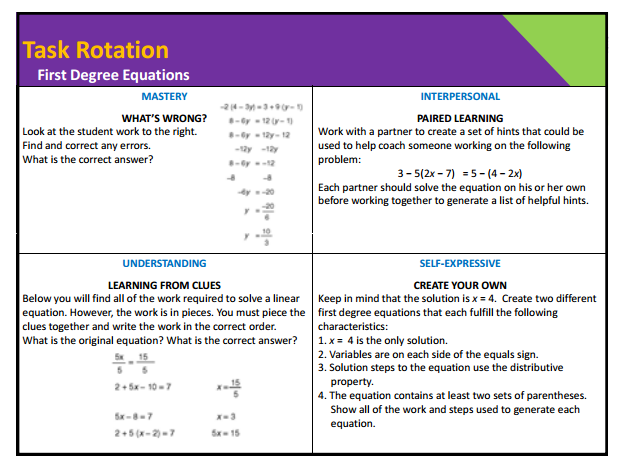
I keep reading about Task Rotations, and I think I could start by creating something like this to use on our "bring it all together" or review days.  The difference between the task rotations and menus is that for the task rotations, you must complete all 4 tasks, and each task intentionally addresses one of the four Silver-Strong learning styles (mastery, understanding, self-expressive, interpersonal).  I found this example on a page of Thoughtful Classrooms' free resources:


A "low prep" idea: I plan to use the vocabulary for each of the profiles, so I could ask my students to identify the types of questions I ask during class.  If they're seated with their like profile groups, I could ask them to change my question to one that "fits" their profile (or make up an additional question, if my question matches their profile).  To stretch themselves, they could exchange questions with another group and answer at least one question from each category.

I hope each week that I'll say things like, "The next part of class will appeal to those of you who are interpersonal learners; otherwise, you'll have an opportunity to stretch outside your comfort zone a bit," or "If you have a self-expressive learner in your group, then s/he will be able to help you think outside of the box for this activity."

Next steps...I'm ready to look at my own calendar, assessments, and lessons!

Any examples of task rotations for math?  Have you grouped your students based on different learning profiles?

Share:

What I KNOW About Learners

OK, thanks to an earlier #eduread, I am now officially obsessed with teaching and differentiating by understanding learning profiles.  I feel like I'm a bit late to this party, and I found so many resources that I finally had to force myself to stop reading, bookmarking, clipping, and flipping articles and posts.  I also had to restrain myself with additional purchases, but I finally settled on one more book, Math Tools, Grades 3 - 12... by Silver et al.

I was thinking about a KWL chart for differentiation by learning profile, and for now, I have a lot of Ks and Ws!

I KNOW that differentiating by learning profile increases efficiency.
I know I have a better understanding of what it looks like to differentiate by readiness or interest (but just because I know what it means doesn't mean that I'm an expert!)
When I first started teaching (ahem...years ago) I thought learning style simply meant auditory, visual, kinesthetic, but now I know that a complete learning profile involves so much more.

During the past two years, my students and I have dabbled with understanding Gardner's Multiple Intelligences and Sternberg's Intelligences (creative, analytical, and practical).  Our  #eduread article introduced me to the Silver-Strong profiles (mastery, understanding, self-expressive, and interpersonal). And hooray, hooray, I just found an older ASCD article and then an image on this slide-share that put everything together for me!


I know I need to educate my students about the different profiles, that the styles fluctuate depending on the context, and that no one profile is better than another!
  • Idea for the first week(s) of school: give students a variety of inventories, have them create a learning profile a la the "Me at a Glance" pages on Sarah's blog.  For the Silver-Strong inventory, I found this post on Math Hombre's page, and he adapted the inventory to math. Teach the vocabulary.  Help students understand the philosophy of strategic flexible grouping.  (Some days we'll be grouped according to your strengths, and some days we'll make you work outside your comfort zone so that you'll be stretched!)  Work on the management aspect of how to let kids know the seating arrangement o' the day.  Create a Google form for students to record their preferred learning profiles.  
  • Oh, I also know that mindset will be part of this conversation, too.  If we're grouping kiddos or if the questioning/task is outside of their preferred learning profile, what can I do to help students persevere? What are their options when they struggle? 
  • I know that building a classroom community is an integral component of the big picture of differentiation, so with our discussion of learning profiles, I will also help students learn the importance of respecting the differences in all of us.
Unfortunately, I have absolutely no tangibles...YET...but at least I have a nebulous idea for the "2nd curriculum" objectives for the first week(s) of school.

A future post will focus on the WHAT.  What I want to know, my goals for the teaching, questioning, and assessing aspect of this idea.

Thanks for reading!  Any other insight on learning profiles?  Do you have favorite inventories that you have used?  
Share: