Learning About Learning


During the past few months, I have been reflecting a lot about documenting learning and how technology can help with that process. For several years, I have been interested in using formative assessments to make instructional decisions, and I know there are connections between the two, so now, I'm reflecting on this year's experiences and trying to put all of these learning-pieces together.

My Knowledge Base

John Hattie's work and his three feedback questions helped me solidify understandings about effective feedback and how/where to infuse feedback into the learning process. In The Google Infused Classroom, Holly Clark and Tanya Avrith share related ideas when they discuss assessment for/as/of learning. In their book, they also provide ways to make thinking visible and discuss how technology can amplify the learning process, and they reference the Project Zero Thinking Routines. The work from Silvia Tolisano and these posts have also inspired a lot of reflections on documenting for/as/of learning. (Silvia also creates fabulous graphics and sketch notes, and I'm looking forward to her upcoming book.) All of these thoughts about learning, feedback, and thinking routines are swirling in my head!

Blending Ideas

Holly and Tanya include a lot of ways to use technology to make thinking visible, so I'm going to try to do the same. I work with adult learners, but I'll begin with some of the strategies I used in my classroom. By the way, one big eye-opener in their book was the importance of learning from others to shift thinking. It's OK to have "public" posts for all to see, and that is definitely a shift in my thinking. Yes, some kids may copy answers, but others may think, "Oh, that's what she meant!" and formulate their own responses.

See-Think-Wonder

One of the first thinking strategies I tried was "What do you notice, and what do you wonder?" We even tried this idea with trigonometry vocabulary words on day 1 to illustrate that a lot of pre-calculus would be based on concepts you already know! (Trying to activate prior knowledge.)

Here's a description of the See-Think-Wonder routine, and here's an example of the routine being used in a health class. I always used the "Notice and Wonder" questions, but I like the structure of See-Think-Wonder, so I'm going to add the third question when I use this routine now.

When I tried this activity in class, I only had students share responses with each other and then "popcorn" out a few answers. In the video linked above, the teacher created a graphic organizer for his students, used think-pair-share for students to compare their responses, and then had a final debrief with a show of hands.

Options with technology...

Instead of simply observing an image, listing a few see/think/wonder statements, and sharing with a neighbor, how could technology be used to amplify this process?
  • You could use comments in Google Docs, and I have used this notice-wonder activity in my sessions. Students could choose their preferred image, and they could reply to each other's comments. 
  • You could use a Padlet board to collect comments from each student, and with the new "shelf" option in Padlet, you can create the see-think-wonder prompts as columns.
  • If you didn't want the kids to see each others' responses, you could use Google Drawings to create a graphic organizer and share as a template in Google Classroom (or "force" a copy for each individual.)
  • Another option if you wanted individual responses: you could use a Google Form to collect all responses.

I can see benefits to both the individual and shared responses...it all depends on the activity. BUT by using technology, you have amplified the process because you are able to hear from every student ("Even the quietest student has a voice!"), responses are documented, and if students can see all of the work, they can learn from and provide feedback to each other.

And with adult learners?

My friend Katie recently used Mentimeter for a faculty poll, and the responses are below.

I think the See-Think-Wonder strategy would be an excellent debrief after this type of activity, and I think it would help educators understand how technology could amplify the learning/feedback process. A few things I hope the participants would see, think, and wonder:

  • There were 184 entries, so the entire faculty had a chance to respond.
  • How long would it take for you to go around the tables and ask 184 people to answer the question?
  • The most common responses/trends are evident. (The largest words received more responses.)
  • How long would it take to see trends if responses were on post-its or slips of paper?
  • If you couldn't immediately think of a response, you could see what others said to give you ideas.
  • How could this tool/strategy be used with your class or team? What are the benefits? What are the drawbacks?
After working on this post today, the ideas are still swirling in my head, but I really like the idea of taking visible thinking routines and looking at tech-options. I firmly believe that you don't use technology for the sake of the bells-and-whistles, but I feel, at least in this case, the use of technology really could amplify the learning/feedback process.

What are your favorite thinking routines? I would love to see if technology could facilitate the process!
Share:

Keep Up with Reading!

I have always loved reading, and I constantly add new books to my shelves (and Kindle app); however, I am still working on ways to take notes while reading to keep up with favorite passages, quotes, and ideas.

In the past year, I have...

  • annotated passage within the book,
  • written paper notes/post-its to stick on the book,
  • created #booksnaps
  • tried #sketchnoting the books on the iPad, and
  • tried #sketchnoting the book using a Rocket book

For my next attempt at keeping up with my reading, I'm trying Google Keep for my book notes, and so far, I love my new system! Keep is a digital post-it note app within G Suite. Because it's part of the Google family, it includes a powerful search feature and the ability to add collaborators to the notes. Furthermore, notes sync between devices.

As I start a new book, I take a picture of the cover to add to my Keep header. Next, I add a few labels (including "books") based on the subject. 

What's on my shelf now...

As I read, I  take notes on any available device, so that's one huge plus. I also pin current books to the top of my Google Keep, and that's a visible reminder to keep reading. Because my "pack" of notes continues to grow, I am thankful for the search feature, and I have become much better about fine-tuning the names of my labels. I have not (YET) created a color-coding system for my books, but that could be the next possibility. I can add reminders and alerts, and from a mobile device, I can even start a new note by recording a message.

The other part of this workflow that is a bonus for me is that I can now easily access my Keep notes within a Google Doc. Most of these books are for work, of course, so as I'm planning a session, I can open a relevant book in Keep, and add those quotes and notations directly into my Google Doc! I am getting so much better at adding page numbers to my notes, so it's incredibly easy to copy, paste, and create the book citations as I plan for upcoming PD sessions.


By the way, The New Pillars of Modern Teaching has been my favorite edu-read from the past year, and I think I documented my reading in every other way mentioned above! I may need to go back and take notes in Google Keep!


Do you have a tried-and-true way of taking notes about books?

I'm so happy when I'm reading, and I'm always up for learning!
Share:

Joy Bots!

Don't you love it when you're inspired by a single sentence? I was scrolling through Twitter during a session lunch break, and this Tweet caught my eye:

Lilly works in a nearby district, and she has an awesome after school program called "Gadget Girls," where she works to encourage elementary girls with STEAM related projects. Her Tweet and the search for @botjoy inspired a fun summer creativity project, and I can't wait to share it with others!

The "bots" are actually hand-painted dominoes, and the idea is to pass along the bot to someone who needs a little physical reminder of joy, love, confidence, etc. The artist, Gary Hirsch, also leaves his Bots in the world for others to find, and he has instructions for how to "program" and activate your Bot on botjoy.com.

There are Joy Bots, which are programmed to bring you instant joy and outrageous compliments; Love Bots love you unconditionally, and there are Brave Bots, Idea Bots, Collaboration Bots...you name it! The project ideas on the website are perfect for school groups, community service projects, and others who want to create and share. In this video, Gary explains his project, and the only supplies you need are white dominos, oil-based markers, and a quick polyurethane coat for protection.


I am not an artist, but I keep reading about the importance of creating and making, so I love this idea as a #growthmindset project. I knew someone at work who would jump on this project too (and she is an artist!) so the first #R10bots have been deployed, and more will be activated soon. :)
One person at this meetup taught 5th grade, and she was so excited about the Bots! She plans to have her students create Bots and then write their stories. Others at our #CoffeeEDU loved the idea so much that we're meeting next week to create Bots together.

I gave away a few Bots during a recent session (for the winning team during a quick contest) and the teachers were thrilled! For the rest of the summer, I will be in and out of various classrooms, so I plan to leave a Bot and card as a thank you note for the use of a room.
Gary Hirsch's 2013 TED talk explains how the Bots were born, and his story is all about collaboration, so it's a wonderful message for everyone.


Have you heard about Joy Bots? Is this a project that your students or teachers would enjoy?

I'm inspired to create, and I'm always learning.
Share:

Inspired by ISTE

This week marks my 2-year anniversary at my "new" job, and I continue to learn, grow, and connect, thanks in part to opportunities provided by my work. Attending last week's ISTE conference was one awesome job perk, and what an incredible learning experience! I attended ISTE last year too, but this year, I tried to be better prepared.

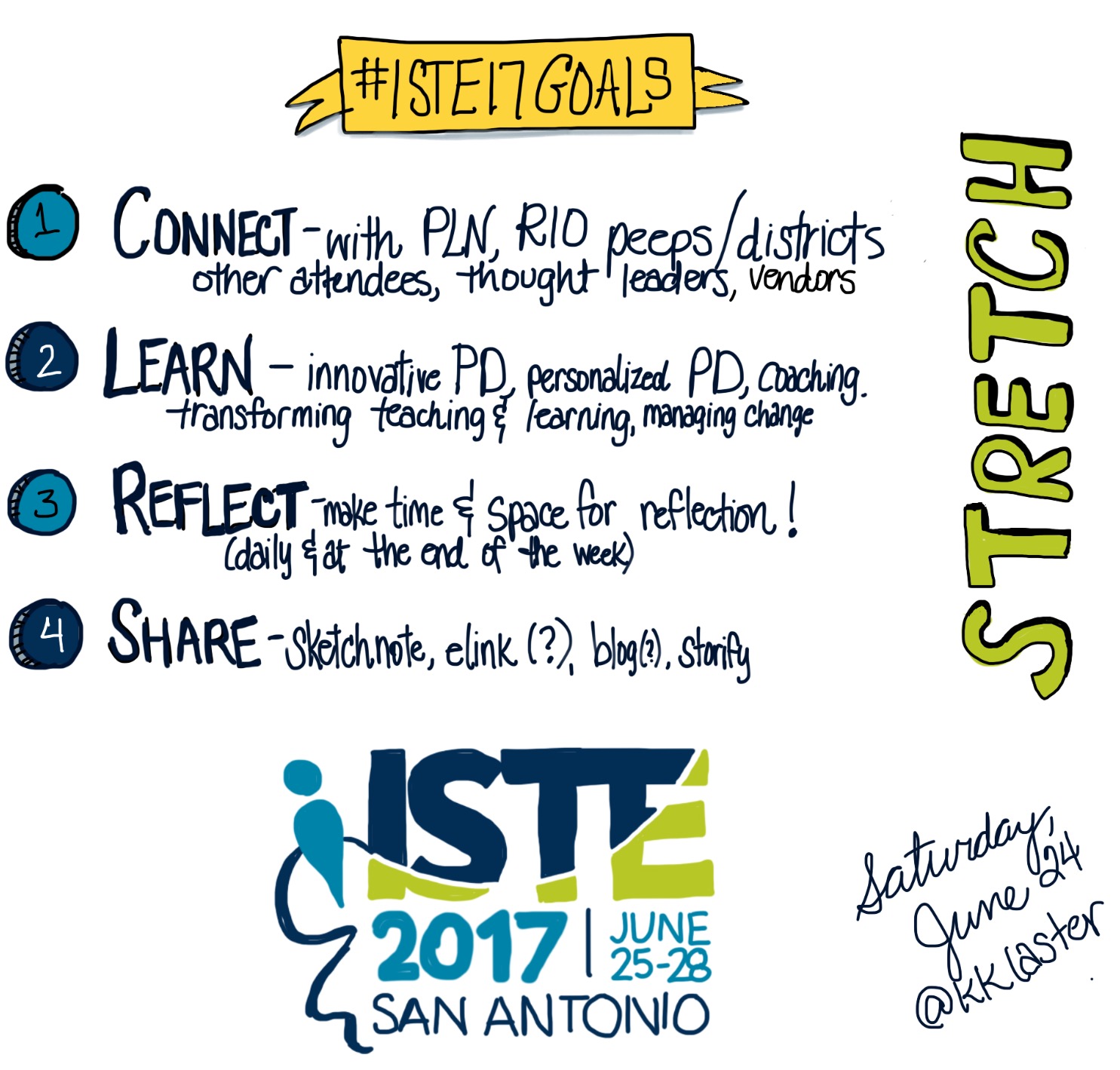
Inspired by advice on Twitter and blogs, I created a few ISTE goals and even sketchnoted my priorities:

I feel I really succeeded at goal #1, and I've decided connections and collaboration will be a priority as I begin year 3 on my job. I know (especially) at tech-focused events, participants are often engrossed in their devices, so at this conference, I was determined to be intentional about striking up conversations, really listening to people, and looking for ways to connect with others. (Such a stretch for me, but it was only for 3 days!) Since ISTE was held in San Antonio, which was a tiny flight or a manageable drive from DFW, I kept running into people from our region, which was so fun! And when I started asking what people were learning and really listening to what they were looking for, I started making connections and started thinking about building bridges, like these...


The past several months, I worked to connect departments and to breach a few silos in the office. It's now time for me to move beyond the workplace and be on the lookout for building those bridges across the region. "You're rural district X and you're just getting into Google? Let me connect you with some leaders in a similar district Y, and they just finished their first year of implementation..." "You're starting a district-wide digital citizenship plan? Let me introduce you to Z who is doing the same thing!" With two years of meeting people and working with more districts and teams, making connections should be a priority!

Bottom line, it always goes back to building relationships, doesn't it?!

Always learning.
Share:

Happy to be Blogging (Again!)

After a lengthy absence from the blogging world, I'm making attempt number ?? to return. Inspired this summer by conference keynotes, other bloggers, and my own desire to be a more reflective educator, I thought I would try, try again.

I started the alphabet journey in 2015, and it's a happy coincidence that I'm at letter H because this week I have the privilege of attending #ISTE17, and I know I can create a post for letter I.

During one of my sessions in Dallas ISD this week, a teacher shared this nugget (thanks, Ed!) and I thought it was an awesome school policy. Would this procedure work for your campus?


As we were reflecting on the day's learning, a few participants expressed some hesitation to try new strategies/tools, mainly because of the stress of an evaluation or an unexpected walk-through. Ed shared his agreement with his principal to have a sign on his door that said, "Teacher Learning in Progress," or "Technical Learning in Progress," which indicated he was trying something new. The administrator was welcome to observe and learn, but that class period would not be used as an evaluation. I love this idea, and what a wonderful way to nurture a culture of #growthmindset. (Actually, I'm sad that some of our schools do not establish a culture of risk-taking and failing forward...but that's another conversation.)

I also simply love the phrase Teacher Learning in Progress because that's what our journey is all about, right? When I started this blog several years ago, my focus was math, and I taught calculus at the time, so the "No Limits on Learning" title was fun (for math nerds) and appropriate, but I love how the blog title is still a perfect fit today.

My learning is definitely in progress!
Share:

Going to a Conference!


Letter G in my #ReflectiveTeacher journey...

Last week, I found this blog post from Imagine Easy Solutions that encouraged educators to blog during their conference sessions...but I forgot about it until now, so I will start tomorrow. I didn't arrive in Austin until almost noon today, and I only attended a couple sessions, so perhaps an end-of-day reflection is OK for today!


Take-Aways:

  • #TCEA16 will probably trend all week. I was almost overwhelmed yesterday (before I even arrived at the conference) trying to keep up with the flood of ideas, posts, and resources. Following giant conference hashtags is now at the top of my to-do list. I can't believe how much I'm learning through Twitter.
  • TCEA organizers have their conference down to a fine science, and I appreciate all of the time and work it must take to pull off an event of this magnitude! Check-in was a breeze, the conference app is constantly updated, and there are signs, marquees, and volunteers everywhere, so my questions are already answered!
  • Presenters: thank you for providing access to your handouts! If we cannot get into your session, your notes, sites, or presentations are giant birthday gifts, waiting to be unwrapped and explored. (I just need more time to look at the 500+ links!)
  • It is hard to attend a ginormous conference by yourself. This year is so much better, though, because I have made so many connections during my time at my new job, so I keep running into people I know (or who know me!) Whether it's in the hallway or in the fast-moving Twitter stream, it's awesome to be a bit more connected this year. 
  • ...but attending a ginormous conference can also be overwhelming, so quiet time at the end of the day is a must for me!
  • I didn't put in a proposal to present this year, and I kind of miss presenting, but I must admit, it is more relaxing to "just" be a learner and participant.
  • At a technology conference, so many people are glued to their devices, so I always appreciate when the presenter prompts us to "turn to your neighbor and share..." In my opinion, one of the best parts of a conference is making connections, and that's a bit difficult when you're constantly looking at a screen.
  • I am such a math-person (linear, concrete-sequential, etc.) and I have planned PD sessions for many years, so I prefer presentations that are super-organized, purposeful, and thoughtful. Your slides don't have to be designed by a graphic artist, but please follow some kind of outline, provide an essential question, or explain the session goals.
  • I caught a Google Hangout (on Air) reflection session from one of our district partners, and I thought that was an awesome way to end the day! The tech leader had several of his teachers tell one or two of their favorite take-aways from the day, and it looks like he plans to follow this model all week. How awesome is that, to model the tool, get the teachers reflecting, and document their learning!?
In other news, I helped moderate the very first Twitter chat for our service center, so that was an accomplishment for the evening. I worked with a science consultant, and we have the next several months of topics planned. (#R10chat) It was a small group, but we know we had lurkers and a few who were new to Twitter, so to get more people excited about connecting is exciting!

Looking forward to another day at #TCEA16.
Always learning.
Share:

Formative Assessment Goodness

Several years ago, I started to up my formative assessment "game," so I wanted to share a few things I learned. I slowed a bit on my alphabet journey for #ReflectiveTeacher, but I'm back on track with formative assessments.

One of the key components of differentiated instruction is continual assessment "that informs teaching and learning," and I have written several posts about DI and assessment. During our DI trainings, one of my favorite analogies about assessment is the medical one:
Summative assessments are like autoposies, and formative assessments are wellness check-ups.
If I start assessing my students' learning on the day of the major test, then I am too late. I need to conduct frequent formative assessments throughout the class/day/unit, and adjust my teaching as a result of these check-ups.

The other big point (that only took a year or so to get) is the last part of the previous sentence: adjust my teaching. Oh yes, I jumped in on the exit ticket bandwagon, but sadly, I didn't always look at the students' responses until days after the assessment. [sad face!] That was too late! I needed to immediately take actions on the students' questions, comments, and (mis)understandings.

I love that technology helps with the efficiency of these quick formative assessments. Whether it's a Google form, a game-based tool (like Kahoot) or a more low-tech tool like Plickers, these resources make it so quick for teachers to get real-time results and feedback on their students' learning. I found this great blog post by @mpilakow, who created a very informative chart to compare several student-response systems.


One of my new favorite tools on the scene is Formative. As a math teacher with a few iPads and smart phones, this tool was an awesome addition to the growing list of student-response systems. I LOVE that students can respond by writing their responses to show all of their work on the screen! I LOVE that I can import an image of a coordinate plane and have students graph their answers on the grid! When I've demonstrated this tool to teachers, they have all oohed and ahhed about its functionality.

Because of the positive responses from so many teachers, I created a short how-to video about using Formative, and it illustrates writing a question and responding. (Their playlist of videos is excellent, by the way!)


My favorite non-tech tool is the good ol' hand gesture fist-to-five strategy. "If you have no idea what I'm talking about, show me a fist. If you could teach this concept to another person, show me a five." I can't remember where I heard the tweak of 5 = teach to another person, but that really helps make the distinction about giving yourself a five.


I could tell this strategy became the norm in our class when students started using phrases such as, "I'm only feeling about a three on this concept, so can I come see you for tutoring in the morning?" During class when I started having "workshops" (small tutoring groups) on a particular concept, I let the students know, "If you feel like you're still a two or three on this objective, I'll be at the table in the back of the room in 10 minutes to answer your questions."

This strategy works with adults too, and I ask the same type of question on a pre-assessment or as an intro to the session. In Google Forms, I can use the linear scale question type, or I revert to the hand gestures, just like with the students.

At the end of class (or a presentation for teachers) I ask students to reflect: "If you felt like you were a fist or one at the beginning of class, did you move to at least a three? If you were a three when we started, are you now a four?"

If you're really into assessments and use Flipboard, I've curated an entire magazine on Assessments, and I share my favorite blog posts, tools, and other resources.

View my Flipboard Magazine.

So now on the more reflective side: I hesitated to write this post (guess that's why there was such a delay) because there are so many great things already written about formative assessments and feedback, whether you want to know the brain research, the strategies that impact learning, or the newest tech tools to help...so what does this post add to the plethora of information already out there?

I know, I know...blogging should be about reflecting, learning, and growing as an educator, and writing this post certainly helped with that idea. Now when I'm training teachers, I will go into a tad more depth about the purpose of the pre-assessment, the first-to-five, and any other assessment we try during the session. Make the strategies more transparent. Good lesson for me.

The other good thought: I work with teachers who have such a wide range of levels of "tech expertise," so these resources for formative assessments are great entry points for teachers who are trying to introduce technology into their classrooms...and used thoughtfully, these tools can impact teaching and leraning. The tools are easy to set-up, they are mostly device agnostic, and they definitely help with the efficiency part of collecting information to inform the teaching decisions.

So OK, the time spent writing this post was worth it. :)
Always learning.
Share:

Excited About 2016!

I considered at least 5 different E words for my alphabet #ReflectiveTeacher blogging challenge, but when I read these reflections on one of my favorite math blogs, Algebra's Friend, her quote and a resolution to "Enjoy the Ride" struck me as a great goal for the year...so Beth, thanks for the inspiration!

2015 was a sine wave for me, and it was full of ups and downs. Since starting the new job in July, however, I have been on the "up" side of everything, and I must remember to keep this positivity and gratitude in the forefront of my mind! I am grateful for so many aspects of my new job, so whenever I have a bit of doubt creep into my head, I must remember all of the blessings of my new career. The biggest change for me: I used to be the person who knew all of the answers and who was involved in everything...but now I am the new person who has all of the questions! It didn't take me long to realize that there is so much that I do not know. But that leads me to the great slogan because I love learning (as we all do) so I just need to enjoy the ride.

  • Enjoy learning about new web resources, apps, and other technologies.
  • Enjoy working solely with adult learners.
  • Enjoy understanding the hierarchies of a region of educators, rather than a single district.
  • Enjoy meeting new people, but also enjoy keeping up with old friends.
  • (Continue) to enjoy learning from others.
I'm excited about the new year, new adventures, and a lot of new learning. By the way, I couldn't decide on #oneword for this year, so I have two other mottos to go with "Enjoy the Ride."

First, my dad is a huge fan of the Life is Good t-shirts and company, so I'm borrowing that phrase for one theme of the year. My other idea is a theme song, "A New Day for You," the 1987 Basia version. (Anyone else know that song? I'm definitely showing my age!)


Here's to a very happy 2016!
It's a new day for you, and life is good, so enjoy the ride.
Always learning.
Share:

Living in a Digital World

D = Digital!
As I continue the ABCs for my #ReflectiveTeacher journey, I had so many "D" words that it was hard to decide on the topic for today's post. The final toss-up was between differentiation and digital "something," but because my new job is all about technology, and I'm working to reflect on that, I went with digital. (I already posted quite a bit about differentiation, and I know there will be a way to include that again, too.)

In my new job, one of my favorite (so far) sessions we provide is called a Digital Fluency Academy. I cannot take credit for this wonderful concept, but I was able to help update the session, so I feel my fingerprints are on today's version. The Academy is a 4-day offering where we introduce participants to the ISTE student standards, we help them understand the idea of what seamless tech integration really looks like, and we help them realize how they can accomplish tech integration in their own classroom or school.

I feel we're about to reach a key threshold in education, which is why I loved the image I found for today's post. As more teachers and students gain access to devices, I often see the deer-in-the-headlights look of "Now what?" There are demands from admin/district/community to jump in to use the devices, but some teachers receive little or no training on the why, how, and what of the device. (I feel that's precisely the purpose of my new job!)

In our Digital Fluency Academy, we first ask the participants to create a definition of digital fluency by describing differences between being digitally literate and digitally fluent. One participant used the analogy of learning a new language and being literate vs. being fluent in Spanish, which I thought was a great comparison.

Next, we direct the educators to this fabulous sketchnote and article by Tim Clark and the BYOT Network.  At this point, we hear a lot of "oops!" and "a-ha!" as some people realize they are working on the digitized side of the chart. It reminds me of when I received technology "credit" on my teacher evaluation for using the overhead and calculators. :)

In our Academy, one of our first slides is "Pedagogy first, then technology," which often brings a sigh of relief. As we go through the ISTE standards, we get to model creativity and collaboration, and we find ways to help others develop information literacy. We challenge the participants to embed digital citizenship in all aspects of their classrooms. Actually, my work partner insists we now use the phrase "Citizenship in the digital age," which I feel is more appropriate. (We also use "Learning in the digital age," rather than "21st-century learning.")

We sometimes overwhelm the participants with information, resources, and tools, but we also provide the most valuable resource--time--for educators to think, process, and share what they've learned.

I am thrilled that more teachers and students have access to devices, and that we now see more examples of how the technology can help us learn and grow...but I also need to remember to take it slow, to realize that we're all in different places on the journey, and we all have different needs, entry points, and experiences as learners. (Oh, there we go: I did get to include my why for differentiation in this post! "We all have different entry points into the learning.")

Always learning.
Share:

C is for Caring

Many years ago, a grad school assignment was to compose a teaching philosophy. Over the next few years, I fine-tuned some of my reflections, and I ended up modeling my thoughts after H. Jackson Brown's book Live and Learn and Pass It On, starting each key point with "I have learned..."

When I changed jobs this summer, I revisited my philosophy, and as I'm working to reflect on the new path of my career, I'm happy to see that most of my original thoughts are still relevant today. The point that is especially poignant this week (with the end of the semester chaos) is my belief that educators must take of each other. In 2004 as part of my philosophy assignment, I wrote the following:

I have learned teachers need to take care of each other. Teaching is a difficult job, so it is crucial to help others whenever you can, whether it is helping someone with his/her computer, teaming with other teachers to create lesson plans, or just listening when someone needs an ear.


As I adjust to new people, places, and responsibilities, I constantly see reminders that educators are some of the most dedicated, hard-working people (on the planet?). With pressures of school and district mandates, testing, and societal expectations, I think it's time for extra doses of caring and kindness. These posts share ideas about creating a culture of kindness and caring, and I found something wonderful in each of the articles.


Most of these ideas are simple: compliment a colleague's class, send a note of appreciation, tell an adminstrator thank you, take a break from work and have lunch with your colleagues... but all were fabulous reminders for me. I'm working to use these ideas to model a community of caring with the people I work with and with the educators I serve.

Always learning.
Share:

Reflect, Blog, Learn, Share, Repeat

I'm incredibly impressed with educators who make blogging a habit. (What are their secrets to a regular posting schedule?!?) I understand the importance of reflection, and I learn so much from others through their blogs and social media, so I feel obligated to reciprocate and share...but in the past, the time commitment overwhelmed me.

With my new job, my time structure is different, so blogging is on my priority list, first as a tool for self-reflection. I know all pro-bloggers say write for yourself, and I need to figure out my new place and roles. But because my job is about serving educators, I also want my blog to include my best finds.

To continue my #ReflectiveTeacher ABC journey, I'm sharing what I recently discovered about blogging, reflection, and habits.

When I first started exploring blogs, I used Google Reader to keep up with posts. I now use Feedly and the Mr. Reader app to access my subscriptions. In the past, I followed blogs via RSS feeds and rarely looked at actual blog pages, so when I started this blog, I wasn't too concerned about the theme, background, widgets, etc. I personalized this blog a bit, but it wasn't a huge concern.

Fast forward just 3 years, and now I discover many resources on Twitter and other places. When I click a link, I now get to see the actual blog...along with all kinds of creativity and more information! As Larry Ferlazzo points out in this post, if you plan to share your work, you must consider a myriad of social media outlets--not just RSS feeds.

Blogging Logistics
In an effort to update my blog, make it more personal, and add functionality, I explored the resources listed below. FYI, some of these updates required a bit of coding, so I'm glad I felt comfortable playing with a bit of HTML!

  • I first updated my template (after downloading and trying about 5 others, plus changing all kinds of options in Blogger.) Personalizing the social media icons, updating the widgets, and changing the header took more work than I expected, but I'm pretty happy with it now.
  • How to Make a Professional Website on Blogger inspired me to buy my own domain name, and I utilized the new Google Domain, which made connecting to Blogger a breeze! I also updated my favicon.
  • Emily LaGrange shares how to create a custom signature, and I've seen many cute ones on other blogs, but this is still on my "maybe" list. This post from Code It Pretty is a bit older, but I followed these steps, and I have a signature that I can also use elsewhere.
  • I never even considered updating an error page until I read this post from Hello Brio Studio.
Blogging Reflections - WHY and HOW


A few resources about the importance of reflection for growth and improvement:

Blogging Habits
Finally, I am working to change my habits for reflecting (thus blogging). I am currently reading Gretchen Rubin's book Better Than Before: Mastering the Habits of Our Everyday Lives to learn more about habits and tendencies. I learned that I am an upholder, so by adding external accountability, I am more likely to keep a habit. I've started by adding "Update Blog" to my weekly calendar, but I may need even more external "pressure." We'll see. :)

Shout out to #MTBoS and "Made4Math" Mondays, which inspired me to start enter the world of educational blogging. I'm now open to any ideas to keep me in the habit of blogging, reflecting, and sharing!
Share:

Always Learning

Update Blog has been on my to-do list for over a year, which is not a good feeling for a person who likes to check off everything on a list.

In August, I caught a Tweet from #ReflectiveTeacher that suggested blog posts with themes that corresponded to letters of the alphabet, and I immediately started working on topics, so I am happy to finally get some thoughts on paper! It is has been quite a year, so I definitely need some time and space to reflect. Today's post is sponsored by the letter A: always learning

After spending 25 years in a school district, I have a new job...and it is my dream job, but it is definitely hard to start over and leave the comforts of everything you know! I went from being the person who has all of the answers to being one with all of the questions. I knew every single adult on our campus, and I had many connections throughout the district, and now I know about 10 people in our building. This experience reminds me of some of the struggles of new teachers, but I have loved every minute of the new job, and I know I've made the right decision to change.

I am now a "Digital Learning Consultant" at an Education Service Center, which means I provide professional development about technology integration for educators in multiple schools and districts. For the past 7 years, I planned our campus staff development, which I truly enjoyed. I also worked diligently to incorporate meaningful technology into my own math classes (and model tech integration into all professional development) so this new job combines two of my favorite things!

The more you learn, the more you realize how little you know.

The quote exemplifies my "theme" from the last few months, and I'm really trying to wrap my head around my purpose, my speciality, and my (new?) WHY. I continue to learn about what meaningful tech integration really looks like, but I know that will evolve. I also now know more about working with administrators, vendors, and adult learners, and I know I'm at the tip of the iceberg with that knowledge. I plan to use this blog to continue my reflections and to share the things I've learned. Maybe by the time I get to Z, I'll have everything straight in my head! In the mean time, I plan to reflect about technology and topics such as...

  • differentiated instruction,
  • formative assessments,
  • best teaching practices,
  • presentation reflections,
  • digital learning and digital fluency,
  • citizenship in the digital age,
  • and (I can't leave out) math!
The last few months have been an incredible journey, but I have a long way to go.

Always learning...
Share:

I Heart AP Summer Institute! (day 1)

I'm attending a calculus AP Summer Institute this week (thank you RISD for sending us to APSI every 4 years!) and even though I'm not teaching calculus next year, I enjoy working math problems, and I have a few great take-aways from day one:

To remind students that it's not just about the answer, our instructor said she has a poster of "WHY?" on her front board.  I would love to display a giant WHY poster to remind my students and to remind me to always look beyond the answer.  During our sessions, I bet we'll be asked "WHY?" many, many times over the course of the week.  (And since WHY has been part of our instructional journey, the question has even more meaning for me...start with why!)

One of our first activities was to explore limits numerically, using problems like the one below. Instead of simply having us fill in the table together, each person in class received a different card with a problem and the instructions "one hundredth to the left" or "one thousandth to the right."  She told the entire class the magic number was -3, and then we evaluated our function at those particular points, i.e. one hundredth to the left of -3 = -3.01. She then collected all of our answers and we filled in the tables to find the limits.   


Creating the table with the class was fine, but the cool part was our debrief. We shared out how we found our answers, and we had so many different methods of evaluating the functions--tables, graphs + trace key, "plug and chug." We were using the TI-89 calculators, which were new to a lot of us, so the activity was primarily an exploration of the calculator.  Our instructor said she uses this activity with complex functions, and students first have an opportunity to practice their calculator typing skills, and then she challenges the students to find the answer in as many ways as possible.  Since we're always trying to explore functions using multiple representations, I loved the flexibility we had in finding our answers, plus it was so interesting to hear how others solved the problem.  Check plus, this strategy can be used in any math class!

One other thing to ponder: our instructor said she does not give her students formal notes; instead, she jots things down on a side board, points out key terms, and creates lists of items.  It is the student's responsibility to learn how to process the information in a way that is meaningful to him/her, and then take the notes using their best method.  She said students often take pictures of her side board of information, and they return to class the next day with their notes organized.

On the ride home, this novel idea of note-taking was a big discussion in my carpool.  No "structure" for note-taking? Gasp! Would that work? I know the left side of INB is for reflection and can be more unstructured and creative, but seriously, no structure?  We plan to ask more questions tomorrow to see if our instructor presents skills-based lessons in this manner.  We did think this idea would work well for concept-based lessons, and that was our model lesson today--the idea of a limit--but we thought skills needed some steps, procedures, and algorithms.  Our entire vertical team is pretty standard ("old school") in the note-taking world, and a math class with no set note-routine might be a bit scandalous! ;)

One last note: I'm in the middle of planning our before school site-based staff development, and 7 hours is a long time to sit and learn.  The first morning of APSI is typically procedural (going over the AP audit, introductions, structure of the week, etc.) but the material was important and had to be covered. Hmmm...Reminder to self: just like the stuff we have to cover at the beginning of the year, whether in staff development or in our classrooms, chunk information, break up the tasks, provide time for interaction, provide variety, take stretch breaks, talk to your neighbor, pair-share, etc...

A lot of good learning today...
Share: