Classroom Management and #ASCDCTE14

Post #3 about the ASCD Conference, and I'm ready to reflect on goodies from one awesome session...

A large part of my job as Instructional Specialist is to support our new teachers, and a top concern for new teachers is classroom management.  In addition, I support all of our teachers on implementing school and district initiatives, and when we're talking about flexible grouping with differentiation, PBLs, and managing technology and devices, we must also have conversations about classroom management and procedures.  It seems like we assume veteran teachers have the management part down, but that's not necessarily the case; therefore, it was a no-brainer that I attended a session on classroom management.

(Side note: I didn't realize that many of the presenters would be pushing their own websites, materials, and books at this conference, but because this message and the presenter were so amazing, I'll include those links!)

If you ever have an opportunity to see Grace Dearborn present, run to her session!  She had our room of at least 300 people completely engaged, laughing, sharing, and accepting her every word as golden.  It's kind of sad that she is no longer in the classroom because I imagine she worked magic with her students...but at least she is sharing her wisdom with others.

Her session was Conscious Classroom Management, and the goal of her session was to provide "Stuff you can use."  Mission accomplished! She shared a few oldies but goodies, but it's always good to hear reminders about these strategies:

  • 2 x 10 -- for your most challenging student(s), if you spend 2 minutes a day for 10 days in a row having a personal, non-academic conversation with that student, behavior will improve.  If a student is absent (ill, suspended, etc.) for several days, you must start over with the 10 days.  Be consistent as possible.
  • "Procedures Precede Content" -- teach and reteach your procedures, and again, be consistent. (She used the example of the safety procedures on airplanes.  Have you ever not heard the flight attendants go over the airplane rules with visuals, demos, and talk-throughs??)  She even provides sample procedure quizzes on her website.  Another suggestion: if you have trouble with the consistency part, i.e. you don't always make your students raise their hands, give yourself a visual, such as a picture of a raised hand, posted in the back of the room where you'll see it.  Also, really spend the time in class to practice the procedures.  For example, require your students to move their desks into groups of 4 within 20 seconds.  Get out the stop watch, make them practice, explain how it must be done, and make them practice again. (One of her engaging strategies: she told us we had "32 seconds" or "17 seconds" or "2.18 minutes" to share--it was never a round number, which really amused me for some reason.)
The new stuff...she was all about visual cues for procedures and management, and that idea was such an a-ha! She took pictures of what she wanted and had those images projected or posted around the room.
  • On test days, as students entered the room, she projected a picture of a desk that was cleared except for a pencil and calculator.
  • For science lab days, she had a picture projected with all equipment needed for the lab (goggles, lab book, pen, calculator, 2 beakers).
  • On her bookshelves, she had two pictures.  The "YES" picture showed her books in order, spines vertical, supplies in the correct containers, everything neat.  The "NO" picture showed the same bookcase with the textbooks mixed together, supplies thrown around, loose papers on the shelves, etc. (She also used this strategy for her youngsters' toy chest at home.)
  • A funny: for the elementary teachers, Grace shared the struggle of dealing with kids who tattle. To remedy that, a teacher posted a picture of a giant ear on the wall, so when kids started to tattle, she said, "Tell it to the ear!"  The teacher said after recess, there might be a line of kids waiting to "tell the ear" what had happened.  Grace also said a high school government teacher posted a big picture of President Obama, and when his seniors started to complain, he said, "Tell it to the President!" and he said kids would actually talk to the poster! :)
Grace was also all about creating rubrics with her visuals, and then she could tell students they needed to get from a "3" to a "5."  She had students demo each number on her rubric, she took pictures of each scenario, labeled each picture with the appropriate number, and then posted or showed pictures when necessary.

  • For high school students, she had an issue of kids packing up before the end of the period, so she created a 1 - 5 rubric for her end of the period procedures.  A "1" was where kids were lined up at the door, ready to leave.  For a "3," some kids were seated, some were standing, some had backpacks on, some students were still working.  A "5" was the ideal situation, and kids were still seated with work on their desks.  She posted the pictures around her door frame, and some days had to say, "I see most of you are at a 3, but I need you to be a 5 before you are dismissed!"  Kids could simply look at the photographs to see what they needed to change.  
  • For her elementary example, she created a similar rubric for kids lining up in the hallways.  This document shows her photos and rubric, plus it gives a couple other examples of using visuals for classroom management.
Added bonus: the images of the expectations would be so useful for our English Language Learners!  We have a large ESL population, so I think this strategy would really help those kiddos understand.  

Another side note: I do not have my own classroom and float into two different classrooms, but it would be easy to keep the photos on my iPad and display them when necessary.

Any other favorite classroom management tips?  Have you ever used visuals or a rubric to help your students learn your class procedures?
Share:

A Lot of Learning at #ASCDCTE14!

I love reading blog reflections after conferences, seminars, and summer institutes (@druinok & @KimAxtell!) and it's a wonderful way to document the great things learned.  Last weekend, I attended the ASCD Conference on Teaching Excellence, and I now have enough new information to keep me thinking and reflecting for at least a month! But before I get to the content, a few side observations...

  • Attending a conference is expensive! I had the ASCD + Texas resident discount, plus my mom lives minutes from the conference location, so I stayed with her.  In addition, she dropped me off each day so I didn't have to pay for parking.  But whoa, how do all of those people and/or districts afford to vacation it up at the conference at the Gaylord? (Next to do: investigate grants for PD!)  It was only mildly embarrassing that I had to tell someone that I was waiting for a ride from my mom. :)
  • I was surrounded by great educators.  One of my presenters was one of Benjamin Bloom's students, yes that Bloom.  I've been fortunate to see Carol Ann Tomlinson before, and I am in awe of her wisdom and thoughtfulness about differentiation, and I am captivated when she speaks.  Her keynote brought tears to my eyes.  One of my presenters was her student, and she was also just as incredible!  I also saw a mind-blowing presentation by Jane Pollock, one of the co-authors of Classroom Instruction That Works, so I guess she's one of Marzano's BFFs.
    • ...however, I learned that just because a person holds multiple advanced degrees and is an educational consultant and author, it doesn't necessarily mean that s/he is an earth-shattering presenter.  Most of my sessions were fantastic, but I heard other comments that were not so great.
  • I was surrounded by great educators part 2.  All of the participants seemed to be amazing educators too, and that was just as energizing!  I met professors, administrators, instructional coaches, curriculum directors, and teachers...all who were excited to learn and find ways to help students succeed.  I don't think I've ever attended a conference that had so many out of state and international visitors.  The people from New York were not happy with our heat and humidity, and the principal from New Zealand said it was snowing back home.  Gotta love summer in Texas.
  • This conference was definitely not tech-y, which was rather interesting and refreshing.  In February, I attended the TCEA (Texas Computer Education Association) conference, and it was almost impossible to meet people because everyone was glued to his device.  During past conferences, I always loved visiting with people at my table, in the hallways, waiting for the next session...but when you're at a tech conference, we're sometimes too engaged with our social media, etc. to have conversations.  At this conference, however, we saw "regular" power-points, and we were never asked to use back channels, poll everywhere, or any other tech response system.  We engaged with our neighbors, and I loved the face-to-face conversations!  There were only a few sessions devoted to technology, but I chose to attend presentations about formative assessment, grit, differentiation, coaching, etc.
  • You chose either 90-minute or 3-hour sessions, which meant in 2.5 days, you didn't have time for a lot of presentations.  At first, I wanted to attend more sessions, but with that amount of time, you really had more opportunities to learn deeply, process, and engage with those around you.  Thumbs up!
I've already blogged about my first session, which was on Fostering Grit; it also coincided nicely with tonight's #eduread

So one quick take-away of something new and tech-y: a teacher shared info about the site http://dropevent.com/, and it's a place where you can quickly upload pictures to a shared site.  (The site is really for parties, weddings, events, etc.)  You can create an "event," and anyone can share photos by emailing to a specified address or posting them on the site.  The event expires after 6 months, but you can download all of the pictures before they expire.  If you want to practice and see how it works, feel free to upload a picture to my "Testing" event: http://dropevent.com/gallery/pho56503 .

My first idea for how to use this is for our site-based staff development.  I could have our new teachers take selfies in the morning, and we will all have pictures of each other and of the day (and important building locations.)   I might also have our teachers take pictures of their classrooms or favorite parts of their classrooms, and then we would have a collection of all kinds of cool classrooms.

For a class, I thought we might take pictures of work, projects, or even daily notes and submit them to the site.  In math, we could ask students to find a picture of a __________ (scalene triangle, parent function, graph in a newspaper, polygon...) and upload the photo before the next class period.  You do have the option to moderate the pictures before they are posted, and I would definitely take advantage of that restriction with my classes.

This Drop Event site was shared at a "networking" breakfast, and the day only got better from there!  I have so much to share and so much to remember...so even if I don't fulfill the July challenge, I might be able to get several posts out of this conference! :)

Super nerd-alert: while I was in the book store, my DI hero, Dr. Tomlinson herself, was just sitting there, waiting to sign books and talk to people!  So I had her sign a book, and I asked if I could take a picture.  An ASCD staff member asked if I wanted to be in the picture too, so the rest is recorded for all of history.  There are actually a few people at school who will be so envious that I got a picture with the differentiation rock star. :)

Yep, that's CAT herself!


Share:

Glorious Struggles and Good Failures

It really is crazy (in a good way) when education worlds collide.  I guess that means the conversation is an important one, and people all over are really reflecting on what we can do to help our students succeed.


Last week during a district staff development, we watched Angela Duckworth's TED talk on Grit, and our school leadership teams discussed ways to help reinforce the idea of a growth mindset and the importance of perseverance in problem solving. This weekend at an ASCD conference, my first session was on "Fostering Grit," and our presenter referenced Carol Dweck's work on mindset and Duckworth's research on grit. Finally, this week's #eduread article was also about developing perseverance in problem solving, specifically with math problems.

Message received!  I need to be intentional about teaching students (and teachers) the importance of grit, how to develop a growth mindset, and that failures help you learn and succeed.  After finishing our article Faster Isn't Smarter, I knew this objective needs to be a priority.

Luckily, I'm not starting from ground zero, but I know I can do much, much more.  For the past two years, we have talked mindset in my classes, and we call my challenge problems on assessments #growthmindset questions.  When I first started my work as an Instructional Specialists, my work partner and I heard the phrase "Glorious Struggle," and we used that when we were having a hard time with our job (which was quite often during the first year!) and I taught the same phrase to my students. Yesterday, I created my first TEDEd lesson on Duckworth's talk, and I will ask my students to watch and reflect on her message. In the past, I talked to my students about "Famous Failures," and last summer, I created the Google presentation with quotes on failure, success, and struggle, and shared it with them.


Our presenter at the ASCD conference was Thomas R. Hoerr, and he leads a "Multiple Intelligences" school where teaching grit is one of top objectives for teachers and students.  In his session, he offered six steps for teaching grit, and these ideas also align with some of the points in Cathy Seeley's article.

Teaching for Grit
  1. Establish the environment.  Students must realize that they are cared for and supported, even when they're struggling. (How many times have we heard that it all boils down to relationships??)  When teaching grit, how can we acknowledge effort and improvements?  How can we make it "cool" for students to be seen working hard?  Have posters in your room or hallways about effort, success, and hard work.
  2. Set the expectations.  Students must understand the value of grit and accept that learning is not always easy or fun. Seeley says the same thing in her article.  Teach that mistakes are good lessons, and there are such things as good failures! (At a different session, we watched "My Favorite No," which I think would help here.)  Teach the students about the brain research, too!
  3. Teach the vocabulary.  Hoerr asks his teachers to frequently use words like grit, growth mindset, frustration, and comfort zone when talking with students and parents.  (Seeley had the same reflections in the "For Families" section of the article.)
  4. Create the frustration.  Another way that my edu-worlds collide: Hoerr suggests to differentiate by process, and ask students to solve problems using an intelligence that was not their dominant intelligence.  (Referencing last week's #eduread article, instead of using the Mastery or Understanding styles, require students to solve a problem as a Self-Expressive or Interpersonal learner.)  Another idea, tell students that "Today is a GRIT day," and the tasks, instructions, or the final product will be intentionally challenging.  Seeley called it constructive struggling, which I loved!  In math, create problems that are complex and require more than just a rote procedure.
  5. Monitor the experience.  Watch your students and their emotions.  Solicit feedback during the gritty experience, either using non-verbal signals or a Likert scale on the work and frustration level.  We don't want students to feel pointless frustration.
  6. Reflect and learn.  Ask the students to share why they didn't give up on a particular task.  What did they do that will help them in the future when they're frustrated again?  
Hoerr also provided a few steps for how to teach students to keep persevering, and this is something that I will start at the beginning of the year:
  • "Anticipate the level of difficulty."  Ask student to self-assess and guess how difficult they think today's work will be.
  • Before beginning the work, ask students to reflect on a time where they have succeeded on something (in academics or outside of school).
  • During the task, require students to give 5 full minutes of full-force effort.
  • Remind students of the power of a "good failure."
So teaching (and learning more) about growth mindset, grit, and good failures are back at the top of my priority list; what else can I do to help my students learn about grit and perseverance?  How do I incorporate those "gritty" problems into my curriculum?  (One per day?  Once per week?  One on each assessment?)  I also need to start planning now to create tasks and problems that are complex and will create those glorious struggles and good failures for my students!

Again, so much to think about...looking forward to the upcoming #eduread to help reflect on these questions!


Jumping to the top of my to read list: Paul Tough's book How Children Succeed: Grit, Curiosity, and the Hidden Power of Character
(Side note--his recent NYT article was another great commercial for teaching grit and perseverance as a "2nd curriculum," and sounds like AVID for college!)


Share:

Trying Out TED-Ed

I spent a weekend of fabulous learning at the ASCD Conference for Teaching Excellence, and I plan to post some reflections during the next couple weeks...but for now, here's my first follow-up.

In the past few years, we've heard more and more talk about growth and fixed mindsets, and I'm now a fan and believer of Carol Dweck's work.  (If you want to join a great conversation, check out the #eduread chats on Wednesday nights!  Our discussion for July 9th, 2014, will be over Dweck's article "Even Geniuses Work Hard.")  The more recent trend has been about grit, and my first session at the ASCD conference was with Thomas R. Hoerr, who presented on Fostering Grit.

During the past couple years, I've discussed growth mindset with my students, but I've wanted to try something more tangible with them, and after hearing Dr. Hoerr's talk, I knew I needed to give them some more specifics.  Last week at a different staff development, we watched Angela Duckworth's TED talk on grit, and I thought that video was short enough for my students...but how could I get them to do a bit of reflecting?  Enter the lessons on TEDEd.

Without too much time or trouble, I've created two TEDEd lessons this morning: one for my students and one for our faculty.

First, you find any YouTube or TED Talk video, and create an account on TEDEd.  Once you choose your video, the lesson creator for TEDEd allows you to write an "objective" and create multiple choice and short answer questions about the video.  For the multiple choice questions, you even add the exact time where the video refers to the answer, so if viewers answer incorrectly, the video returns to that location to help students find the correct answer.  (You may create up to 15 questions, plus you may edit and re-order the questions at any time.)  Students must create an account with TED to be able to respond on the site and receive feedback; perhaps I'll create a Google Form that mirrors the questions so that they may respond there...still thinking.


Next, you may add additional resources, links, and images that allow the viewers to "Dig Deeper."  For my students' lesson on grit, I found links to Duckworth's grit test, a video on growth/fixed mindset, and a link to Dweck's work on how to change your mindset.


There is also a place for discussion, if you would like to add that feature, but I'm asking my students respond on a protected Google doc instead.  You may add or delete any of these sections for your TEDEd lesson.

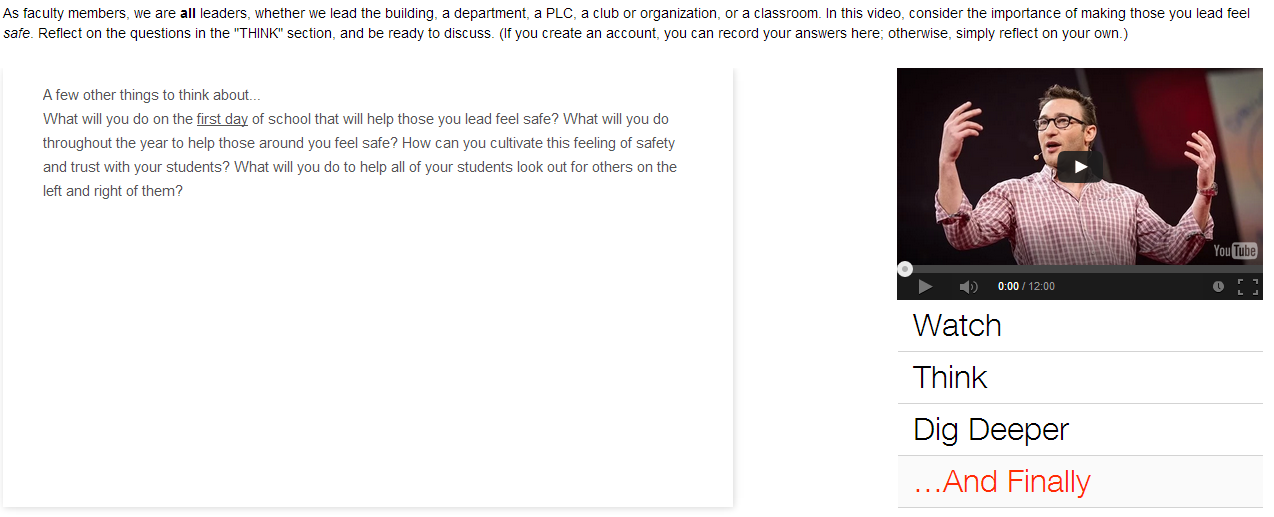
And last, there is the "...And Finally" section.  Here, you may type additional reflections, take-aways, and what happens next.  For our faculty's TEDEd, I plan to flip this video and ask that they view it before the first day of professional development.  We'll begin our discussions with the "...And Finally" reflections.  Over the past several years, we've discussed Simon Sinek's Start With WHY, and his latest TED talk is Why Good Leaders Make You Feel Safe.  My TEDEd lesson asks us to reflect how his ideas of leadership, safety and trust look in the school, departments, and in our classrooms.


I loved learning about the lesson possibilities on TEDEd, and for my purposes this morning, the features were fantastic.  I can't wait to try these videos with our students and teachers.  Watching and reflecting on Angela Duckwork's talk may be part of my assignment on day #1!

My stack of reading continues to grow...

Share:

Learning about our Learners

It's been so long since I've written anything (and I never blogged much overall) but the Read...Chat...Reflect #eduread article chats have so inspired me (and challenged me!) that I had to write. :)

This week's article was "Creating a Differentiated Mathematics Classroom," and since our district has been on a journey to differentiated instruction during the past three years, I am always on the lookout for DI ideas specific to math.

I've had a lot of professional development on DI, and I'm in the Dr. Carol Ann Tomlinson fan club, so if you're not familiar with the tenets of differentiated instruction, here's a quick summary of what I know...

The principles of DI include high quality curriculum, ongoing assessment, *instruction that responds to student variance, all working within a classroom community.  (Dr. Tomlinson's latest edition of The Differentiated Classroom has changed a bit of the wording. When we first learned about DI, we separated *this tenet into flexible grouping and respectful tasks.)  Teachers can differentiate through content, process, and product, all according to the student's readiness, interests, and learning profile.

In addition, differentiation by interest increases student motivation, differentiation by readiness produces growth, and differentiation by learning profile improves efficiency.

As as a math teacher, the "easiest" way for me to understand differentiation was by student readiness.   I thought, "Sure, I can do a quick assessment to see where my students are struggling," and respond to their needs.  (That only took two years, and I'm definitely not an expert, but I have a growth mindset about learning about assessment!)  I'm still working on writing awesome pre-assessments for my students, though...that is a real challenge for me!

I struggled with understanding learning profile, but the first thing I tried was to have my students assess themselves on their intelligence type.  (They learned a tiny bit about Gardner's Multiple Intelligences, they completed a survey and responded on a Google form, so then I had a record of their personal assessments.)  I created seating charts and groups based on their preferred intelligence, and they enjoyed sitting with like-minded students, but I didn't do much else with that grouping.  (sad face)

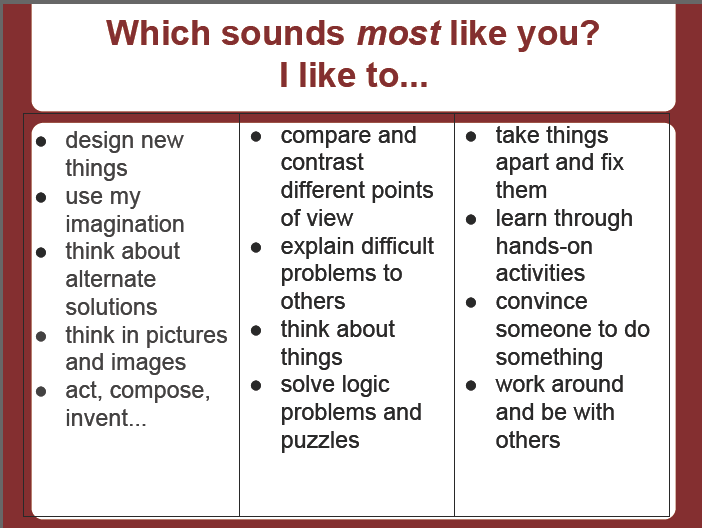
This year, I tried an additional activity to use learning profile, and it was moderately successful.  In recent trainings, I enjoyed "CAP" activities, so that's what I tried to duplicate for math...but I only did this one time.  (another sad face!)   I talked my students through the creative-analytical-practical descriptions of Sternberg's Theory of Intelligence, and they quickly self-assessed their intelligence on this Google form.

Column 1: Creative; Column 2: Analytical; Column 3: Practical

My students divided into their C-A-P groups, and they had the remainder of the period to work on this assignment.  We were creating and solving sinusoidal models, and I originally thought this type of assignment was general enough that it could be used with a variety of future lessons.  (Sigh.  Perhaps if I had been faithful about blogging, I would have returned to this idea!)


I'm now trying to picture how this week's #eduread article will add to the entire schema of learning profiles in my classroom.  Several teachers in our school refer to the True Colors test, which is loosely based on Myers-Briggs, and I like how the profiles in this article align with the colors.  (Mastery = Gold, Understanding = Green, Interpersonal = Blue, and Self-Expressive = Orange)  Someone in our district found this learner profile worksheet, and I like the structure of this handout.  I also saw the "Me at a Glance" post for interactive notebooks at Everybody is a Genius, and I loved all of her ideas about putting all of the strategies on a page.

I guess the bottom line is to know your students, craft lessons based on their needs, and be purposeful about students' work and assessments.  (Whew, is that all???)  I'm looking forward to the #eduread chat to help solidify my thinking about differentiation and learning profiles in mathematics!


A few of my summer educational reads...

  • The Differentiated Classroom: Responding to the Needs of All Learners (2nd edition), Carol Ann Tomlinson
  • Trust Matters: Leadership for Successful Schools (2nd edition), Megan Tschannen-Moran
  • Instructional Rounds in Education: A Networked Approach to Improving Teaching and Learning, City, Elmore, Fiarman and Teitel
  • Leaders Eat Last, Simon Sinek
  • Quiet: The Power of Introverts in a World That Can't Stop Talking, Susan Cain
  • (re-read) Teach Like a Pirate, Dave Burgess


Share:

Even More Mindset!

Our faculty started studying mindset a couple years ago, and after the first sessions in the How To Learn Math course, I knew I was on the right track with teaching about mindset, but I need to do much more. I just finished session 4 of the course, and one of the questions asked what can we do to communicate positive messages to our students.  We presented something to our faculty last year, I've practiced in my class this year, so that question was an easy one to answer.  As a reminder to myself and to solidify my thinking, I wanted to share my responses here.
One thing I've already prepared for next year is a slideshow of mindset, failure, and mistake quotes. I plan to show this power point during transition times, passing periods, or maybe on days where we have challenging lessons.

Last year, my students regularly used #growthmindset when they were struggling on concepts or problems.  I would also write #growthmindset on the bottom of tests/quizzes or class problems.  The students also would call me out when I said something with a fixed mindset. (ME: "Oh, I'll never get my old computer to work with this projector, I give up!" STUDENT: "Fixed mindset, Ms. Laster, keep trying!")

For something new, I've toyed with the idea about creating a "Growth Mindset" digital badge for my students. They would need to watch videos, reflect on mindset, and demonstrate how they've shown a growth mindset in our class and in another area in their lives.  It hasn't happened YET...but I still have one month 25 days until school begins. :)  I also LOVED the idea @karlfisch created of the letter before school and this "assignment".

Ideas shared with our faculty and what I've tried...

  • Guide the students through the 4 steps to changing mindset. (The example I shared with our faculty and students was my first attempt at Wii Zumba--definitely heard my fixed mindset voice then!) 
  • Present students with brain research and its potential to grow.
  • Provide students with role models of individuals who have succeeded because of a growth mindset. (love the Michael Jordan failure commercial)
  • Provide opportunities for students to reflect on their growth mindset experiences (student blog example and teacher blog about the "Power of Yet").
  • Model your own growth mindset.
  • Praise for strategies, effort and processes instead of for intelligence and ability.
  • Create a Failure Quote wall in your classroom.
Quotes about failures & post-its of mistakes & how teachers/kids learned

Giving Feedback

  • “You really studied for your test, and your improvement shows it. You read the material over several times, outlined it, and tested yourself on it. That really worked!”
  • “I like the way you tried all kinds of strategies on that math problem until you got it.”
  • “It was a long, hard assignment, but you stuck to it and got it done. You stayed at your desk, kept up your concentration, and kept working. That’s great!”
  • “I like that you took on the challenging project. It will take a lot of work – research, designing the machine, buying the parts and building it. You’re going to learn a lot of great things.”

I'm still looking for ideas, and I'm still learning and growing.  Using scoop.it, I continue to curate blog posts and articles I find using #HowToLearnMath.

Any other ideas to share?  
What are you doing in your classrooms to help change your students' mindsets?
Share:

Mistakes and Mindset

I love when my education worlds collide!  This weekend, I worked on session 3 of #HowToLearnMath, which is "Mistakes and Persistence," I finished chapter 5 of Embedded Formative Assessment, which is all about providing feedback, and I created something for our new teachers to introduce them to our school's path to differentiation...and all 3 of these projects involved mindset!  

For those participating in the course, or if you recently studied Carol Dweck's work, do you hear and see the word mindset everywhere you turn?  (I do!)  During the past two years, I talked to my students a bit about the brain research, the importance of making mistakes, and how to foster a growth mindset, but I need to do much, much more.  One of the questions in #HowToLearnMath asked what should a failure/mistake poster say, and we talked about that same idea in an #efamath discussion.  Since I am a floater teacher, the wise @druinok suggested a power point, rather than a poster, so that's what I did.

Since there has been so much talk about mindset, mistakes, and failure, I found great quotes to create the presentation embedded below.   Several of the images came from Krissy Venosdale's wonderful site of free posters.  I found a few other posters on Live Life Happy, and several quotes came from this post on the Practical Savvy blog.  I plan to show this slideshow to my classes during passing periods or during other transitions, and I want to ask my students to contribute their favorite quotes about mindset, mistakes, and failures.

If interested, feel free to use/modify the presentation.  I believe you can download the presentation as a power point, but I doubt all of the fonts will transfer.  If you prefer, I can share the Google doc with you.


Larry Ferlazzo's blog contains countless ideas on motivation, mindset and learning from mistakes and failures, so if you would like additional videos, articles, or studies, you will certainly find them in his many lists of resources.

It has been a great summer of learning, and I am looking forward to sharing everything with our teachers and students!  What will you share with your students about mindset and mistakes?
Share:

Classroom Tour 2

At the beginning of the past two years, we have had room decorating contests, so I compiled a lot of pictures of classrooms.  (Our principal provided prizes for the best rooms, by the way.)  I shared some of the best pictures on this post, but this presentation (created for our new teachers) includes even more pictures, so I thought I would share here, too.  Enjoy!


Share:

Watch and Win!

As usual, a recent Twitter chat motivated me to write this post.  It definitely fits into my differentiation theme, and I wanted to explain this school initiative, but our recent #efachat prompted me to pick up the tempo on sharing the idea.

Several years ago, we received staff development "credit" for observing two teachers' classrooms. Earlier this year, I heard, "Hey, do you remember when we were required to watch other classrooms? That was great! I wish we could do that again.  I would love to see Mr. W's class or Mrs. N's class."  The department chair replied,  "Why don't you just ask if you can watch their classes? It doesn't need to be a requirement for you to watch and learn."

A few weeks later, the department chair and I (with admin approval) decided to create an opportunity for teachers to feel more comfortable about visiting other classrooms.  We called the initiative "Watch and Win!" and we created this brief reflection form for teachers.  We knew brief was important, and we definitely didn't want the visit to feel like an evaluation, thus happy face clip art and cute font.  (The fun font is KG Seven Sixteen.) 


Our principal first promoted the initiative, and we sent follow-up emails that encouraged teachers to simply watch any other classroom and win teaching strategies, lesson plans, and classroom set-up ideas.  We emphasized the observations did not need to take the whole class period--visit any portion of any classroom. We also reminded teachers to ask permission before visiting.  We did not require teachers to return the reflection form, but our principal was kind enough to provide a prize as an incentive for visiting and reflecting. 

For the upcoming school year, the district is now encouraging (requiring) teachers to visit other classrooms, but schools will have the option to choose to what extent.  We are so happy that we can expand our Watch and Win initiative and slowly work on changing the culture of our school.  (One option from the district was to participate in Japanese Lesson studies, but we are not ready for that kind of intense observation/reflection!)

We will begin the school year with version 2.0 of Watch and Win.  We will first encourage teachers to open their classroom doors as often as possible.  Using scrap wood, our construction class made door stops for all rooms, and our Girls Service League's summer project was to paint all of the door stops.  We are also printing and laminating these signs for teachers' doors, so when a teacher is up for visitors, he/she hangs the sign on the door.  We hope that as teachers walk down the hall and see green signs, they'll be motivated to drop by and visit the classrooms.  (I created my very first iMovie as a somewhat staged "commercial" for this school plan, so if you're dying to see my amateur video of some of our teachers and classes, I can send you the link.)

KG Only Hope font
We are also going to encourage teachers to share (via departmental or mass email) invitations to observe particular parts of a lesson.  "Hey, I'm using the Socrative exit ticket app today, so if you would like to see a demo, please feel free to stop by B112 during the last 10 minutes of 1st, 2nd, or 5th periods."

We hope teachers win a lot of ideas from these observations, but we also believe visiting classrooms will help build our school community of teacher-learners.  We hope teachers will more frequently say things like, "I just saw this cool idea in Mr. G's room, and I thought it would be great if our class tried it, too!"  (a la "I just read about this great idea on another blog," or "My twitter friends were talking about this lesson.")


Once teachers realize the observations are not evaluations, our next step will be to facilitate how observations can be used for learning.  We realize that not all teachers are there yet, but we hope Watch and Win is a step in the right direction.

  • I'm trying to improve my questioning techniques.  Will you please visit my classroom and record my types of questions?
  • I would love some help with keeping my 6th period students engaged.  Would you please watch that class and provide feedback about your observations?


Another Twitter reminder--Krissy Venosdale shares her lovely, free posters on this amazing site!
If you are not (yet) in the position to create a school-wide initiative, what about convincing others in your subject-team or department to observe each other?  Or ask your lunch friends to commit to observing other classrooms?  Observing other teachers is one of the favorite parts of my job, and I learn something new every time I visit another classroom.

Is visiting other classrooms encouraged in your school?  How can we convince others that classroom observations are positive learning experiences and not a waste of time?

To be continued...

Growing List of Summer Educational Reads:
5 Practices for Orchestrating Productive Mathematics Discussions, Margaret S. Smith & Mary Kay Stein
Embedded Formative Assessment, Dylan Wiliam
Engaging Teachers in Classroom Walkthroughs, Donald S. Kachur et al
Essential Questions, Jay McTighe & Grant Wiggins
How to Assess Higher-Order Thinking Skills In Your Classroom, Susan M. Brookhart
Leadership for Differentiating Schools and Classrooms, Carol Ann Tomlinson & Susan D. Allan
More Good Questions, Marian Small & Amy Lin
Teach Like a Pirate, Dave Burgess


Share:

My DI Journey

Differentiated Instruction (DI) is nothing new in education-speak, but for me, it is a recent classroom changer, so I want to share my (limited) wisdom about DI.

In a previous post, I mentioned our district is doing our DI initiative right, which means slow implementation, training for teachers and administration, extra staff/support, and continuous professional development.  As a campus instructional specialist (IS) I was part of the initial training, and I helped roll-out the plans to our departments, common planning teams, and campus.  Our year-3 framework and goals are now in place, and this summer, I am working on a new-and-improved classroom.

My First Ah-Ha Moments…
#1: One of the first things we learned was the DI is NOT a set of strategies, but it is a way of thinking about teaching and learning.  It starts with Mindset.  It is about being proactive.  We plan to share this video with our new teachers to get them motivated about DI:


#2:  One teacher used the analogy that she previously thought of teaching as triage: kids who need the most help get a blood transfusion and transplant, but those who already “got it” would be fine with a band-aid.  But DI means to move kids, where ever they are, from one level to the next.  So that means if after the first week of school I already know a student would make a 5 on an AP exam, I must find a way to move her beyond that.  And when a non-English speaking refugee enrolls in my class, I cannot let him keep falling behind, but I must find a way to move him forward, even if by mere millimeters.  DI is teaching up.

#3: DI does NOT always mean “activities” and group work.  Parts of the lesson will be whole group instruction.  When you do utilize group work, the groups should be flexible.  (I intend to explain that part of my journey in another post!)

Next…
The non-negotiables of DI are high-quality curriculum, supportive classroom community, continuous assessment, flexible grouping, and respectful tasks, but all components are intertwined.  Texas is not a CCSS state (we have TEKS) and our district provides curriculum for tested subjects, so our district/campus focus is the remaining 4 non-negotiables. 

Side-note: I teach pre-AP pre-calculus, which is not tested, so one summer project was to transform my old curriculum to one of “higher quality.”  I researched Essential Questions and Understanding By Design to write my KUDs (know-understand-do).  (The “do” part is what I will differentiate!)

DI and Assessments…
I completely believe in the power of continuous assessment, so what happens next?  What does it look like in my classroom?

My students complete a pre-assessment/exit ticket/quick classroom check for understanding (which is why I’m lovin’ #EFAmath) and I realize that most kids are ready to move on, but a few are still stuck on one concept.  While the majority of the class is working on something else, I call those few kids to the board at the back of the room, and we hold a “10-minute tutorial” on the missing concept.  (One example of flexible grouping is to group by readiness.)  And because we have established a sense of community and respect in our classroom, no one has a problem with being a tutoree.  We have this sign hanging in our classroom, and students realize we will do whatever it takes to make each person successful!


Real-life example: one master teacher at our school was ready to “DI-it” from day one, and her level 3 students completed a pre-assessment during the first week of school.  She realized 1-2 students lacked a bit of knowledge, so she created an opportunity in class to pull those kids aside for a review.  The problem: one student was so upset and proclaimed, “I know why you’re pulling us aside! You took our quiz from yesterday and put us in groups! I’m not dumb!”  Teacher and student continued the conversation in the hall, and the teacher quickly soothed the student.  When the teacher reflected on the situation, she said she had not yet had time to build the community in her class and establish trust with her students.  Bingo!

DI Goals…
This process all makes sense in my head, and I can’t wait to try it out in this year’s classrooms.  I will have high quality, engaging lessons (thanks to EQs and TLAP).  Because I am familiar with the curriculum, I am aware of the typical tough spots, and will be proactive in my planning.  Formative assessments will be a regular part of the curriculum (thanks EFA) and I will immediately use the results to plan for and respond to students’ needs. I will create a supportive classroom community.  Students will understand that when grouped, their teams will change regularly, depending on their needs, the lesson, or activity. 

It sounds so reasonable, but there are so many other components that are part of this whole process. 

Whew, what a journey! To be continued…


Summer Educational Reads:
Embedded Formative Assessment, Dylan Wiliam
Essential Questions, Jay McTighe & Grant Wiggins
How to Assess Higher-Order Thinking Skills In Your Classroom, Susan M. Brookhart
Leadership for Differentiating Schools and Classrooms, Carol Ann Tomlinson & Susan D. Allan
Teach Like a Pirate, Dave Burgess

Share:

Flipping Over Made4Math


Happy (belated) birthday, #Made4Math!   Because of #Made4Math, how many teachers progressed from simply reading posts to tweeting and/or creating blogs? (me!)  And because of these amazing resources, how many different teachers tried a new idea, changed/improved a lesson, collaborated more with colleagues, read a new book, or took a risk?

One of the popular summer reads is Teacher Like a Pirate, so I decided #Made4Math = a treasure hunt and a chest of gold.

Because of #Made4Math, my blog list exploded! Each time I find a new blog, it's a treasure hunt of additional links, pages, tabs, downloads, and ideas.  Because of #Made4Math, I learned a bit about ColourLovers and creating graphics, Vistaprint, and how to cut composition notebooks.  Bloggers shared everything from posters, to organizing ideas, to 1st day activities.  I work with all of our teachers and I help plan our staff development, so I frequently share your posts with our faculty.  The assessment ideas, such as this post (which inspired me to buy Embedded Formative Assessment and to use similar exit tickets) and the video blog on post-it exit tickets were both favorite blogs for many people at my school.

Because I now have a giant treasure chest of gold ideas, I need a better way to organize all of my blog reads.  Since I've had my iPad, I've used Mr. Reader, which I love, and I'm so happy it now syncs with Feedly.  I'm also using Pocket, but I am still not doing a good job of organizing favorites.  I also tried Pinterest and keeping lists on Google documents, but those options were not working for me either.

Enter Flipboard, which is making me very happy.  I'm not using it for my blog feeds (or Twitter or Facebook); instead, I'm using it as a way to organize my favorite posts and to find new content.  I created quite a few different "magazines," so when I find something I love, I add articles to the appropriate place.

For this week's #Made4Math, I created "Math Goodness," so if you have the Flipboard app, you are welcome to browse my magazine.  If you haven't tried Flipboard yet, it is available on iOS and Android devices.  I learned about it and watched the videos here and on the Flipboard site, and it is very easy to set-up and use.  For my math magazine, I included some of the links mentioned above, but I also tried to add quite a few posts that weren't necessarily math but could be easily adapted to math classrooms.  (Next I need to create a magazine just for assessment ideas!)

For me, one advantage of this format is that I can preview most of the articles.  "Academic" articles do not always include images, so Pinterest isn't the best option for these types of posts.  (And I'm a "words" person, rather than a visual person, so I guess that's why it appeals to me.)


It is easy to share articles via Flipboard, and you can also collaborate on magazines.  If you're still looking for a Google Reader replacement, you can use Flipboard for reading blogs and for your social network feeds.


I have flipped over all of the wonderful new resources I found this year, so thank you #Made4Math and the math blogging community for being such a treasure trove of ideas!  Thank you for encouraging me to share and learn!
Share:

Learning Profiles vs. Learning Styles

I know I've neglected this blog, but after a recent #efamath chat (and a little hint from @druinok) I'm ready to dive back in and am ready to share, reflect and learn!


Over the past two years, our district has wholeheartedly embraced differentiated instruction (aka DI) and they are doing everything right to make certain that we know, understand, and do everything to embrace it, too.  In my role as an instructional specialist (an instructional "coach" for our school) I have participated in all kinds of wonderful additional professional development, have planned training for our departments and school, and have tried a lot of new things in my classroom.  These struggles and successes have provided enough material for at least 10 new blog posts, and I hope to use this forum as a place to help reflect and sort through what I've learned.

On to Learning Profiles...
In Embedded Formative Assessment, the author discusses the "myth" of Learning Styles and the lack of research to substantiate the use of learning styles to improve learning.  Several teachers mentioned this misconception in the recent #efachat, and I will raise my hand to admit that I've given kids quizzes at the beginning of the year to assess learning styles!

Thanks to some amazing training (first at a DI Institute with Carol Ann Tomlinson and then with a lot of follow up from my district) I now have a better understanding of a learner's profile, rather than a learning style, and have used learners' profiles a bit in my classroom.

It has taken me almost 2 years to comprehend and begin to implement the DI philosophy into my classroom (DI is not a set of strategies, by the way!) so a blog post will not do it justice.  However, for the sake of getting to the point, one of the non-negotiables of DI is flexible grouping.  According to Tomlinson, you may group students based on readiness, interest, or learner profile (or random) and each grouping achieves different goals.  Readiness leads to growth, grouping by interest increases motivation, and grouping by learner's profile improves efficiency.

The DI gurus use either Robert Sternberg's Theory of Multiple Intelligences (analytical, creative, practical) or Howard Gardner's Multiple Intelligences Theory (which I believe more people know) to address learning profiles.

To introduce the idea to our faculty, we used this brief activity during a staff development (which we modeled from something we saw at our DI Institute.)   After teachers completed the task individually, we asked them to group together with one person from each group to share their responses.  (Hold up a finger 1, 2, or 3, and find the other two numbers to form a group.)


We then shared the slide to show the green group was analytical, yellow was the  practical group, and purple was the creative group.  If we had grouped by like intelligences, the discussion would have been very quick, thus the efficiency.  (One person read the definition, yeah, we all got that, too.)  


Now to stretch yourself, what if you complete the same activity using the prompt from another group?  Or what if we asked teachers to write the definition in 3 different ways?  (That idea reminds me of a Frayer model.)

In a math classroom, a quick example (or exit ticket) could be something like "Explain what a function is," choosing one of these prompts: a) write a definition that you might find in your textbook glossary; b) write a list or examples of the attributes of a function; or c) draw a visual representation or metaphor of a function (not necessarily a graph).  I only did this a few times, but a goal for next year is to make this type of quick assessment more of a norm.  "For concept _________, either write a definition, write how you could explain it to someone, or draw a representation."  Students could turn in their work, share with their table, or share with "unlike" intelligences.  (Wouldn't this be an easy assessment for any level, any content area?)

For my classroom this year, instead of the good ol' learning styles quiz (auditory, visual, kinesthetic) that I had used in the past, I tried assessing my students on Gardner's multiple intelligences.  With my class blog post, I found several surveys (online and paper copies), included videos and definitions, and had the kids complete a Google form with their results.

I then created a seating chart based on their intelligence preference (as best as I could) and let the kids try those groups for a few weeks.  I did notice the discussions, questioning, and explanations were quite different from each of the groups, so that was interesting, but I didn't design enough tasks that catered specifically to their strengths.  (Another post for another day...)

In Embedded Formative Assessment, the conclusion to the "Learning Styles" section was simply to be aware of different styles and encourage all students to use as many styles as possible.  So I don't think the old learning style idea is completely wrong, but perhaps it's just incomplete and can be strengthened by adding a bit more information.  This document is something from our district, but I do not know where it came from, so I cannot give the appropriate credit (and it's a PDF, unfortunately) but it is an example of a very thorough learner's profile.  In addition to the intelligence theory, DI also requires building the community in your classroom and with your students, which means the importance of learning students' interests.  (Another post for another day...)

I'm really looking forward to reading the rest of the book, and the book is about using assessments, not the small tangent of learning styles/profiles.  But in learning about differentiation, I really see the connection and importance of both.  Isn't the bottom line that we must know our students?? 

Once again, thanks to @druinok and #made4math to motivate me to start blogging in the first place.  I've been an avid blog reader for several years, but writing about practices really helps me solidify my thinking.

I loved this post by @pamjwilson who challenged us to "Model What We Wish To See" and who now posts her great reading list on her blog.  So to follow her lead...

Summer Educational Reads:
Embedded Formative Assessment, Dylan Wiliam
Essential Questions, Jay McTighe & Grant Wiggins
How to Assess Higher-Order Thinking Skills In Your Classroom, Susan M. Brookhart
Leadership for Differentiating Schools and Classrooms, Carol Ann Tomlinson & Susan D. Allan
Teach Like a Pirate, Dave Burgess

Interesting Posts:


Thanks for reading!  Anything to add?  What else do you know about learning profiles?
Share:

Made4Math - Digital Word Walls

I've really missed blogging and participating in #Made4Math, so after reading so many wonderful ideas over the past few months, I'm happy to be able to contribute to this week's collection.


Several years ago, we jumped on the "Word Wall" bandwagon, and teachers in all content areas learned the importance of vocabulary building, displaying vocabulary, and actively using their word walls.

Had to throw in an English teacher's example, too! 

Fast forward several years, and we're now in the digital age.  One of our junior high teachers, Omar P., who teaches at a technology magnet school and who has created this fantastic informational site, led us into the 21st century with his idea of digital word walls.  (His site includes informational videos, app reviews, and presentations, and his work is helping our entire district!)

At a recent staff development, Omar shared his ideas and how he used his digital word walls, so I created one for my class and wanted to share this great strategy.

Instead of posting words/pictures/diagrams on a bulletin board, the same types of images are stored in folders on your iPad or computer.  Using the slideshow option, you can project the pictures as students are entering the classroom, while they're working on an activity, or during tutoring time.

I created my pictures using screen shots of handwritten notes, of Keynote slides, and of slides using a presentation app called Haiku deck.  I also plan to take pictures of the students' work and add those slides to the folder.  Omar has more iPads in his classroom, so he has had students create word walls using Keynote.  You could also find free images online for additional pictures or backgrounds.
Made using the Haiku deck app


I also included a few slides that were quotes or reminders about strategies for working these problems.


Our test is this week, so for the next few days, I plan to have these slides showing as the students enter the room.  (If you want to see the other slides, my trig identity folder is here.  I just noticed that the Haiku deck app provided a background that misspelled "adjacent," so I'm not too happy about that, but other than that, the slides were pretty and the app was easy to use.)  

I love the fact that these folders of pictures can be saved, changed, and shared.  Teachers and students could collaborate on unit folders, share photos, and update the words/images each year.  As we're reviewing for finals and preparing for other tests, we'll have these folders of pictures easily available and ready to go.  If you would like more information, Omar has a video explanation here about how he has used the digital word wall in his classroom.

Do you have a word wall in your classroom?  How do you use your word wall?  How do you reinforce vocabulary in your classroom?
Share: